Tag Archives: shigure

Sumiyoshi-sha uta’awase kaō ni-nen 28

Round Three

Left

まきのやのしぐれのおとにゆめさめてみやここひしきねにぞぬれぬる

maki no ya no
shigure no oto ni
yume samete
miyako koishiki
ne ni zo nurenuru
Beneath a roof of cypress boards
The sound of showers
Wakes me from my dreams, and
Longing for the capital
I drench myself with weeping.

Chūnagon
55

Right (Win)

たびねするのぢのしばやにおとづれてすぐるはよはのしぐれなりけり

tabinesuru
noji no shibaya ni
otozurete
suguru wa yowa no
shigure narikeri
Sleeping on my travels
Cross the plains in a brushwood hut
A sound comes calling,
Passing by at midnight—
A shower.

Sokaku
56

The style of the Left’s poem is elegant but, in addition to feeling that there may well be cypress roofs in places other than the capital, the final line is insufficient, I think. The Right’s poem has nothing remarkable about it, but it sounds pleasant. I make it the winner.

Sumiyoshi-sha uta’awase kaō ni-nen 27

Round Two

Left (Win)

ならしばのたびのいほりにおとづれてしぐれもいまぞやまめぐりする

narashiba no
tabi no iori ni
otozurete
shigure mo ima zo
yama megurisuru
Oak boughs make
My traveller’s hut, where
I am visited by the sound of
Showers—they, too, now
Are on pilgrimage through the mountains.[1]

Shōkaku
53

Right

たびごろもうらがなしかるあさぢふによはのしぐれよいかにせよとぞ

tabigoromo
uraganashikaru
asajū ni
yowa no shigure yo
ika ni seyo to zo
In my traveller’s garb and
Sad at heart among
The clumps of cogon grass,
O, midnight shower,
Tell me, what I am I to do?[2]

Jakuchō
54

While both Left and Right sound pleasant, I make the Left the winner, because it sounds slightly more moving at present, with a traveller’s hut being visited by showers.


[1]Alluding to: Composed when caught in a shower, while making a pilgrimage to one hundred temples in Higashiyama.  もろともに山めぐりするしぐれかなふるにかひなき身とはしらずや morotomo ni / yamamegurisuru / shigure kana / furu ni kainaki / mi to wa shirazu ya  ‘Together with me / On my mountain pilgrimage are / The showers! / ‘Tis pointless to fall / On my sorry self, don’t you know!’ Master of the Left Capital Office Michimasa (SKS IV: 149)

[2] Alluding to: 旅ごろもうらがなしさにあかしかね草の枕は夢もむすばず tabigoromo / uraganashisa ni / akashikane / kusa no makura wa / yume mo musubazu  ‘In my traveller’s garb / My heart-sickness / I cannot lift, for / My grassy pillow / Brings no dreams, at all…’ Hikaru Genji (Genji monogatari 223)

Sumiyoshi-sha uta’awase kaō ni-nen 26

Showers at one’s lodgings on a journey

Round One

Left

しぐれするもみぢのにしきゆかしきにあけてをたたむふたむらのやま

shiguresuru
momiji no nishiki
yukashiki ni
akete o tatamu
futamura no yama
Under the showers
The scarlet leaves’ brocade
I long to see, so
With the dawn let’s set forth
To Mount Futamura!

Jakunen
51

Right (Win)

みやこにもおもひやすらむくさまくらうちしぐれたるよはのねざめを

miyako ni mo
omoiyasuramu
kusamakura
uchishiguretaru
yowa no nezame o
Even in the capital
Might you think of me?
On a grassy pillow
With a shower
Awoken at midnight…

Suke
52

The Left poem’s ‘With the dawn let’s set forth / To Mount Futamura’ sounds charming, but as we can see from Lord Kanesuke’s poem ‘Futami Bay / Let’s see with the dawn’, it is quite pedestrian. Then there is the expression ‘long to see’—this really isn’t appropriate diction for poetry. I will admit that it appears from time to time in imperial anthologies, and so it is certainly permissible depending upon the style of the poem, though. There’s also the term ‘long to know’—one really shouldn’t use diction in a poetry match which doesn’t express the poet’s true feelings. As for the Right’s poem, it’s also quite pedestrian to say that showers fall on one’s way on a journey, but don’t necessarily fall in the capital, but saying that folk there might think of you waking on your journey, well, why wouldn’t they do that? The conception of the poem is pleasant, and I make it the winner.

SKS IV: 149

Composed when caught in a shower, while making a pilgrimage to one hundred temples in Higashiyama. 

もろともに山めぐりするしぐれかなふるにかひなき身とはしらずや

morotomo ni
yamamegurisuru
sigure kana
Furu ni kaFinaki
mi to Fa sirazu ya
Together with me
On my mountain pilgrimage are
The showers!
‘Tis pointless to fall
On my sorry self, don’t you know!

Master of the Left Capital Office Michimasa

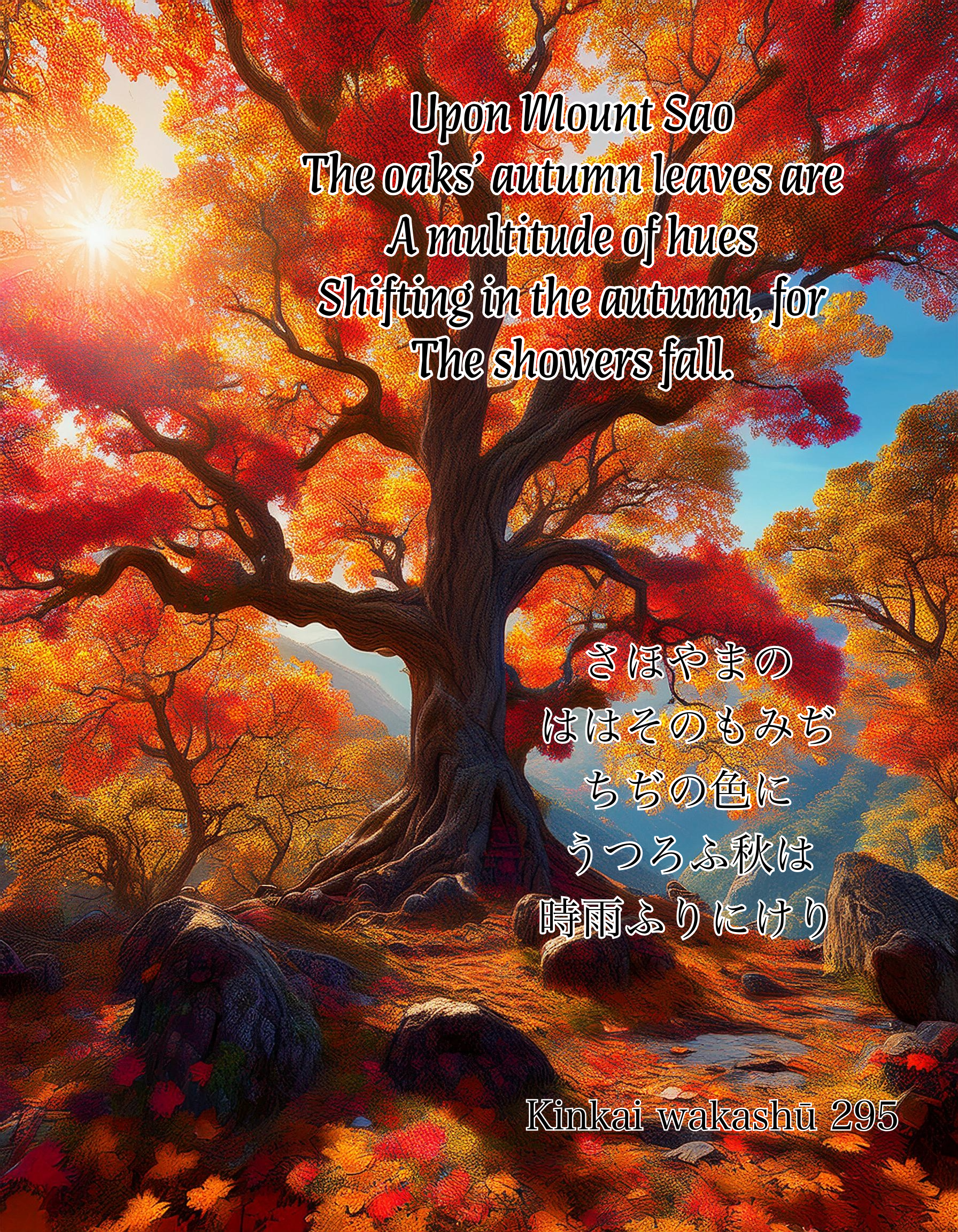
Kinkai wakashū 295

Composed after I had had various people compose on the autumn oak leaves on Mount Sao in a shower.

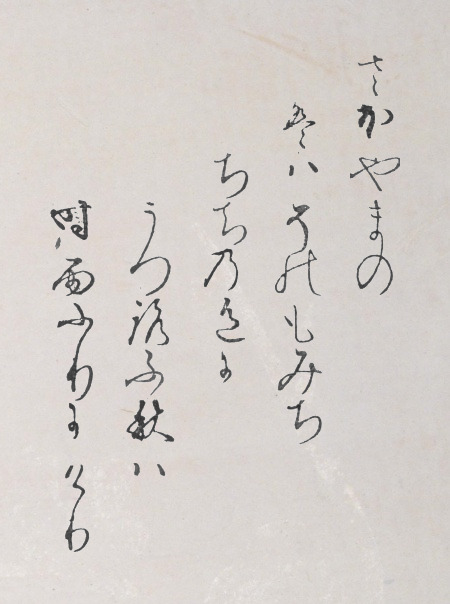
さほやまのははそのもみぢちぢの色にうつろふ秋は時雨ふりにけり

saoyama no
hahaso no momiji
chiji no iro ni
ustsurou aki wa
shigure furinikeri
Upon Mount Sao
The oaks’ autumn leaves are
A multitude of hues
Shifting in the autumn, for
The showers fall.

Daikōtaigōgū no suke taira no tsunemori-ason ke uta’awase 48

Round Twelve

Left (Tie)

柞原しぐれにそむるくれなゐはこずゑの風や吹きてほすらん

hahasowara
shigure ni somuru
kurenai wa
kozue no kaze ya
fukitehosuran
The oak groves by
The showers are dyed
With scarlet—
Might the wind through the treetops,
Gusting, bring dryness?

Shinkaku
95

Right

紅葉ばは入日の影のさしそひてゆふくれなゐの色ぞことなる

momijiba wa
irihi no kage no
sashisoite
yūkurenai no
iro zo kotonaru
The autumn leaves
By sunset’s light
Are struck, and
Evening’s scarlet
Hue is startlingly fine!

Lay Priest Norinaga
96

In the Left’s poem I would want there to be an expression such as ‘robe’ or ‘brocade’ which is being blown. As for the Right, it lacks any unusual diction, but has no noticeable faults, so these should tie.

Daikōtaigōgū no suke taira no tsunemori-ason ke uta’awase 42

Round Six

Left (Win)

山姫はもみぢのにしきおりてけりたちなやつしそ嶺の朝霧

yamahime wa
momiji no nishiki
oritekeri
tachi na yatsushi so
mine no asagiri
The mountain’s princess,
Of scarlet leaves brocade
Has woven;
In your rising don’t despoil it,
O, morning mists upon the peak!

Lord Kinshige
83

Right

しぐれには紅葉の色ぞまさりける又かきくもる空はいとはじ

shigure ni wa
momiji no iro zo
masarikeri
mata kakikumoru
sora wa itowaji
A shower makes
The scarlet leaves’ hues
Most fine;
So, the swiftly clouding
Sky I could not dislike.

Lord Masahira

84

The Right sounds as if the poet has just come to the revelation that, even though a showery sky is charming, can one possibly dislike it, given that it improves the hues of the scarlet leaves. The Left isn’t bad, but it does have two identical sounds ending lines, and this has been called the same-sounding rhyme fault, I believe. With that being said, in the Tentoku Poetry Match, there were some poems with this feature which were criticized, and some which were not, so I wonder if this is not something to particularly worry about. In this poem it doesn’t sound like a defect and, taking this together with the fact that the Right’s poem is poor, the Left should win.

Daikōtaigōgū no suke taira no tsunemori-ason ke uta’awase 39

Round Three

Left

くれなゐのこぞめの色とみえつるや八しほの岡の紅葉なるらん

kurenai no
kozome no iro to
mietsuru ya
yashio no oka no
momiji naruran
With scarlet
Hues deeply dyed
Do, perhaps, seem
Yashio Hill’s
Autumn leaves?

Kenshō
77

Right (Win)

初時雨ふりにし里をきてみればみかきが原は紅葉しにけり

hatsu shigure
furinishi sato o
kitemireba
mikaki ga hara wa
momijinishikeri
The first showers
Have fallen on this ancient estate
I have come to see:
Mikaki Field has
All turned to autumn hues.

Suketaka
78

While the Left displays great technical skill in juxtaposing ‘deeply dyed with scarlet hues’ and ‘Yashio Hill’, the Right at present is conclusively composed with a somewhat more decorous configuration relaxed manner. In this it conveys emotion as poems of old did, and so I believe it should certainly win.