Tag Archives: waters’ edge

Tōgū gakushi noritada uta’awase 01

Poetry Match held by Noritada, Confucian Tutor to the Heir Apparent[i]

Topics

Poets

Judge

Sweet-flags in the Valley

Left

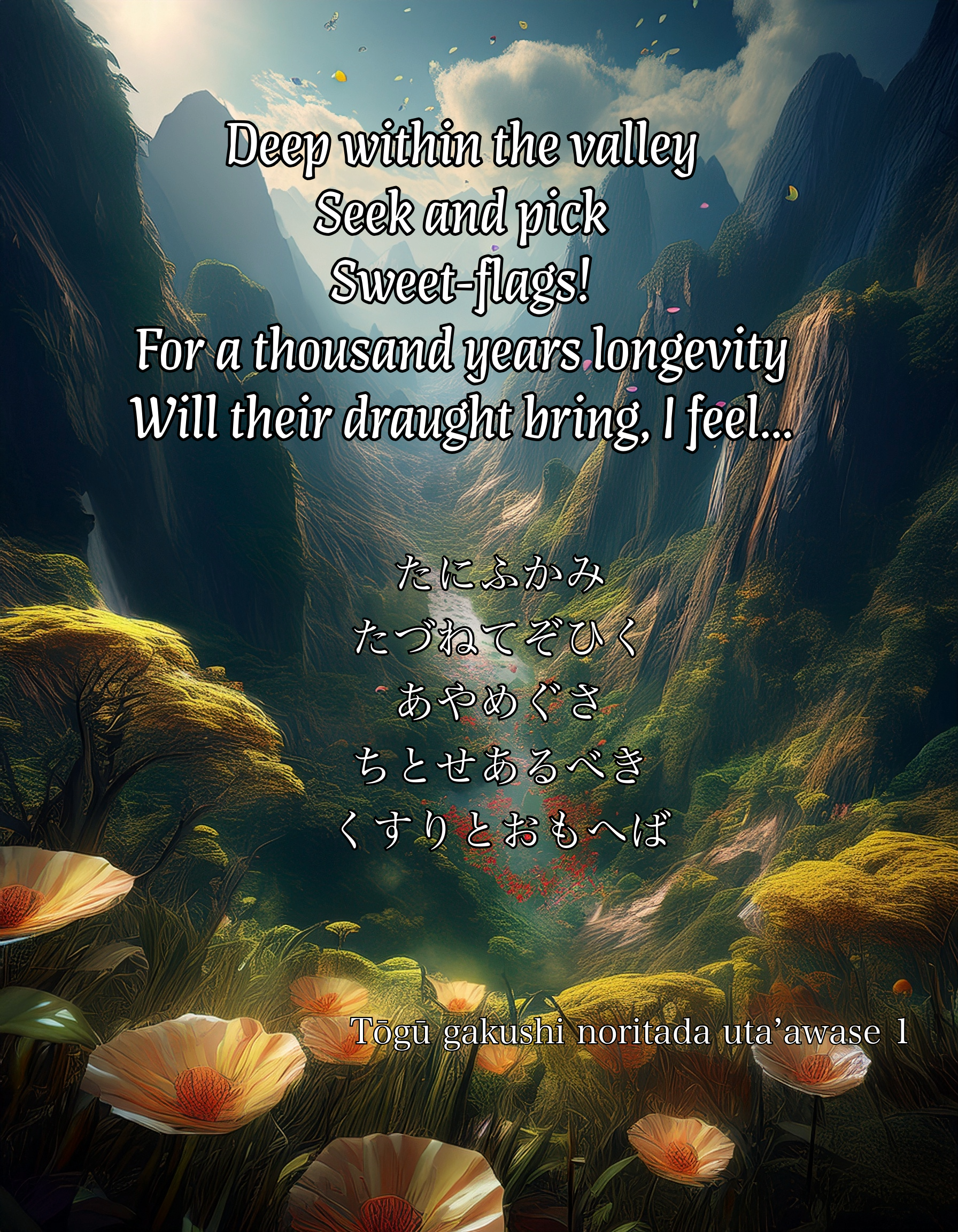
たにふかみたづねてぞひくあやめぐさちとせあるべきくすりとおもへば

tani fukami
tazunete zo hiku
ayamegusa
chitose arubeki
kusuri to omoeba
Deep within the valley
Seek and pick
Sweet-flags!
For a thousand years longevity
Will their draught bring, I feel…

1

Right

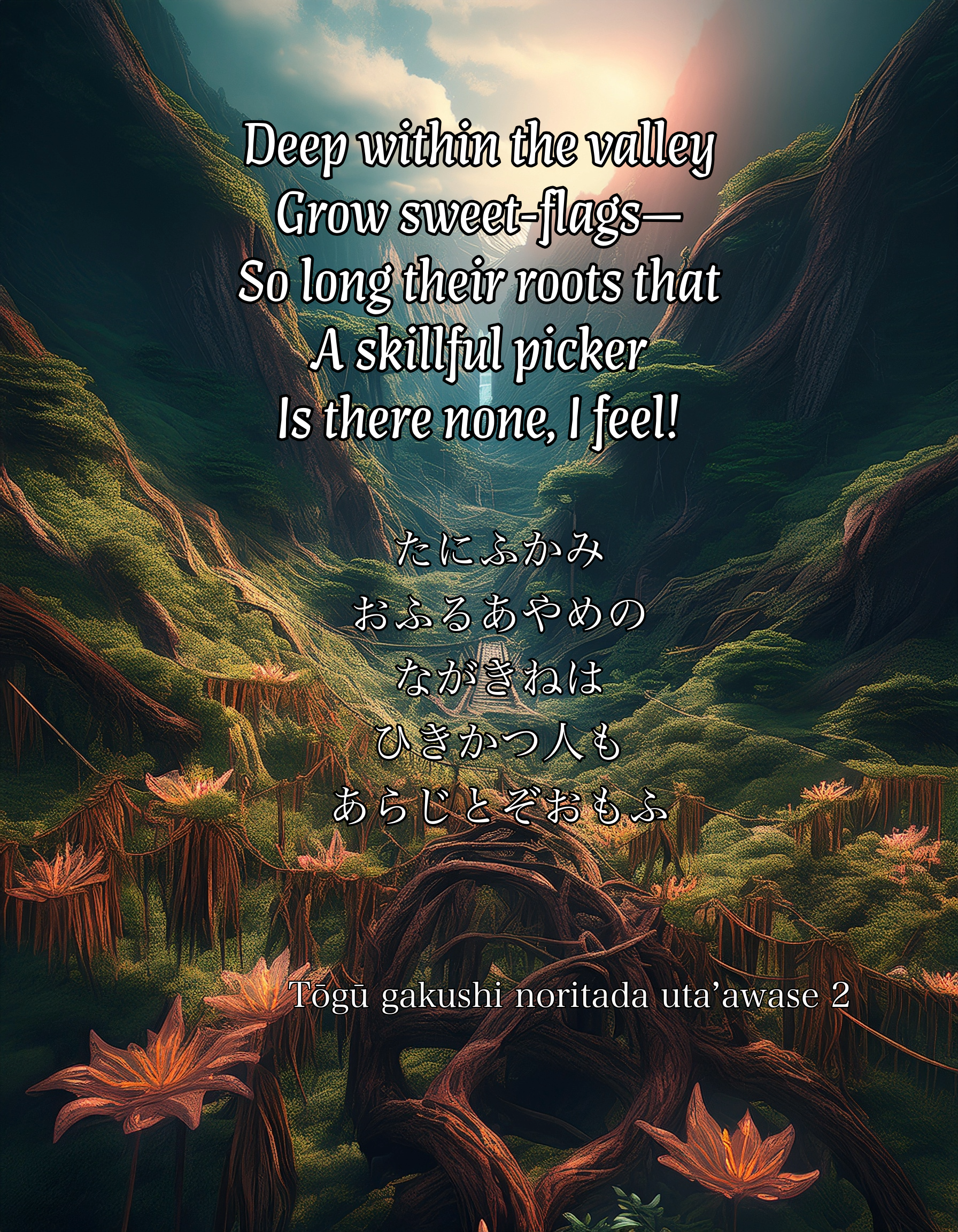
たにふかみおふるあやめのながきねはひきかつ人もあらじとぞおもふ

tani fukami
ouru ayame no
nagaki ne wa
hiki katsu hito mo
araji to zo omou
Deep within the valley
Grow sweet-flags—
So long their roots that
A skillful picker
Is there none, I feel!

2

Nine-knotted sweet-flags grow in valleys atop rocks, so every year on this day, folk gather together and pick sweet-flag roots to make medicine from them, so one should compose as though cupping the water of this conception in one’s hands. The overall impression of the Right’s poem, while it may be something encountered occasionally, is that it shows ignorance of the conception of the topic and only refers to how long the roots are—it loses, but there may be some depth there.

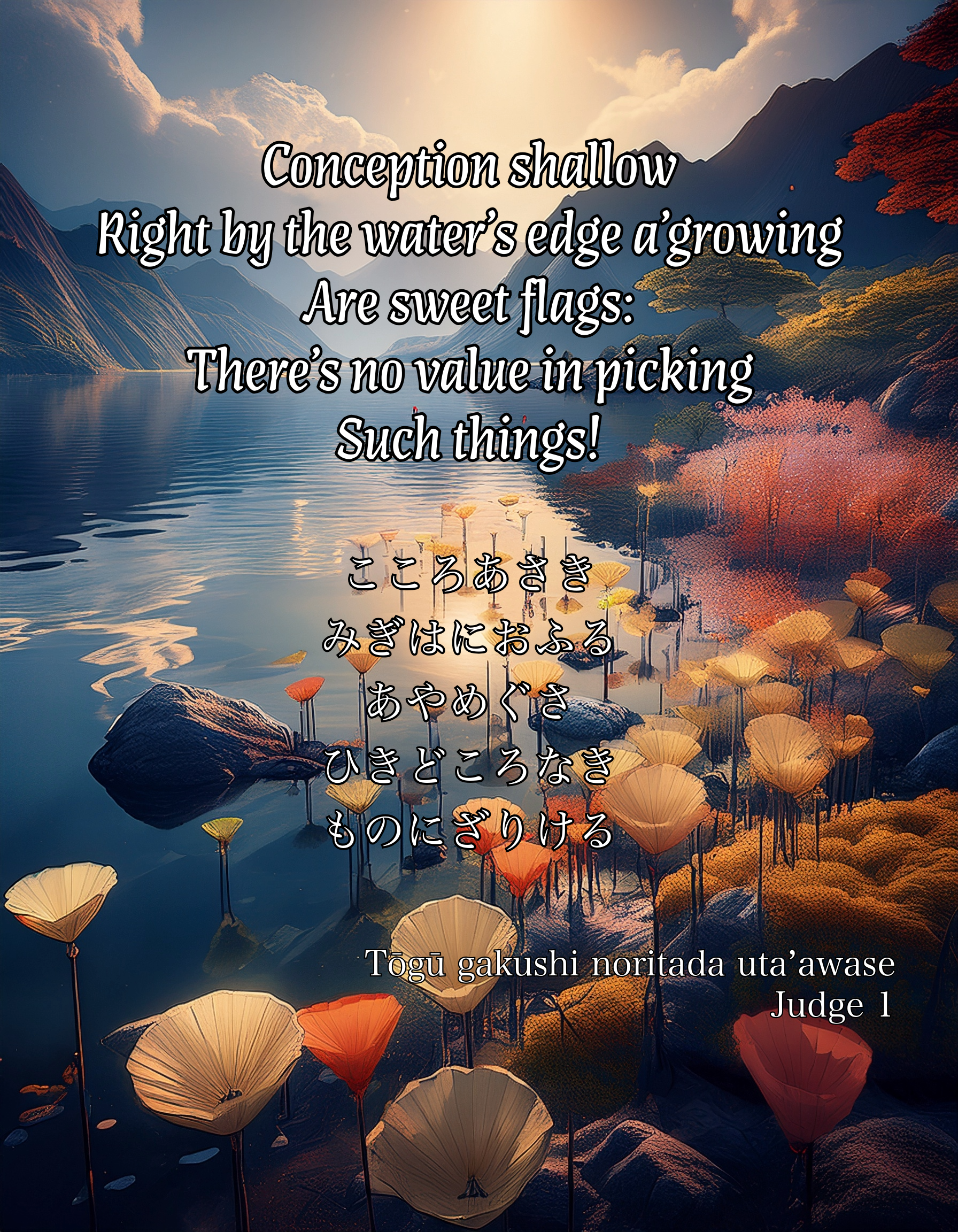
こころあさきみぎはにおふるあやめぐさひきどころなきものにざりける

kokoro asaki
migiwa ni ouru
ayamegusa
hikidokoro naki
mono ni zarikeru
Conception shallow
Right by the water’s edge a’growing
Are sweet flags:
There’s no value in picking
Such things!

Judge 1


[i] Tōgū gakushi noritada uta’awase 東宮学士義忠歌合
Naidaijin-ke uta’awase 30

Round Six

Left (T – Tie)

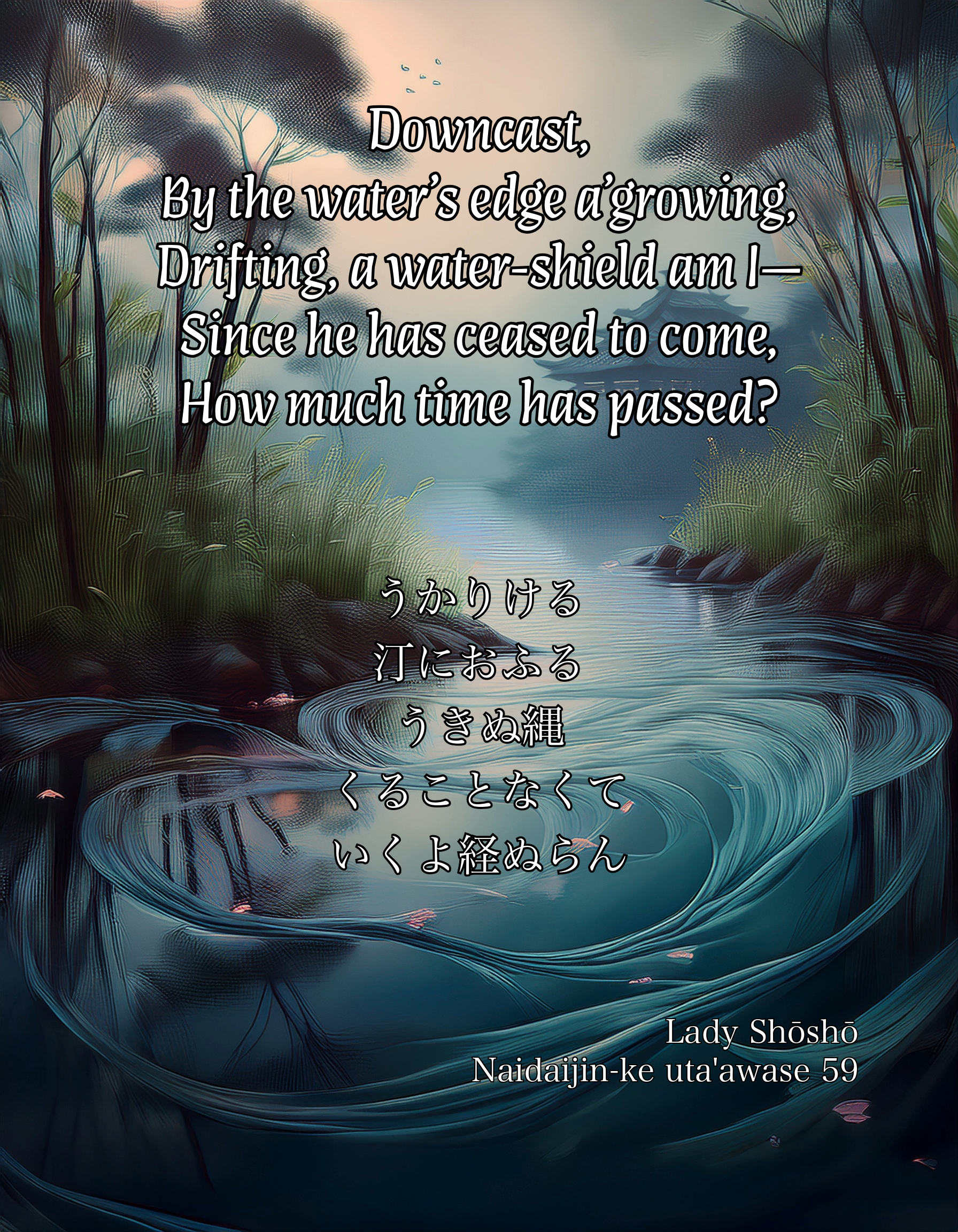
うかりける汀におふるうきぬ縄くることなくていくよ経ぬらん

ukarikeru
migiwa ni ouru
uki nunawa
kuru koto nakute
ikuyo henuran
Downcast,
By the water’s edge a’growing,
Drifting, a water-shield am I—
Since he has ceased to come,
How much time has passed?

Lady Shōshō
59

Right (M – Win)

夜とともに袖のみぬれて衣川こひこそわたれ逢瀬なければ

yo to tomo ni
sode nomi nurete
koromogawa
koi koso watare
ause nakereba
With the coming of night
My sleeves are simply soaked—
The River Robe
Goes on does my love,
Though meetings are there not…

Lady Shinano
60

Toshiyori states: neither Left nor Right appears to have any faults. They are, as expected,  somewhat trite, so I would say they are equivalent.

Mototoshi says: both of these poems seem pleasant. ‘Love going on without a meeting’ is particularly charming.

Naidaijin-ke uta’awase 29

Round Five

Left (T – Tie)

つれなさのためしは誰ぞたれにても人なげかせてはてはよしやは

tsurenasa no
tameshi wa ta zo
tare nite mo
hito nagekasete
hate wa yoshi ya wa
For cold cruelty
Who is your exemplar?
Whoever it might be,
Is causing one such grief
A good thing, in the end?

Lord Morotoshi
57

Right (M – Win)

逢ふ事をまつの汀に年ふればしづえに波のかけぬ日ぞなき

au koto o
matsu no migiwa ni
toshi fureba
shizue ni nami no
kakenu hi zo naki
For a meeting
Pining by the waters’ edge
As the years go by—
Lower boughs by waves
Washed not on any day, at all…

Lord Sadanobu
58

Toshiyori states: it is impossible to say that that the configuration and diction of the first poem is anything special. In the second poem, ‘For a meeting / Pining by the waters’ edge’ has poetic qualities, but continuing with ‘Lower boughs by waves / Washed not on any day, at all’ does not seem like a love poem, and if the poet had wanted to allude to tears here, well, it just doesn’t sound like it, does it. The Left has the conception of a Love poem, but it language lacks elegance; the Right is smooth, but has only a faint conception of love, and thus these tie.

Mototoshi states: this poem’s diction is particularly bizarre. What an objectionably unpleasant feeling of love! One does see this in the passage giving the reply by Nakatomi no Tokuin, and then there seems to have been the poem ‘go on then, you creeper’, but that one continues extremely charmingly, while this sounds ghastly. Then ‘For a meeting / Pining by the waters’ edge’, truly is a charming composition, and the subsequent ‘Lower boughs by waves / Washed not on any day, at all’ seems entirely clear. It seems to approach the quality of Komachi’s poem, to me! This is a win for the Right, I have to say.