hototogisu yama yori ochi no satobito wa matade ya yowa no hatsune kikuran
O, cuckoo, Far from the mountains, Will villagers Without waiting, at midnight Ever hear your first cry?
Chikanari 45
Right
うちしめる花橘の五月雨に軒もる夜半のほととぎすかな
uchishimeru hanatachibana no samidare ni noki moru yowa no hototogisu kana
When utterly drenched is The orange blossom by The summer showers. Dripping from the eaves at midnight is A cuckoo’s call!
Ie’kiyo 46
The Right’s poem has ‘Dripping from the eaves at midnight is a cuckoo’s call!’—this sounds like it conveys the conception, but yet is stylistically unclear. The Left’s poem takes up the conception of ‘On the leg-wearying / Mountains’ far side / Folk dwell—I wonder / Do they not have to wait for the autumn / Moon to fill their gaze?’,[1] doesn’t it? Neither has any real point worth making, so they tie.
[1] This poem is: Topic unknown. あしびきの山のあなたにすむ人はまたでや秋の月をみるらんashihiki no / yama no anata ni / sumu hito wa / matade ya aki no / tsuki o miruran Former Emperor Sanjō (SKKS IV: 382).
samidare ni yasurau kure no hototogisu sonata no kumo ni koe na hedate so
In a summer shower, Hesitating, at twilight, O, cuckoo, Let not the intervening clouds Interrupt your song!
Shō 43
Right
過ぎぬなりさやはちぎりし時鳥なく音ばかりはこぞにかはらで
suginunari saya wa chigirishi hototogisu naku ne bakari wa kozo ni kawarade
And so you’ve flown by— Is that what you vowed, O, cuckoo? For only the sound of your song Is unchanged from the year before…
Nagatsuna 44
The Left’s poem doesn’t seem bad. The Right poem’s ‘For only the sound of your song is unchanged from the year before’ is somewhat difficult to grasp—if the cuckoo’s call has not changed, then what has? After all, cuckoos have ‘the voice of yesteryear’[1]—among other references—so it’s obvious that their calls don’t change, so the Left is somewhat better, I think.
shigaraki no toyama no sue no hototogisu ta ga sato chikaki hatsune naruran
In Shigaraki At the foothills’ end A cuckoo By whose estate Might let out his first cry?
Takasuke 41
Right
橘のにほひを空に尋ねきて山時鳥なかぬ日ぞなき
tachibana no nioi o sora ni tazunekite yamahototogisu nakanu hi zo naki
Orange blossom’s familiar Scent within the skies I seek out, while The mountain cuckoo Fails to sing on not a single day…
Shimotsuke 42
The Left poem’s ‘near whose estate does it first call’ does not sound bad. The Right’s poem, too, seems to have no faults to mention, yet the Left still wins by a hair.
akenbono wa namida ya moroki hototogisu naku ne ni otsuru mori no shitazuyu
With the dawn Are you swiftly to tears moved By the cuckoo’s Calling cries, falling from The forest drip dewdrops?
Dōchin 39
Right
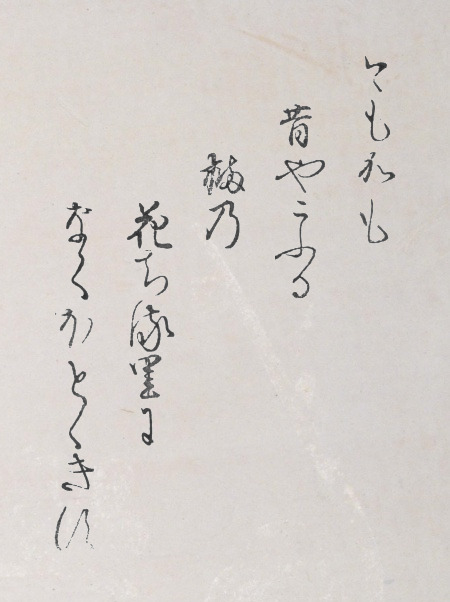
今もかも昔やこふる橘の花ちる里になく郭公
ima mo kamo mukashi ya kouru tachibana no hana chiru sato ni naku hototogisu
I wonder, is she now, As in days gone by, beloved Where orange Blossom falls on the estate— The calling cuckoo?[1]
Dharma Master Nyokan 40
Both Left and Right are of the same quality, yet I wonder about the sound of the Right poem’s final section, so the Left wins.
[1] An allusive variation on: A poem by the Governor-General of Dazai, Lord Ōtomo. 橘の花散る里の霍公鳥片恋しつつ鳴く日しぞ多き tachibana no / hana chiru sato no / hototogisu / kata koishitsutsu / naku hi shi zo ōki ‘Orange / Blossom scatters round my estate where / The cuckoo / For unrequited love / Does cry on many a day…’ Ōtomo no Tabito (MYS VIII: 1473)
kamu saburu nageki no mori no hototogisu hiku shimenawa mo nakunaku ya koshi
In divine Nageki’s sacred grove Does the cuckoo to Where the holy garlands Are hung not, come to sing?[1]
The Former Minister of the Centre 35
Right
さとわかずなけや五月の郭公忍びし比は恨みやはせし
sato wakazu nake ya satsuki no hototogisu shinobishi koro wa urami ya wa seshi
In every hamlet Sing, O, Fifth Month Cuckoo! For when you chirped before, I did not hate you for it…
Kozaishō 36
The Left’s poem is based on ‘Prayers / Alone I seem to hear at / This shrine, indeed, but / In the end, passion to grief’s / Grove will turn, no doubt…’ and sounds pleasant. The Right’s poem says ‘For when you chirped before, / I did not hate you for it’ and has a graceful style—thus, they tie.
[1] An allusive variation on: Topic unknown. ねぎ事をさのみききけむやしろこそはてはなげきのもりとなるらめnegigoto o / sanomi kikikemu / yashiro koso / hate wa nageki no / mori to narurame ‘Prayers / Alone I seem to hear at / This shrine, indeed, but / In the end, passion to grief’s / Grove will turn, no doubt…’ Sanuki (KKS XIX: 1055)
ochikochi no chiru hana goto ni taguitsutsu haru wa kokoro no akugaruru kana
Here and there Every single scattered blossom Enthralls me; Spring within my heart I hold so dear.
Lord Saburō 3
Right (Win)
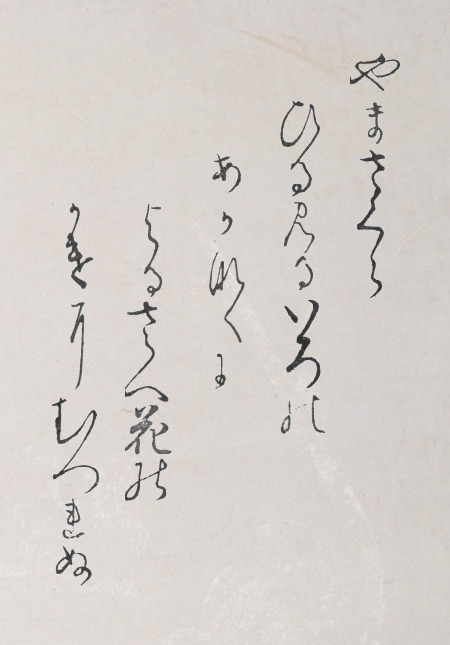
やまざくらひる見るいろのあかなくによるさへ花のかげにむつれぬ
yamazakura hiru miru iro no akanaku ni yoru sae hana no kage ni mutsurenu
Mountain cherry, Viewed in daytime has hues That will not sate, so Even at night the blossoms’ Glow entangles me.
Ushigimi 4
The Left’s poem has nothing remarkable about it. I say that, but it also has no particular faults. The Right’s phrase ‘’ feels curt, so I make the Left the winner.
The Left’s poem does not appear to have any particular faults—it describes the world as it is, so it seems to lack any novel phrasing.
The diction of the Right’s ‘Viewed in daytime has hues’ is extremely immature. With that being said, being entangled and lingering unsated has some conception to it.. I should say this is the winner.
Former Director of the Bureau of Carpentry, Toshiyori[i]
Cherry
Round One
Left
みやまにはしひがかざをれはやけれどふもとのはなはことしさくめり
miyama ni wa shii ga kaza’ore hayakeredo fumoto no hana wa kotoshi sakumeri
Deep within the mountains, Brushwood is broken by the wind So swiftly, yet In the foothills the blossom Will bloom this year, it seems.[ii]
Lord Dainagon 1
Right
ちるはなをさそふとみつるはる風のうはのそらにもすててけるかな
chiru hana o sasou to mitsuru harukaze no uwa no sora ni mo sutetekeru kana
The scattered blossoms Look to be beckoned by The spring breezes, Even high up in the skies To be abandoned!
Lord Chūnagon 2
I would say there’s no reason to say that the poem of the Left is superb, yet it does have a little bit of interest. The poem of the Right’s ‘Even high up in the skies /To be abandoned!’ completely fails to exceed vulgar diction. Thus, I make the Left the winner.
The poem of the Left’s ‘Brushwood is broken by the wind’ and so forth cannot be called ordinary and is an extremely charming use of diction. However, if the branches are broken and lost, then it would appear difficult for them to bloom, yet the addition of ‘yet’ to ‘swiftly’ gives the impression that there are branches remaining, thus following this with ‘Will bloom this year, it seems’ appears clumsy.
The poem of the Right has nothing remarkable about it, and no particular errors. Even so, because except in exceptional circumstances, the Left must win the first round, I make the Left the winner.
[i] This match was initially judged by Fujiwara no Mototoshi, but at some point after this, one of the participants, Sōen, submitted an ‘Appeal’ (chinjō) claiming these were unfair, and Toshiyori was asked to re-judge the match. The result is that there are two manuscript traditions for this event, one with Mototoshi’s judgements and one with Toshiyori’s. I am including both sets of judgements here.
[ii] The end of winter-beginning of the Twelfth Month. みやまにははやまのあらしあらげなりしひのかざをれいくそかかれり miyama ni wa / hayama no arashi / aragenari / shii no kaza’ore / ikuso kakareri ‘Deep within the mountains / Across the timber slopes the storm wind / Rages; / Brushwood is broken by the wind / O’er countless tens of trees.’ Sone no Yoshitada (Yoshitada-shū 342)