Early Evening (晩立)
夕立はきりにきるともあづさ弓いにいてさへばくれずも有るかな
| yūdachi wa kiri ni kirutomo azusayumi ini’ide saeba kurezu mo aru kana | Evening showers Clad in mist, yet When a catalpa bow Emerges to interfere There is no dusk, at all. |
Toshiyori
Composed on plovers for a poetry competition in Eishō 4 [1050].
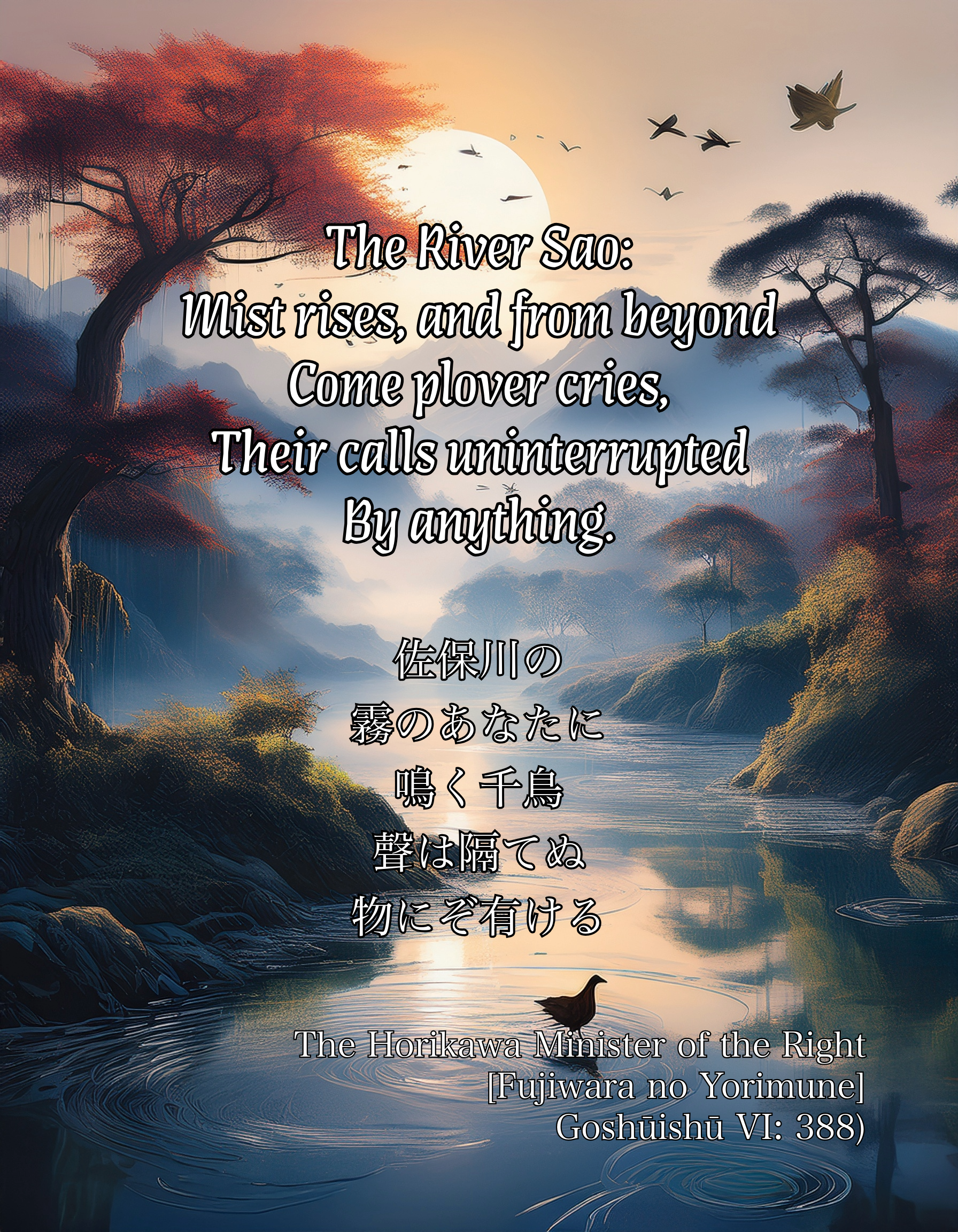
佐保川の霧のあなたに鳴く千鳥聲は隔てぬ物にぞ有ける
| saFogaFa no kiri no anata ni naku tidori kowe Fa Fedatenu mono ni zo arikeru | The River Sao: Mist rises, and from beyond Come plover cries, Their calls uninterrupted By anything. |
The Horikawa Minister of the Right [Fujiwara no Yorimune]

Left (Win).
秋はなを霧の靡に鹿鳴て花も露けき夕なりけり
| aki wa nao kiri no nabiki ni shika nakite hana mo tsuyukeki yū narikeri |
It truly is autumn – Through the fluttering mist Comes the belling of a stag, and The blooms, too, are dew-drenched At even time… |
373
Right.
哀をばいかにせよとて入會の聲うち添ふる鹿の音ならん
| aware o ba ika ni seyo tote iriai no koe uchi souru shika no ne naran |
More sad Than this there’s nothing! The evening bell Tolling, accompanied by The belling of a stag. |
374
The Right wonder, ‘In the expression “the blooms, too”, what does the “too” (mo) connect with? In addition, simply finishing the poem “At even time” (yū narikeri) shows a lack of conception.’ The Left counter that, ‘In the Right’s poem, expressions such as “more sad” (aware o ba) and “the belling of a stag” (shika no ne naran) are feeble. In addition, what of having iriai (“evening [bell]”), without explicitly including “bell” (kane)?’
Shunzei’s judgement: While I do wonder about the expression, ‘at even time’, with the inclusion of ‘too’ in the phrase ‘the blooms, too’, there is the impression of unspoken emotional overtones to the poem. The configuration of the first phrase, too, is particularly tasteful. As for the Right’s poem, it is not the case that iriai must always be accompanied by kane (‘bell’) – one can hear the bell in the phrase. However, overall, the Left’s poem gives a stronger impression, and so wins.
Left.
夕暮に思へばけさの朝霞夜をへだてたる心地こそすれ
| yūgure ni omoeba kesa no asa kasumi yo o hedatetaru kokochi koso sure |
In the evening Pondering on the morn’s Morning mist: That a night does stand between, The feeling strikes me strongly. |
125
Right (Win).
かくしつゝつもればおしき春の日をのどけき物と何思らむ
| kakushitsutsu tsumoreba oshiki haru no hi o nodokeki mono to nani omouramu |
Doing this and that Time passes, so I should regret These days of spring, Spent in peaceful Thought – and for what! |
126
Neither team has any comments to make about the other’s poem this round.
Shunzei states, ‘The Left seem to touch on the topic of the round only distantly, while the Right’s ‘Time passes, so I should regret’ (tsumoreba oshiki) appears particularly splendid. It must be the winner.