野辺みれば春の日暮のおほぞらにひばりとともにあそぶいとゆふ
| nobe mireba haru no higure no ōzora ni hibari to tomo ni asobu itoyū | Gazing on the plains At a springtime sunset In the heavens Together with the skylarks is Heat haze… |
Nakamasa
On the 11th day of the Eighth Month, Tenryaku 10,[i] when Her Northern Highness[ii] was at the Bōjō Mansion[iii] and the moon was particularly charming, the ladies and gentlemen composed on the topics of plants in the garden in her presence. The gentlemen were on the Left and the ladies were on the Right.
Moon
Left (Tie)
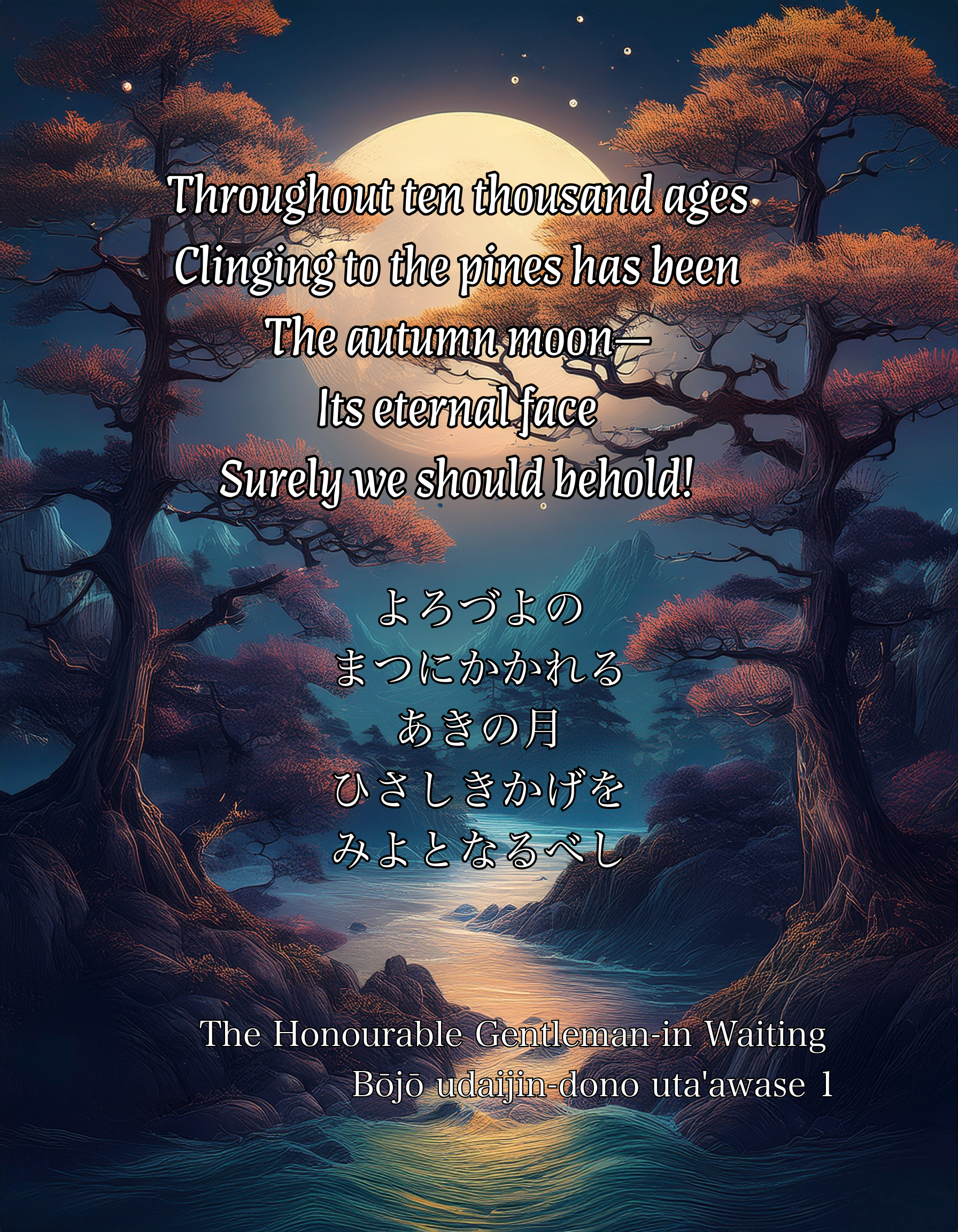
よろづよのまつにかかれるあきの月ひさしきかげをみよとなるべし
| yorozuyo no matsu ni kakareru aki no tsuki hisashiki kage o miyo to narubeshi | Throughout ten thousand ages Clinging to the pines has been The autumn moon— Its eternal face Surely we should behold! |
The Honourable Gentleman-in Waiting
1[iv]
Right
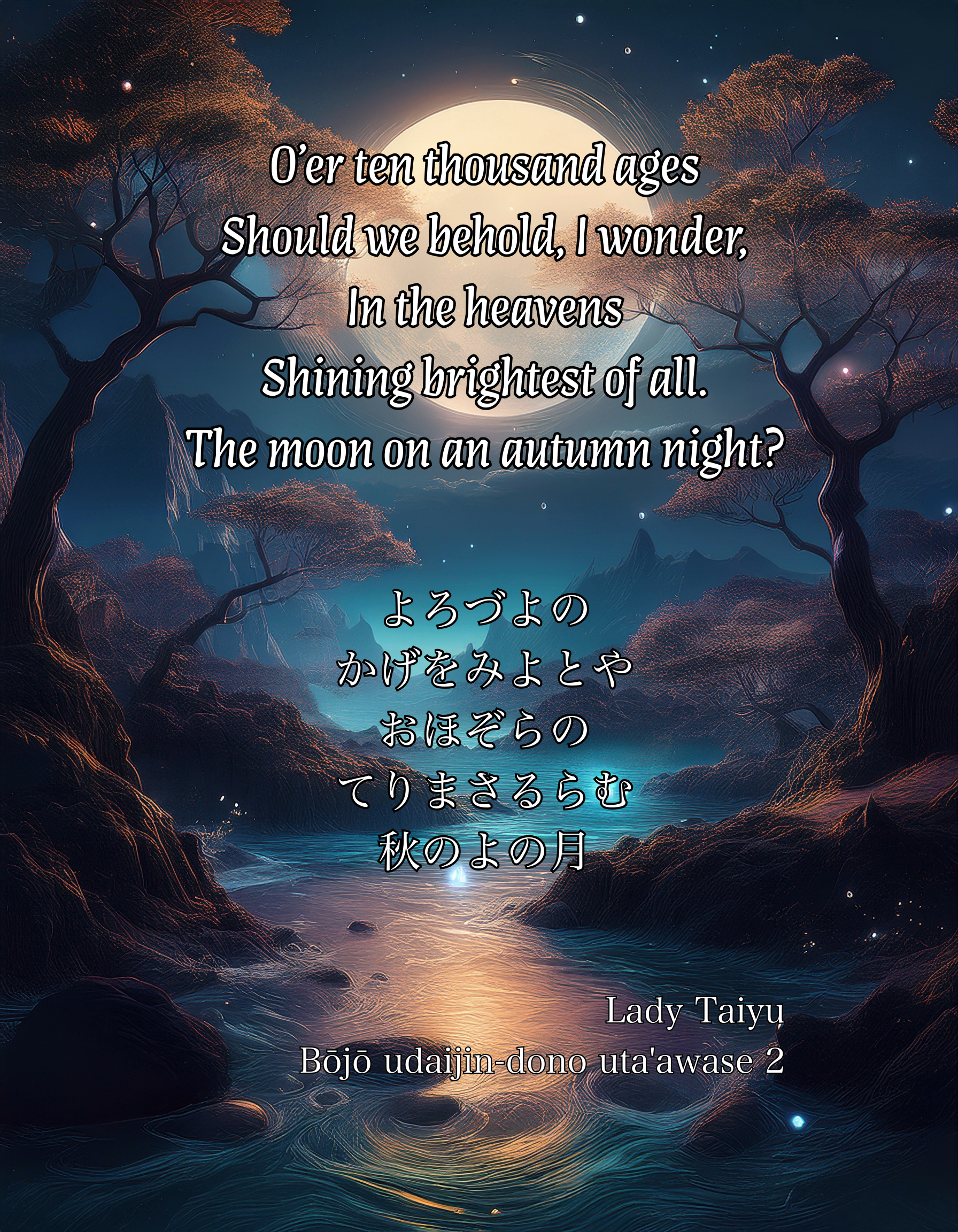
よろづよのかげをみよとやおほぞらのてりまさるらむ秋のよの月
| yorozuyo no kage o miyo to ya ōzora no terimasaruramu aki no yo no tsuki | O’er ten thousand ages Should we behold, I wonder, In the heavens Shining brightest of all, The moon on an autumn night? |
Lady Taiyu
2
[i] This date corresponds to 17 September 956.
[ii] Probably Imperial Princess Yasuko (Kōshi) 康子内親王 (919-957), Fujiwara no Morosuke’s final wife.
[iii] The Bōjō Mansion (Bōjōden 坊城殿) was a residence belonging to Fujiwara no Morosuke where he resided in his later years. Records of its exact location have not survived, but it was most likely to the west of Bōjō-kōji 坊城小路 (modern Bōjō-dōri 坊城通), south of Shijō 四条 in Kyoto.
[iv] This poem is included in Shin senzaishū (XX: 2324) attributed to Fujiwara no Takamitsu, with the headnote ‘Topic unknown’; it is also included in Takamitsu’s personal collection, Takamitsu-shū (8) with the headnote ‘From a poetry match’.
The Middle of Autumn
Left
大空の道みえぬまでふる霧は秋のなかばにとめむとかもし
| ōzora no michi mienu made furu kiri wa aki no nakaba ni tomemu to kamo shi | Until all the endless sky Ways unseen are Descend the mists In the heart of autumn— Will they stay a while, I wonder? |
15
Right
女郎花おほくの秋にあふものをからくもあだにおもひけるかな
| ominaeshi ōku no aki ni au mono o karaku mo ada ni omoikeru kana | Maidenflowers Many in autumn Does one meet, but Bitterly, faithless Do I feel they are! |
16


Round Twenty-Two
Left
いなむしろしきつのうらのまつかぜはもりくるをりぞしぐれともしる
| inamushiro shikitsu no ura no matsukaze wa morikuru ori zo shigure to mo shiru | A straw mat spread At Shikitsu Bay, where when On the wind through the pines Come dripping droplets I know a shower is falling! |
Lord Kiyosuke
93
Right (Win)
おほぞらもみやこのかたをしのぶらしこよひはことにうちしぐれつつ
| ōzora mo miyako no kata o shinoburashi koyoi wa koto ni uchishiguretsutsu | The heavens, too, Of the capital Think fondly, it seems, For tonight is especially Filled with constant showers… |
Lord Sanetsuna
94
The poem of the Left appears to have a pleasant conception, blending showers with the wind through the pines and saying, ‘Come dripping droplets / I know a shower is falling!’, but it appears that the straw mat has only been spread because of the reference to Shikitsu [spreading] Bay. Considering the actual nature of a straw mat, however, I do not feel that the sense links with Shikitsu Bay, although it would be charming if sleeping on a journey in the shade of the willows beside a river, or even in a hut among the rice-fields. I do not feel it is appropriate to spread a straw mat beneath the pines at Sumiyoshi. In addition, it is only the straw mat here which has the conception of a journey—how should one feel about that? The configuration of the Right’s poem, beginning with ‘The heavens, too’ and following with ‘Of the capital / Think fondly, it seems’, I would say is a poem for a poetry match. While a counter-argument has been made about the Left’s poem, it’s really asking for the impossible, isn’t it. So, I impose victory for the Right.


Left
おほぞらの心ぞまどふめにみえてわかるる秋ををしむわがみは
| ōzora no kokoro zo madou me ni miete wakaruru aki o oshimu wa ga mi wa | The heavens’ Heart lies confused Before my eyes; Departing autumn Leaves me with with nothing but regret. |
37
Right
とどむれどとまらぬ秋ををしむとて心にはかるなをやたちなん
| todomuredo tomaranu aki o oshimu tote kokoro ni wa karu na o ya tachinan | I would have it linger, yet It will not—autumn, I regret so Within my heart, briefly Should I call it that? |
38
Left
あきごとにさかずはあらねど女郎花散りゆくことはをしくぞありける
| aki goto ni sakazu wa aranedo ominaeshi chiriyuku koto wa oshiku zo arikeru | Every single autumn, It’s not that you bloom not, yet O, maidenflowers, That you scatter away I regret, indeed! |
11
Right
めにみえてわかるる秋ををしまめやおほぞらのみぞながめらるらん
| me ni miete wakaruru aki o oshimame ya ōzora nomi zo nagameraruran | Before my eyes Autumn is departing— Should I regret it, or Simply to the heavens, alone, Ever turn my gaze? |
12
Left
雁のねは風にきほひてわたれどもわが待つ人のことづてぞなき
| kari no ne wa kaze ni kioite wataredomo wa ga matsu hito no kotozute zo naki | The goose cries Competing with the wind Come across, yet From the man I’m waiting for There is no word at all… |
92
Right
大空をとりかへすとも見えなくにほしかとみゆる秋の草かな
| ōzora o torikaesu tomo mienaku ni hoshi ka to miyuru aki no kusa kana | The heavens Claimed back, they Do not appear to be, yet Somehow, they seem like stars: These autumn grasses! |
93
Left
春ながら年はくれなん散る花ををしと鳴くなる鶯のこゑ
| haru nagara toshi wa kurenan chiru hana o oshi to nakunaru uguisu no koe | ‘Tis spring, but The year draws to an end; ‘The scattering blossom I regret!’ sings The warbler’s song. |
23[1]
Right
大空をおほふばかりの袖もがな春咲く花を風にまかせじ
| ōzora o ōu bakari no sode mogana haru saku hana o kaze ni makaseji | If only the heavens I could simply cover With my sleeves, then The blossoms blooming in springtime I’d not abandon to the wind! |
24[2]
[1] Shinsen man’yōshū 35; Shinchokusenshū II: 88.
[2] Shinsen man’yōshū 263.
When His Majesty was particularly impressed by his reply, and presented him with two rolls of silk.
きのふまでうらみしかぜはおほぞらのうきくもはらふつかひなりけり
| kinō made uramishi kaze wa ōzora no ukikumo harau tsukai narikeri | Until yesterday I did despise the wind: The heavens Sweeping clear of drifting clouds – That was its task. |
Mibu no Tadami