miyagino no ko no shitakaze ya suginuran tsuyu ni okururu akihagi no hana
On Miyagi Plain has The breeze beneath the trees Passed by? For Missing the dewfall are The autumn bush clover blooms…
Takasuke 57
Right
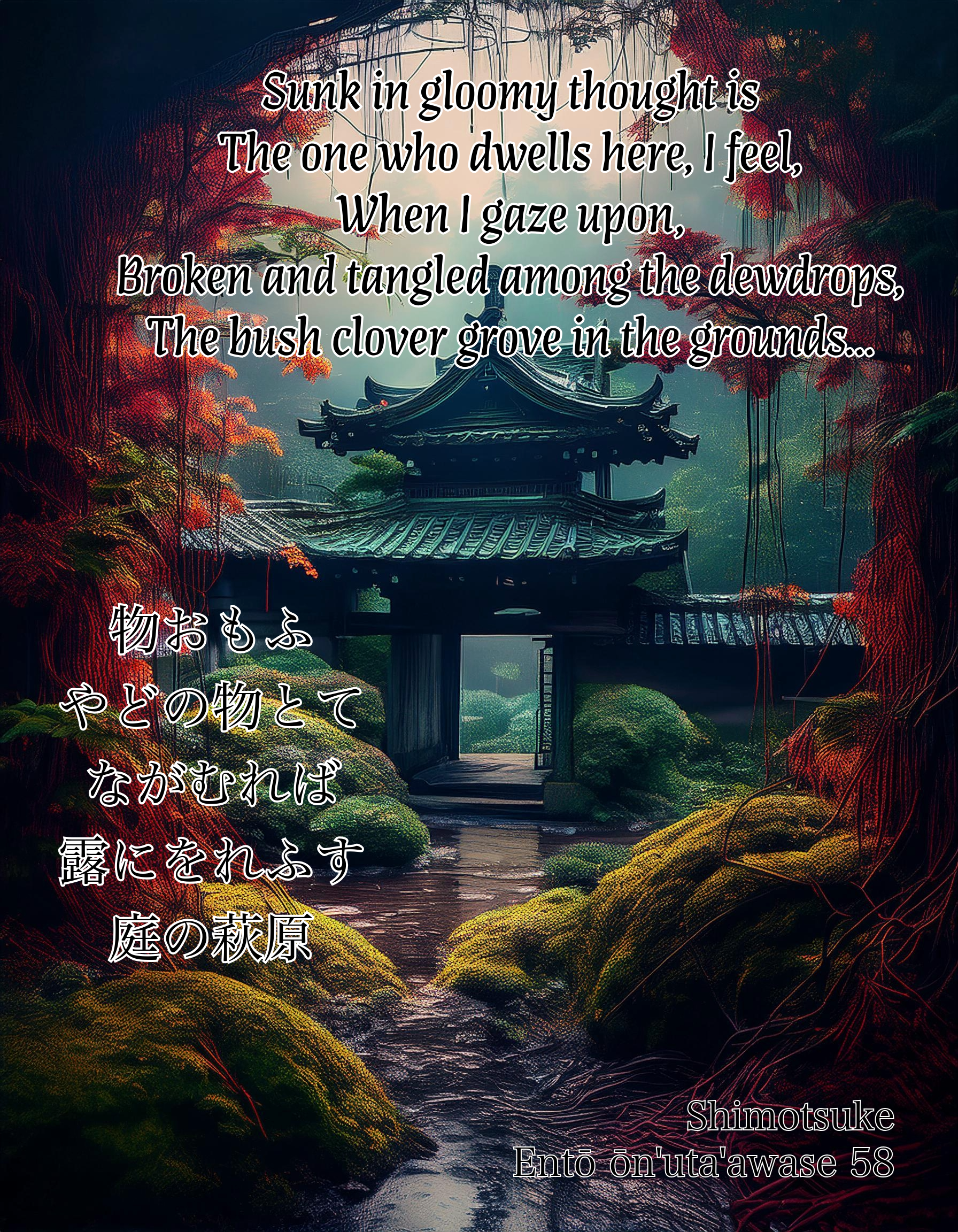
物おもふやどの物とてながむれば露にをれふす庭の萩原
mono’omou yado no mono tote nagamureba tsuyu ni orefusu niwa no hagiwara
Sunk in gloomy thought is The one who dwells here, I feel, When I gaze upon, Broken and tangled among the dewdrops, The bush clover grove in the grounds…
Shimotsuke 58
The Left poem’s ‘Missing the dewfall are the autumn bush clover’ sounds pleasant. The Right poem has no faults either, yet the Left should win.
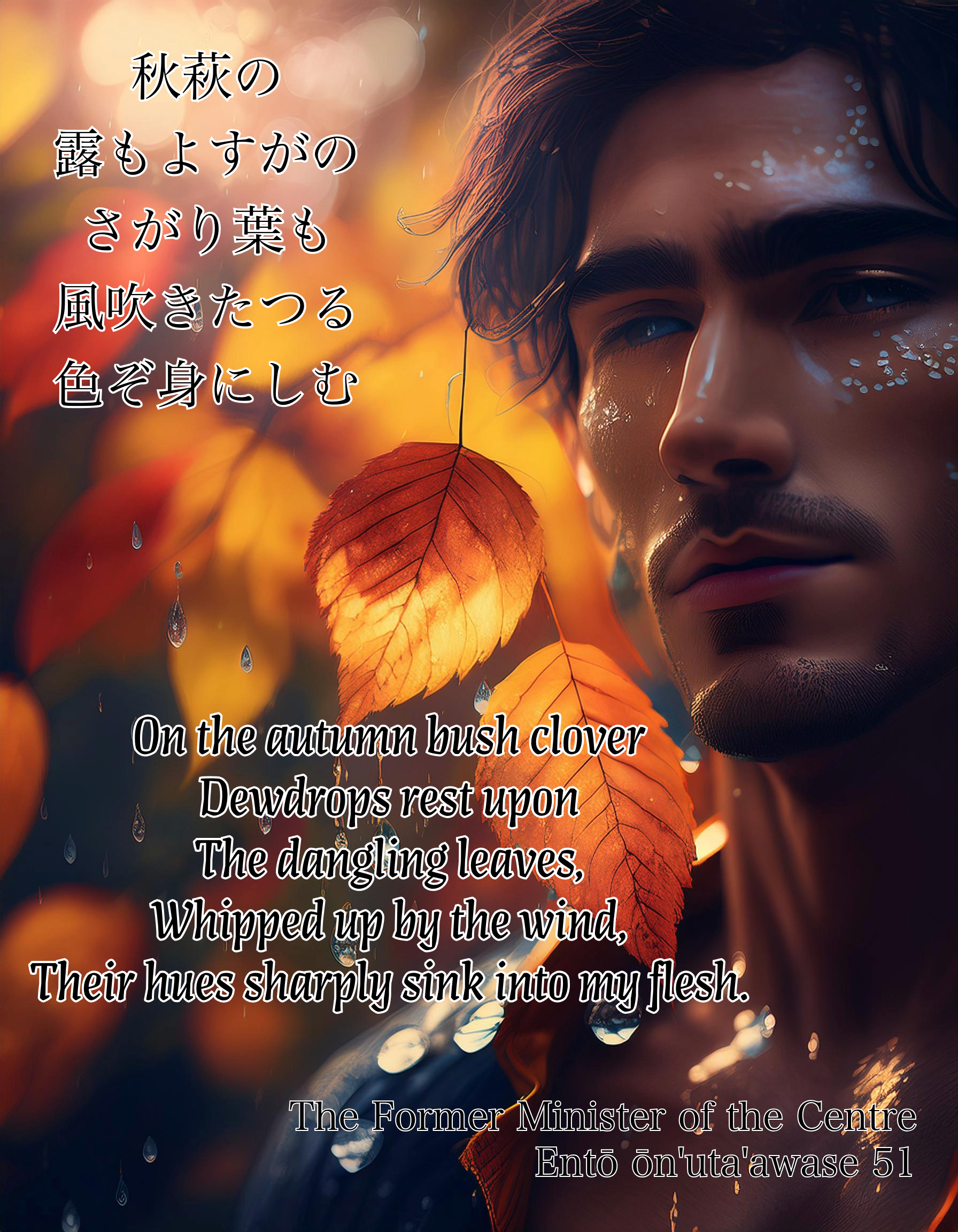
akihagi no tsuyu mo yosuga no sagariba mo kaze fukitatsuru iro zo mi ni shimu
On the autumn bush clover Dewdrops rest upon The dangling leaves, Whipped up by the wind, Their hues sharply sink into my flesh.
The Former Minister of the Centre 51
Right (Win)
さだめなき風を待つ間もうつろひぬもとあらの萩にむすぶ白露
sadamenaki kaze o matsu ma mo utsuroinu motoara no hagi ni musubu shiratsuyu
While the unsettled Breeze they do await, Faded from The sparse bush clover have The clinging dewdrops.[1]
Kozaishō 52
The Left poem’s ‘rest upon the dangling leaves, whipped up by the wind’ seems a novel style, and yet, even though everything about dangling leaves is contained in the Ancient and Modern, it does not sound particularly evocative. The Right lacks even a small fault and appears gorgeous, so it should win.
[1] An allusive variation on: Topic unknown. 宮木野のもとあらの小萩つゆをおもみ風をまつごと君をこそまつ miyagino no / motoara no kohagi / tsuyu o omomi / kaze o matsu goto / kimi o koso matsu ‘On Miyagi Plain / The sparse bush clover / Weighed down with dewdrops / Awaits the wind, just as / I do wait for you…’ Anonymous (KKS XIV: 694)
shitaba ni wa iro naru tama ya kudakuramu kaze no fukishiku hagi no ue no tsuyu
From the underleaves Hues have the gemlets taken In their shattering? Spread by the gusting wind Are the dewdrops on the bush clover…
A Court Lady 49
Right (Win)
又やみむ又や見ざらん白露の玉おきしける秋萩の花
mata ya mimu mata ya mizaran shiratsuyu no tama okishikeru akihagi no hana
Will I see again, or Will I not Silver dewdrop Pearls spread upon The autumn bush clover blooms?
Ietaka 50
The Left’s poem does not seem to have a particularly superlative style. The Right’s poem, saying ‘will I see again, or will I not silver dewdrops’ is particularly charming and moving. Thus, it wins.
akenbono wa namida ya moroki hototogisu naku ne ni otsuru mori no shitazuyu
With the dawn Are you swiftly to tears moved By the cuckoo’s Calling cries, falling from The forest drip dewdrops?
Dōchin 39
Right
今もかも昔やこふる橘の花ちる里になく郭公
ima mo kamo mukashi ya kouru tachibana no hana chiru sato ni naku hototogisu
I wonder, is she now, As in days gone by, beloved Where orange Blossom falls on the estate— The calling cuckoo?[1]
Dharma Master Nyokan 40
Both Left and Right are of the same quality, yet I wonder about the sound of the Right poem’s final section, so the Left wins.
[1] An allusive variation on: A poem by the Governor-General of Dazai, Lord Ōtomo. 橘の花散る里の霍公鳥片恋しつつ鳴く日しぞ多き tachibana no / hana chiru sato no / hototogisu / kata koishitsutsu / naku hi shi zo ōki ‘Orange / Blossom scatters round my estate where / The cuckoo / For unrequited love / Does cry on many a day…’ Ōtomo no Tabito (MYS VIII: 1473)
fuyugare ni utsuroi nokoru shiragiku wa uwaba ni okeru shimo ka to zo miru
Sere in winter, Faded and lingering A white chrysanthemum as, Fallen upon its upper leaves, Frost does appear, perhaps?
Lord Morikata 39
Right
露じもの暁置きのあさごとに移ひまさるしらぎくの花
tsuyujimo no akatsuki oki no asa goto ni utsuroi masaru shiragiku no hana
Frosty dewdrops With the dawn fall—arising Every morning Fading fairer become The white chrysanthemum blooms.
Lord Michitsune 40
Toshiyori states: I have the feeling that I have never heard the expression ‘sere in winter’, and I certainly have no recollection of it being in the Collection of a Myriad Leaves. The poem of the Right is smooth and extremely charming; I’m very familiar with the expression ‘dew fallen in the morning when I arise’, and here there seems to be some reason for it, doesn’t there! Still, the first poem is better.
Mototoshi states: the expression ‘faded and lingering’ is difficult to distinguish. In addition, saying ‘Fallen upon [the flower’s] upper leaves, / Frost’ is a severe misjudgment. The poem of the Right has the tautology ‘with the dawn fall’ and then ‘every morning’. Clearly neither of these appears to win or lose, so I make this a tie.
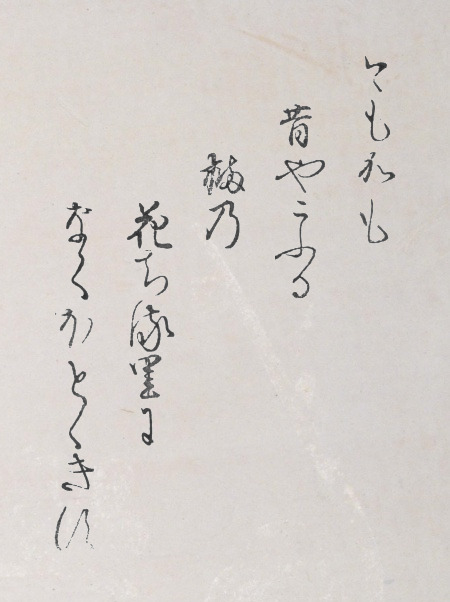
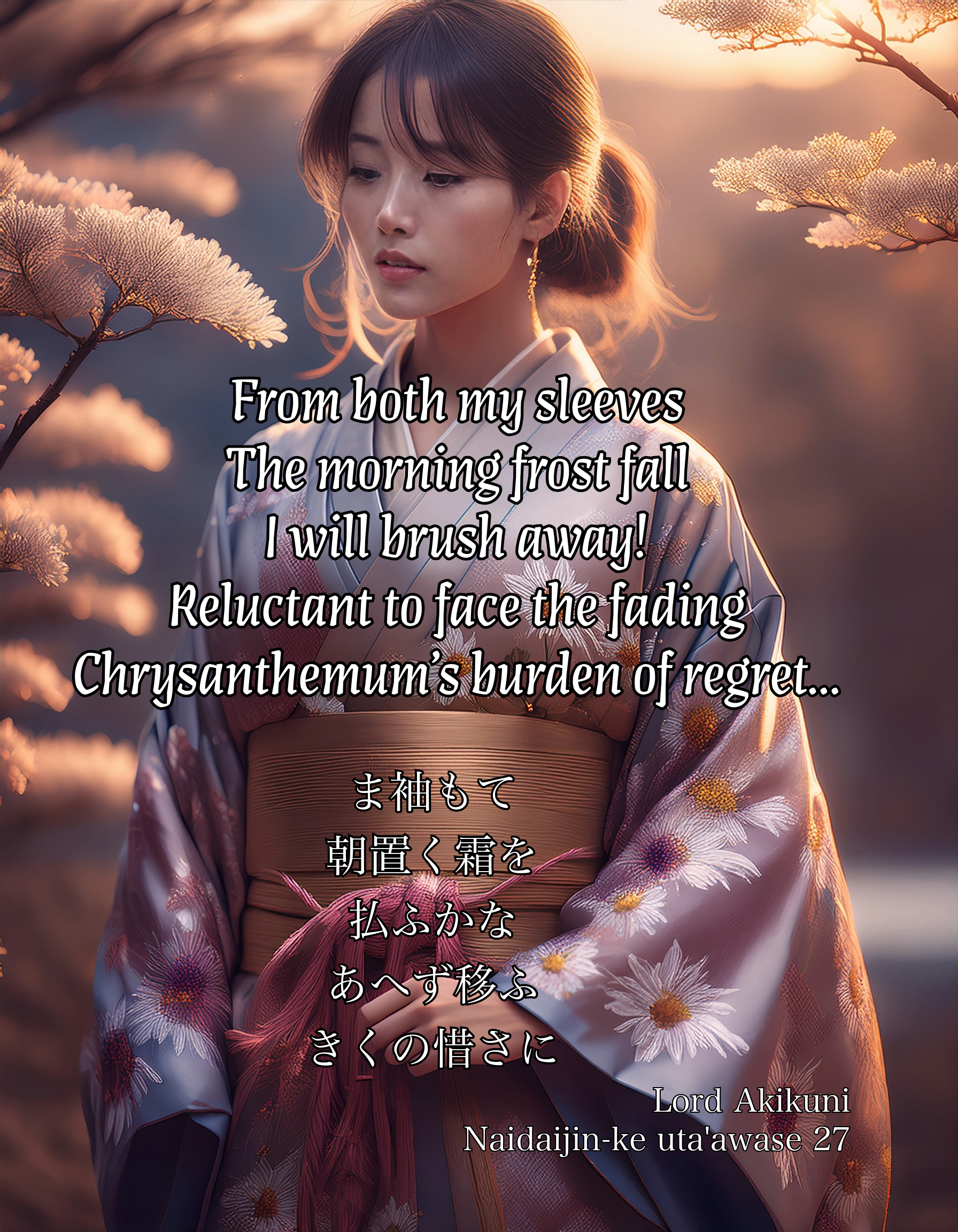
masodemote asa oku shimo o harau kana aezu utsurou kiku no oshisa ni
From both my sleeves The morning frost fall I will brush away! Reluctant to face the fading Chrysanthemum’s burden of regret…
Lord Akikuni 27
Right (Both Judges – Win)
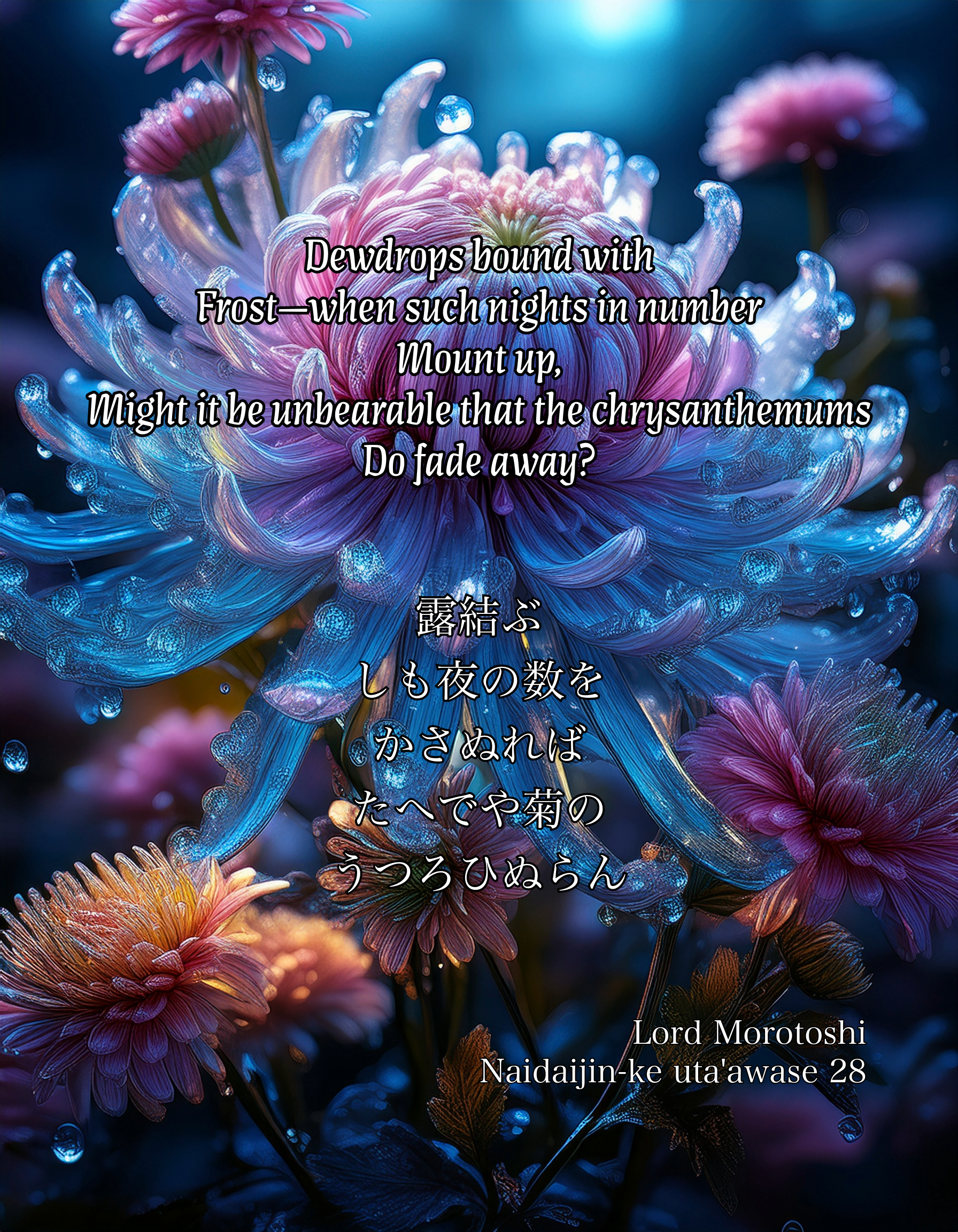
露結ぶしも夜の数をかさぬればたへでや菊のうつろひぬらん
tsuyu musubu shimo yo no kazu o kasanureba taede ya kiku no utsuroinuran
Dewdrops bound with Frost—when such nights in number Mount up, Might it be unbearable that the chrysanthemums Do fade away?
Lord Morotoshi 28
Toshiyori states: the first poem is extremely charming. Nevertheless, I must question the use of ‘reluctant to face the fading’ as I feel this is something I have not heard before. I can grasp the sense of diction such as ‘unable to do anything about’ or ‘without taking on autumn hues’, but did the poet mean to use the diction ‘unbearable’, perhaps? Even though this is somewhat archaic phrasing, it is used in composition. This poem’s expressions, though, I feel are somewhat unfamiliar. The conception and diction of the second poem are both extremely charming. However, this poem, too, is vague. What is going on with the initial ‘dewdrops bound’? Does it mean that the dewdrops get turned into frost? If so, then, from what is known of the calendar, this is something which only occurs on a single night, and from the following night there is only frost. It sounds as if the conception of this poem, though, is that night after night dew turns to frost, and this would be a fault. Despite this vagueness, however, its tone is elegant, so it seems superior.
Mototoshi states: the poem of the Left has a poetic configuration, but I strongly feel that it would have been preferable not to use the diction ‘both my sleeves’. It does seem as if this was used in the ancient Collection of a Myriad Leaves, but even given that was the case, in the preface to the Ancient and Modern, I recall it saying, ‘On examining the poems of ancient times, we find they use many archaic expressions. These were there not just to please the ear, but simply for moral instruction’. It appears that there are no instances of this piece of diction being used in poetry matches from the period of the Ancient and Modern, Later Selection and Gleanings, and these were all conducted for entertainment. Even in a poetry match conducted in Engi 12 [912], when the term ‘sleeve’ was used, I get the feeling that it was such a source of amusement that the poem was not recited. While the quality of the Right’s poem is not superb, the tone of ‘Dewdrops bound with / Frost—when such nights in number’ is not bad, so I feel the dew can still remain bound!