Tag Archives: mist

Eien narabō uta’awase 26

Round Five

Left (Tie)

うちきらしあまぎるそらと見しほどにやがてつもれる雪の白山

uchikirashi
amagiru sora to
mishi hodo ni
yagate tsumoreru
yuki no shirayama
Suddenly concealed
By mist, the skies
I glimpsed and
In a moment drifted
Snow covered Shira Mountain with white.

Controller’s Graduate
51

Right

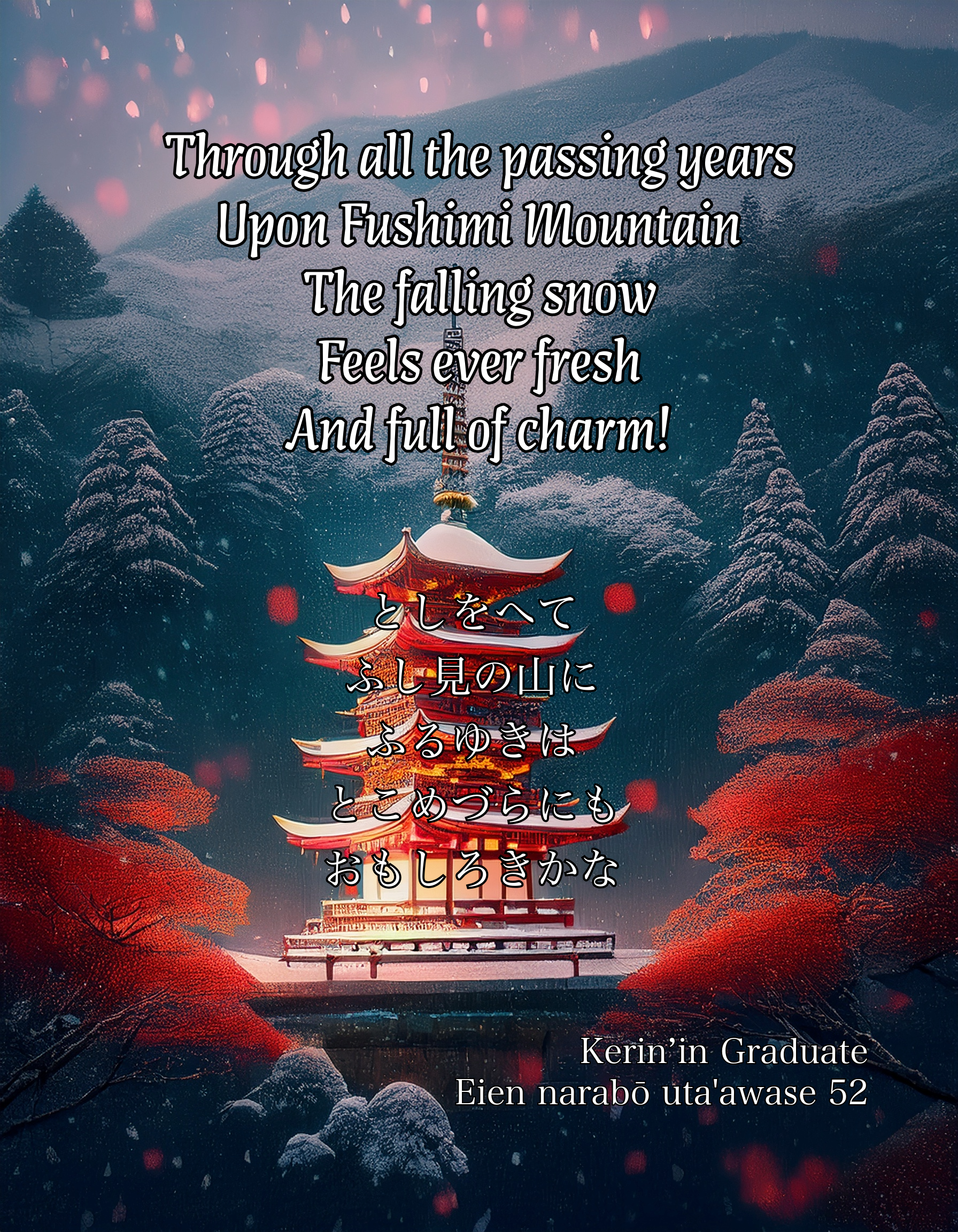
としをへてふし見の山にふるゆきはとこめづらにもおもしろきかな

toshi o hete
fushimi no yama ni
furu yuki wa
tokomezura ni mo
omoshiroki kana
Through all the passing years
Upon Fushimi Mountain
The falling snow
Feels ever fresh
And full of charm!

Kerin’in Graduate

52

The poem of the Left’s ‘Suddenly concealed / By mist, the skies’ is a clear case of repeating the same meaning. In addition, ‘snow covered Shira Mountain’ is one which is snow-capped regardless of whether it’s summer or winter. It’s not a mountain where one would be startled at seeing it ‘suddenly concealed’. The poem of the Right says that ‘through all the passing years the estate at Fushimi…feels ever fresh’, which seems as if this poem is specifying a period when this applies. It’s certainly a bit of a reach to say that this would be charming, but it’s not incongruous. Thus, I make this a tie.

I am unable to grasp the sense of the Left poem’s ‘suddenly concealed’. If it had been ‘concealed with falling’ then that would be better. In addition, I don’t understand the final ‘snow covered Shira Mountain’ either. I would have preferred it if the order had been ‘Shira Mountain’s snow’, but putting the ‘snow’ first seems to lack fluency and so, regretfully I would change this.

The Right’s ‘Fushimi Mountain’ is difficult to understand. It seems that ‘estate’ is a more standard composition, and ‘mountain’ is a novel usage. Having ‘Fushimi’ ‘feel fresh’ is evidence of thought, but even so, ‘mountain’ is vague.

Daikōtaigōgū no suke taira no tsunemori-ason ke uta’awase 23

Round Eleven

Left

さをしかの空にあはれときこゆるは山のたかねになけばなりけり

saoshika no
sora ni aware to
kikoyuru wa
yama no takane ni
nakeba narikeri
A stag belling
To the skies, sadly
I hear—
Perhaps, because ‘tis on the mountain’s peak
He cries so…

Lord Masahira

45

Right (Win)

ゆふまぐれ霧のまがきのさびしさにをしか鳴くなり秋の山里

yūmagure
kiri no magaki no
sabishisa ni
oshika nakunari
aki no yamazato
Tangled in twilight
With mist around my brushwood fence,
Loneliness fills me, as
A stag bells, by
A mountain retreat in autumn

Shinkaku
46

What on earth is the conception of ‘sadly hearing something in the skies’? While no one can truly know why a stag bells, what is the point of saying that ‘sadness is in the skies’? And if one does hear it, it isn’t the case that anyone really knows that the stag is belling out of longing for his mate, is it. The stag seeming to bell by a brushwood fence in the mist, seems to sound a bit more moving at the moment.

Hon’in sadaijin-ke uta’awase 07

Marlberry

Left

あさごとにきりはふれどもあしひきのやまたち花はいろもかはらず

asa goto ni
kiri wa furedomo
ashihiki no
yamatachibana wa
iro mo kawarazu
With every morning
The mist rolls down, yet on
The leg-wearying
Mountains, the marlberry’s
Hues remain unchanged.

13

Right

みねだにやすみうくならんあしひきのやまたち花のみやまゐをせる

mine dani ya
sumi’ukunaran
ashihiki no
yamatachibana no
miyamai o seru
Does even the peak
Seem so hard to dwell upon?
The leg-wearying
Mountain marlberry has
Turned the hidden spring a darker hue.

14

MYS V: 839

波流能努尓 紀理多知和多利 布流由岐得 比得能美流麻提 烏梅能波奈知流

春の野に霧立ちわたり降る雪と人の見るまで梅の花散る

paru no no ni
kiri tatiwatari
puru yuki to
pito no miru made
ume no pana tiru
In the springtime meadows
Filled with spreading mist,
As falling snow
To folk’s eyes appears
The scattering plum blossom.

Denshi no Makami, Clerk of Chikuzen
筑前目田氏真上

Shiki koi sanshu uta’awase – Autumn

Autumn

Left

秋の夜の有明にみれど久堅の月のかつらはうつろはぬかな

aki no yo no
ariake ni miredo
hisakata no
tsuki no katsura wa
utsurouwanu kana
An autumn night’s
Dawn I see, yet
The eternal
Moon’s silver trees
Show no sign of fading!

13

秋萩の花咲く比の白露は下ばのためとわきて置くべし

aki hagi no
hana saku koro no
shiratsuyu wa
shitaba no tame to
wakite okubeshi
In autumn, the bush clover
Flowers bloom—just then
Silver dewdrops
For the under-leaves
Do fall, marking every one.

14

秋風はいなばもそよとふきつめりかりみる程と成りやしぬらん

akikaze wa
inaba mo soyo to
fukitsumeri
kari miru hodo to
nari ya shinuran
The autumn breeze
Seems to rustle the rice stalks
As it blows;
Seeing if ‘tis time to reap them—
Is that what it is, I wonder?

15

Right

銀河とわたる舟は花薄ほにいづるほどぞかげもみゆべき

ama no kawa
towataru fune wa
hanasusuki
ho ni izuru hodo zo
kage mo miyubeki
Across the River of Heaven
A boat goes ferrying:
When the silver grass
Ears burst into bloom,
Can its shape be seen.

16

女郎花さがの花をば色ながら秋をさかりといはれずもがな

ominaeshi
saga no hana oba
iro nagara
aki o sakari to
iwarezu mogana
Maidenflowers:
Blossoms from Saga
Reveal their hues, and
In autumn are most fine—that
Goes without saying!

17

小男鹿の朝たつ霧にうりふ山嶺の梢は色こかりけり

saoshika no
asa tatsu kiri ni
urifuyama
mine no kozue wa
iro kokarikeri
Stags
Within the rising morning mist on
Urifu Moutain, where
The treetops on the peak
Have taken darker hues.

18

Love VIII: 18

Left (Win)
鴨のゐる入江の浪を心にて胸と袖とにさはぐ戀かな

kamo no iru
irie no nami o
kokoro nite
mune to sode to ni
sawagu koi kana
Ducks flock on
The inlet’s waves
Within my heart, so
My breast and sleeves both
Are raucous with love!

Lord Sada’ie
1055

Right
佐保川の霧のまよひの程だにも妻もとむとて千鳥鳴夜を

saogawa no
kiri no mayoi no
hodo dani mo
tsuma motomu tote
chidori naku yo o
To the vernal river:
The mist brings confusion
And in its midst,
Seeking a mate,
A plover cries at night…

Jakuren
1056

The Gentlemen of the Right state: we wonder about the appropriateness of ‘my breast and sleeves both are raucous’ (mune to sode to ni sawagu)? The Left, in appeal, state: there is ‘the river-mouths of my sleeves’ (sode no minato) and ‘when I think, upon my breast’ (omoeba mune ni) so linking ‘breast’ and ‘sleeve’ is entirely uncontroversial. The Gentlemen of the Left state: we find no faults to mention in the Right’s poem.

In judgement: I understand the views of the Left’s poem held by both teams. It has also been said that the Right’s poem lacks faults. However, in ‘seeking a mate, a plover cries at night’ (tsuma motomu tote chidori naku yo o) only the two words ‘at night’ (yo o) have any conception of love. The remainder of the poem is simply about plovers, so there is little of love about it. ‘Breast and sleeves both’ (mune to sode to) should win.