Tag Archives: ashitazu

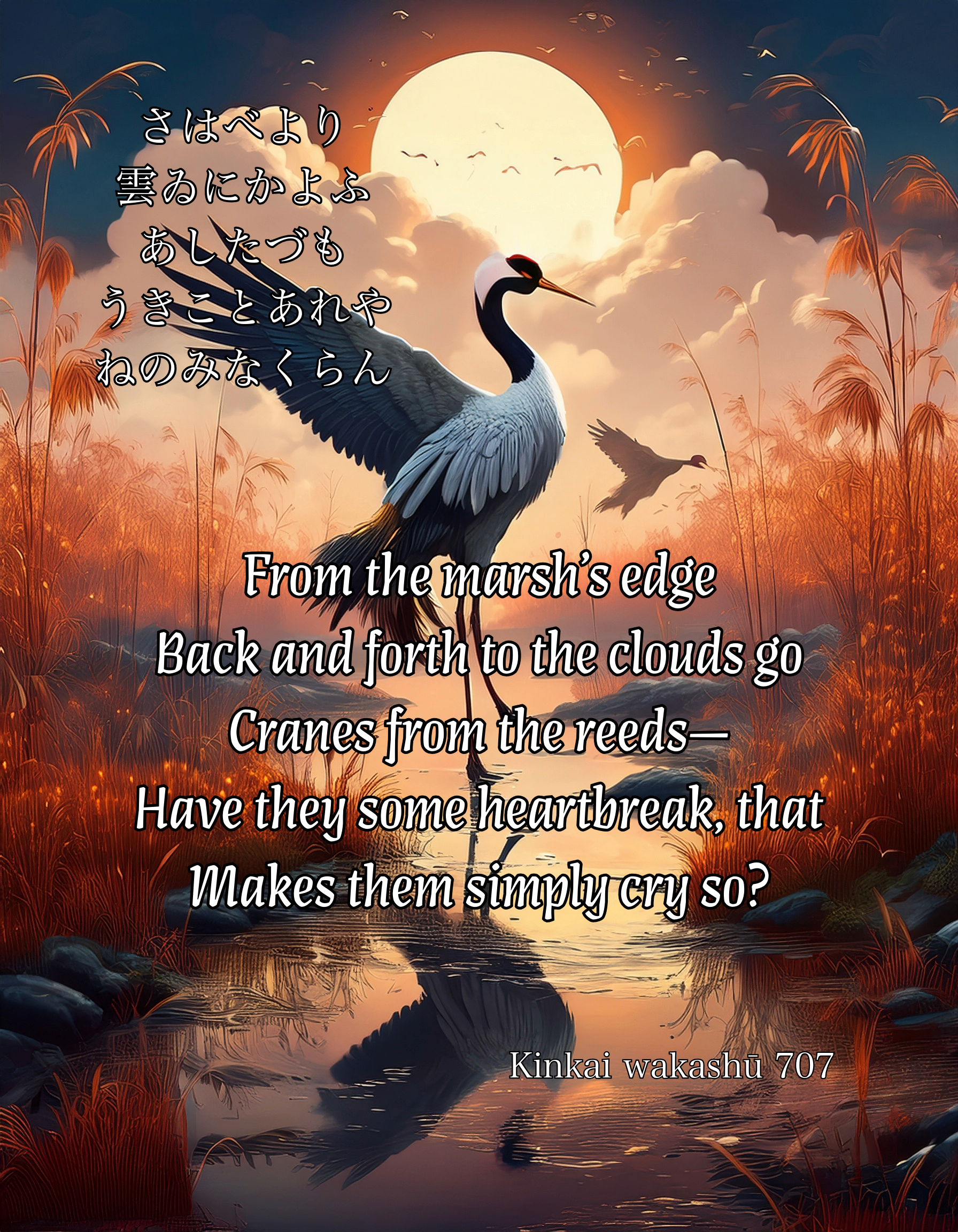
Kinkai wakashū 707

Cranes.

さはべより雲ゐにかよふあしたづもうきことあれやねのみなくらん

sawabe yori
kumoi ni kayou
ashitazu mo
uki koto are ya
ne nomi nakuran
From the marsh’s edge
Back and forth to the clouds go
Cranes from the reeds—
Have they some heartbreak, that
Makes them simply cry so?[i]

707


[i] See: Her reply. あしたづのくもゐにかかる心あらば世をへてさはにすまずぞあらまし ashitazu no / kumoi ni kakaru / kokoro araba / yo o hete sawa ni / sumazu zo aramashi ‘If, among the reeds, a crane / Toward the clouds / Had set his heart, then / Passing ages within the marsh, and / Dwelling there he surely would not!’ Princess Isoko (Gosenshū XI: 754)

GSS XI: 753

Sent to the Princess of the Fourth.[i]

葦たづの沢辺に年はへぬれども心は雲のうへにのみこそ

asitadu no
saFabe ni tosi Fa
Fenuredomo
kokoro Fa kumo no
uFe ni nomi koso
Among the reeds, a crane,
By the marsh’s edge years
Have passed, yet,
His heart is for the clouds’
Heights, alone…

The Minister of the Right
753


[i] Princess Isoko (Kinshi) 勤子 (904-938), the fifth daughter of Emperor Daigo 醍醐 (885-930; r. 897-930) (her sobriquet comes from her rank – shihon 四品 (‘Fourth Order’). She was to marry Fujiwara no Morosuke  藤原師輔 (909-960), who writes to her here, in 930, after a secret affair, becoming the first imperial princess to marry a commoner. She is chiefly remembered today, however, as the patron of Minamoto no Shitagō 源順 (911-983) who ordered him to produce Japan’s first dictionary, Wamyō ruijushō 和名類聚抄 (931-938).

San’i minamoto no hirotsune ason uta’awase 16

Cranes in a garden (庭上鶴馴)

Left

庭の面に人になれたるあしたづはよはひをきみにゆづるなるべし

niwa no omo ni
hito ni naretaru
ashitazu wa
yowai o kimi ni
yuzurunarubeshi
Upon this garden’s face stands,
Accustomed to folk,
A crane;
His years to my Lord
Will he bestow, no doubt!

A Court Lady
31

Right

千とせふるやどのけしきやしるからん汀のたづのなれにけるかな

chitose furu
yado no keshiki ya
shirukaran
migiwa no tazu no
narenikeru kana
Is it that a thousand years old
This dwelling does appear?
For to the muddy
Water’s edge the cranes
Have become accustomed!

A Court Lady
32