Category Archives: Naidaijin-ke uta’awase gen’ei gan-nen jūgatsu futsuka

Naidaijin-ke uta’awase 17

Round Five

Left (T – Tie; M – Win)

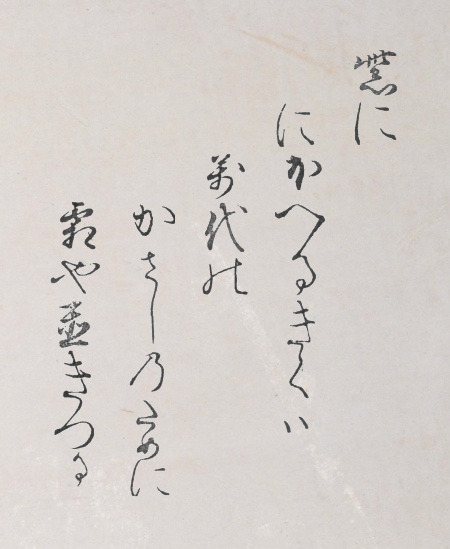
秋はてて霜枯れぬれどきくの花残れる色は深くみえけり

aki hatete
shimogarenuredo
kiku no hana
nokoreru iro wa
fukaku miekeri
With the end of autumn
Burned by frost they are, yet
The chrysanthemum blooms’
Lingering hues
Appear all the deeper.

Lady Shinano
33

Right

白ぎくも移ひにけりうき人のこころばかりとなにおもひけむ

shiragiku mo
utsuroinikeri
ukibito no
kokoro bakari to
nani omoikemu
This white chrysanthemum, too
Has faded; ‘tis simply as
My cruel lady’s
Heart—
I wonder why would I think so?

A Court Lady
34

Toshiyori states: the first poem has ‘With the end of autumn / Burned by frost they are’ and this gives the impression that there is nothing remaining. But saying that autumn has ended, yet one can still see the chrysanthemums, so, in the end, ‘hues appear all the deeper’ means there is a mismatch between the beginning and end of the poem. As for the second poem, it’s a commonplace style of composition to say that you despise someone who has forgotten you, but this is certainly a love poem, and it does not resemble a chrysanthemum one. Nevertheless, there’s nothing particular to point out in this poem and it has some vague parts, so I say this is a tie.

Mototoshi states: the phrase ‘Lingering hues / Appears all the deeper’ doesn’t say what these look like or how they appear. In addition, the poem’s style is not that superlative, and its diction seems halting. With that being said, however, the poem of the Right does not resemble one regretting the chrysanthemums in the slightest. It expresses the feelings of despite between a man and woman who have parted and become distant from each other using the metaphor of the chrysanthemum, and thus the conception of the topic lacks depth, so again the Left has to win.

Naidaijin-ke uta’awase 16

Round Four

Left (M – Tie)

白砂の霜よに置きてみつれども移ふ菊はまがはざりけり

shirotae no
shimo yo ni okite
mitsuredomo
utsurou kiku wa
magawazarikeri
White as mulberry cloth.
Frost has fallen tonight
I see, and yet
The faded chrysanthemums
I can clearly tell apart.

Lord Masakane
31

Right (T – Win)

八重菊の花の袂をあかずとや霜のうはぎを猶かさぬらん

yaegiku no
hana no tamoto o
akazu to ya
shimo no uwagi o
nao kasanuran
Of eightfold chrysanthemum
Bloomed sleeves
I cannot get my fill, but
Is a frosty jacket
Yet laid upon them?

Lord Tadafusa
32

Toshiyori states: the assemble company have stated about the first poem that in the absence of the moon or the stars it would difficult to distinguish chrysanthemums from the frost, and it certainly sounds like this would be the case. In the latter poem, we need to think of who it is that is feeling that they cannot get their fill of bloomed sleeves—the person wearing them should be included, or if the chrysanthemums are, perhaps, the subject, then ‘eightfold chrysanthemum’ is an error. Even so, the style of the poem seems elevated.

Mototoshi states: the poem stating ‘White as mulberry cloth. / Frost has fallen tonight’ is a bit hackneyed, and it then continues ‘The faded chrysanthemums / I can clearly tell apart’—I question whether one would really mistake faded chrysanthemums and frost. As for the Right’s poem, which says ‘Bloomed sleeves / I cannot get my fill’, well, this really is difficult to grasp. I spent quite a bit of time going back and forth agonizing over whether these were a person’s sleeves or those of the chrysanthemum! I feel that the diction in both poems is skillful, but there’s a lack of necessary information, so it’s impossible to decide a winner or loser here.

Naidaijin-ke uta’awase 15

Round Three

Left

万代の秋のかたみになす物はきみがよはひをのぶるしらぎく

yorozuyo no
aki no katami ni
nasu mono wa
kimi ga yowai o
noburu shiragiku
Of ten thousand ages’
Autumns a keepsake
I will make:
My Lord’s age
Extended by a white chrysanthemum!

Lord Akinaka
29

Right

今朝みればさながら霜をいただきて翁さびゆくしら菊の花

kesa mireba
sanagara shimo o
itadakite
okina sabiyuku
shiragiku no hana
When this morn I look
That’s how it is: with frost
Bestowed
A lonesome ancient seems
This white chrysanthemum bloom!

Lord Mototoshi
30

Toshiyori states: this first poem is strongly characterized by felicitation, and that’s about all the fault I can mention. As for the second poem, ‘a lonesome ancient seems’ is certainly an expression I don’t know. Still, if I think of examples from prior poems, ‘lone ancient’ could be interpreted as deriving from ‘dotaged ancient’, but then the conception seems different here, so this is most likely wrong. I can only give a decision once I am certain.

Mototoshi states: ‘Of ten thousand ages’ / Autumns a keepsake / Will make’ resembles Kanemori’s famous work,[1] which has often been alluded to in composition, I think. This poem is charming. ‘Will make’ is an extremely abbreviated expression, and so the final ‘age / Extended by a white chrysanthemum’ appears to have little connection to it. There is Tomonori’ s ‘Dew-dappled / Let us pluck and wear’[2], and also responses sent on the 9th day of the Ninth Month to the residences of Tadamine and Tsurayuki like ‘Bearing droplets / Age is extended by / Chrysanthemums’, aren’t there. Given that’s the case there would be many such keepsakes of extended age. As for the Right’s ‘That’s how it is: with frost / Bestowed / A lonesome ancient seems, well, it seems that just how I composed a poem about lingering chrysanthemums—have I done something wrong?


[1] SIS III: 214

[2] KKS V: 270

Naidaijin-ke uta’awase 14

Round Two

Left

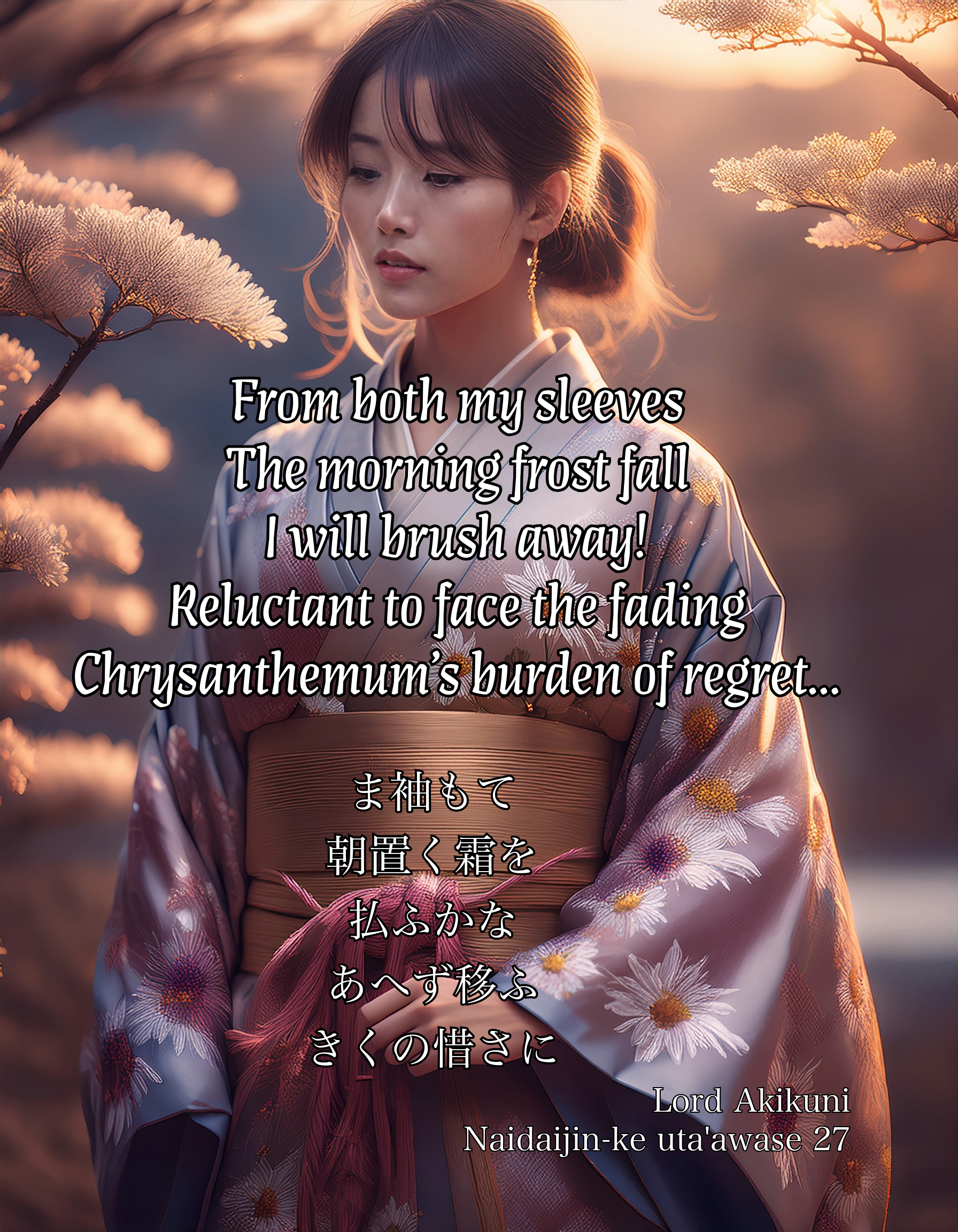
ま袖もて朝置く霜を払ふかなあへず移ふきくの惜さに

masodemote
asa oku shimo o
harau kana
aezu utsurou
kiku no oshisa ni
From both my sleeves
The morning frost fall
I will brush away!
Reluctant to face the fading
Chrysanthemum’s burden of regret…

Lord Akikuni
27

Right (Both Judges – Win)

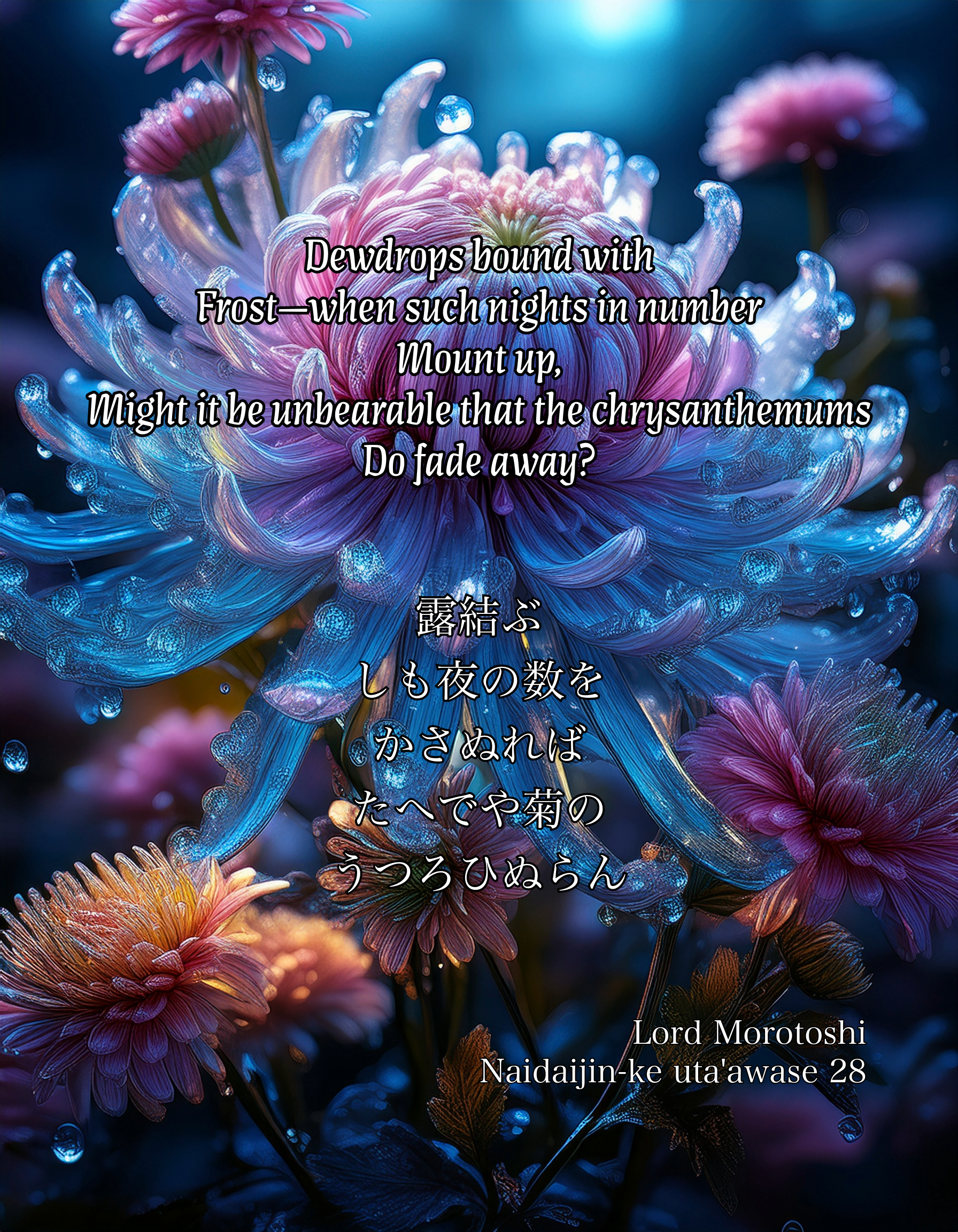
露結ぶしも夜の数をかさぬればたへでや菊のうつろひぬらん

tsuyu musubu
shimo yo no kazu o
kasanureba
taede ya kiku no
utsuroinuran
Dewdrops bound with
Frost—when such nights in number
Mount up,
Might it be unbearable that the chrysanthemums
Do fade away?

Lord Morotoshi
28

Toshiyori states: the first poem is extremely charming. Nevertheless, I must question the use of ‘reluctant to face the fading’ as I feel this is something I have not heard before. I can grasp the sense of diction such as ‘unable to do anything about’ or ‘without taking on autumn hues’, but did the poet mean to use the diction ‘unbearable’, perhaps? Even though this is somewhat archaic phrasing, it is used in composition. This poem’s expressions, though, I feel are somewhat unfamiliar. The conception and diction of the second poem are both extremely charming. However, this poem, too, is vague. What is going on with the initial ‘dewdrops bound’? Does it mean that the dewdrops get turned into frost? If so, then, from what is known of the calendar, this is something which only occurs on a single night, and from the following night there is only frost. It sounds as if the conception of this poem, though, is that night after night dew turns to frost, and this would be a fault. Despite this vagueness, however, its tone is elegant, so it seems superior.

Mototoshi states: the poem of the Left has a poetic configuration, but I strongly feel that it would have been preferable not to use the diction ‘both my sleeves’. It does seem as if this was used in the ancient Collection of a Myriad Leaves, but even given that was the case, in the preface to the Ancient and Modern, I recall it saying, ‘On examining the poems of ancient times, we find they use many archaic expressions. These were there not just to please the ear, but simply for moral instruction’. It appears that there are no instances of this piece of diction being used in poetry matches from the period of the Ancient and Modern, Later Selection and Gleanings, and these were all conducted for entertainment. Even in a poetry match conducted in Engi 12 [912], when the term ‘sleeve’ was used, I get the feeling that it was such a source of amusement that the poem was not recited. While the quality of the Right’s poem is not superb, the tone of ‘Dewdrops bound with  / Frost—when such nights in number’ is not bad, so I feel the dew can still remain bound!

Naidaijin-ke uta’awase 13

Lingering Chrysanthemums

Round One

Left (Both Judges – Win)

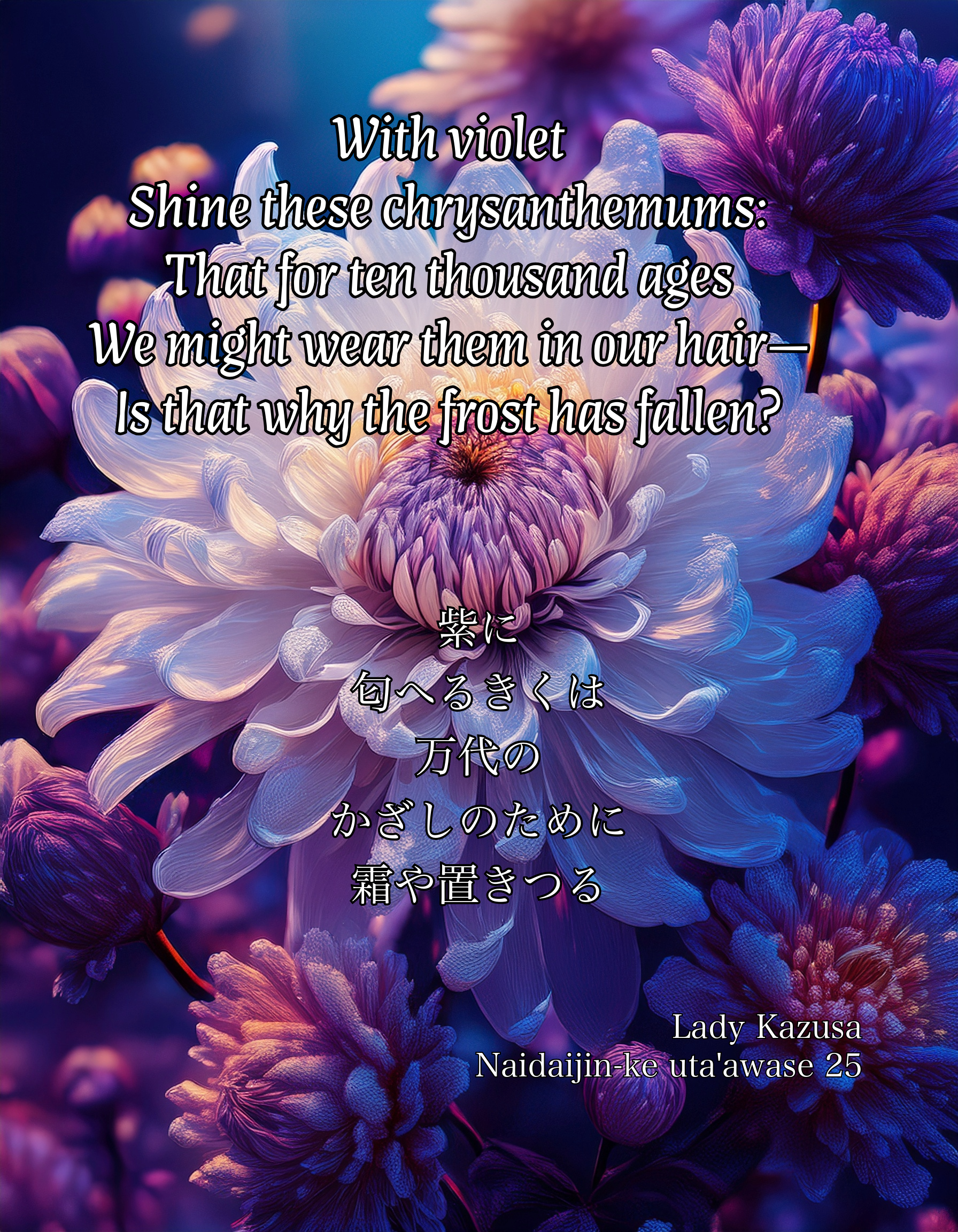
紫に匂へるきくは万代のかざしのために霜や置きつる

murasaki ni
nioeru kiku wa
yorozuyo no
kazashi no tame ni
shimo ya okitsuru
With violet
Shine these chrysanthemums:
That for ten thousand ages
We might wear them in our hair—
Is that why the frost has fallen?

Lady Kazusa
25

Right

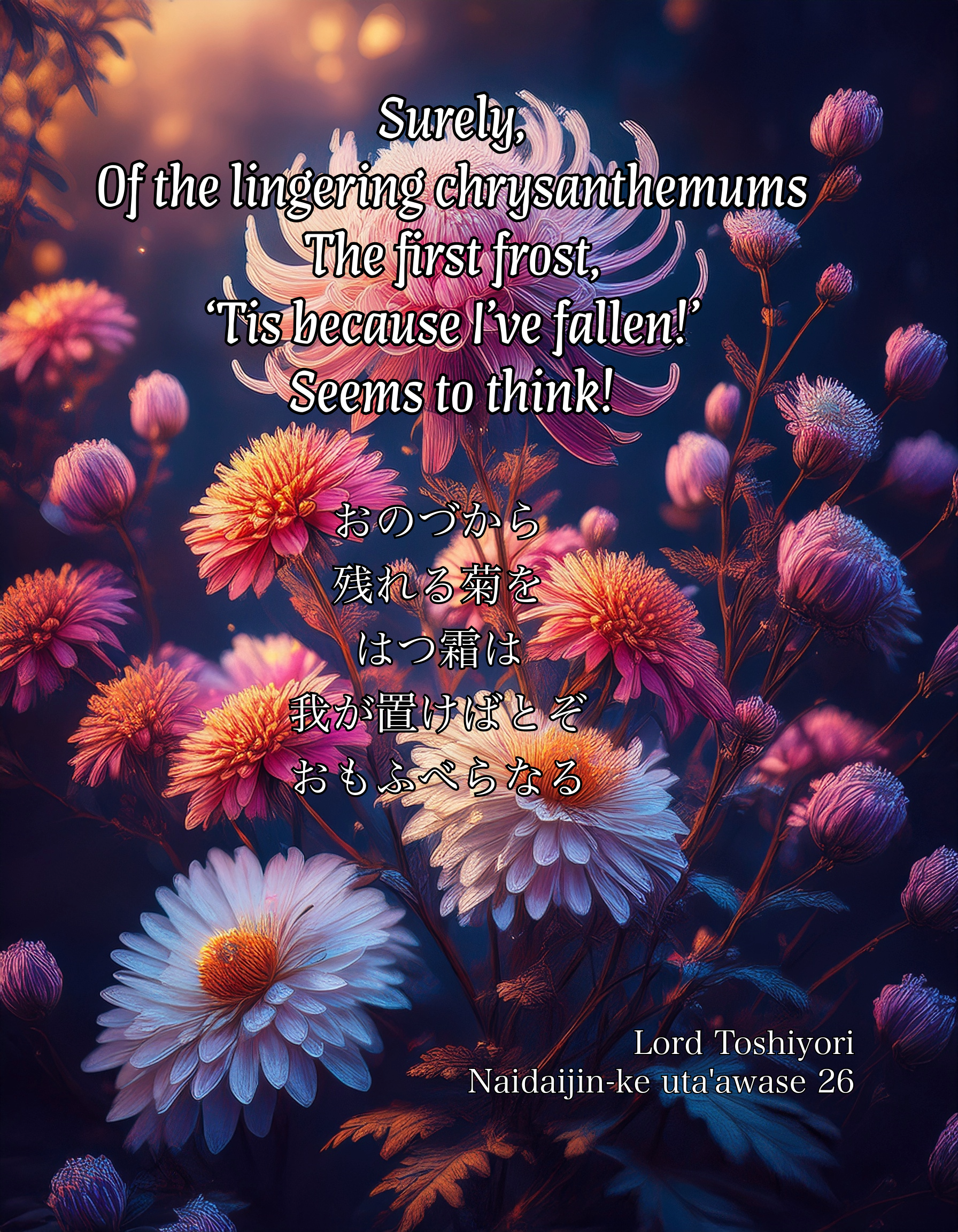
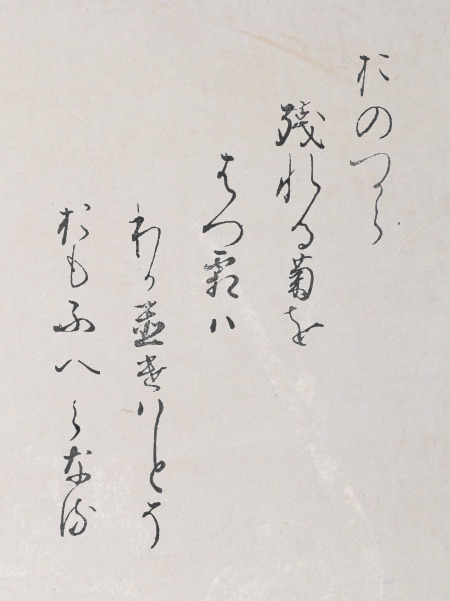
おのづから残れる菊をはつ霜は我が置けばとぞおもふべらなる

onozukara
nokoreru kiku o
hatsushimo wa
wa ga okeba to zo
omouberanaru
Surely,
Of the lingering chrysanthemums
The first frost,
‘Tis because I’ve fallen!’
Seems to think!

Lord Toshiyori
26

Toshiyori states: while the first poem is not remarkable, it does sound smooth. The concluding ‘has fallen’, though—would it be excessive to say that I feel it’s a bit grating? In the second poem, the assembled company have stated that ‘seems to’ is something that they have never heard before in their lives and given that they have said that this is what it sounds like, I make the Left the winner.

Mototoshi states: ‘With violet / Shine these chrysanthemums’ sounds appropriately poetic, but saying ‘that…we might wear them in our hair’ followed by the final ‘has fallen’ is a sequencing that is, in great part, inharmonious and lacking in gentle beauty. Nevertheless, I feel that the second poem’s ‘Surely, / Of the lingering chrysanthemums’ and the final ‘seems to’ is so unfamiliar that it makes me wonder what is going on with the sequencing there, so a single dipping in violet dye is superior and, I feel, all the sweeter!

Naidaijin-ke uta’awase 12

Round Twelve

Left (T – Win)

柞原紅ふかく染めてけり時雨の雨はいろなけれども

hahasowara
kurenai fukaku
sometekeri
shigure no ame wa
iro nakeredomo
The oak groves
Deeply scarlet
Have been dyed,
Though the rain shower
Lacks any hue at all…

Lord Shigemoto
23

Right (M – Win)

山里はならのから葉の散敷きてしぐれの音もはげしかりけり

yamazato wa
nara no karaba no
chirishikite
shigure no oto mo
hageshikarikeri
My mountain retreat has
The oaks’ withered leaves
Scattered and spread around, so
The sound of showers is all
The more severe.

Lord Tamezane
24

Toshiyori states: the ‘oak grove’ poem, saying that plants fade and autumn leaves are dyed by things like dew and frost is as unremarkable as saying that one’s sweetheart’s skirt trails down. The ‘mountain retreat’ poem has ‘the oaks’ withered leaves’ and this is problematic. It would certainly have been better to avoid using ‘withered leaves’. In addition, I wonder about saying ‘the sound of showers is severe’? I feel it would be better to use this when looking down on the stony valley gate from the high peak of Mount Arachi. The first poem is slightly superior.

Mototoshi states; the poems of Left and Right are about the same quality, but the Left’s poem lacks a conception of showers and is entirely a poem on scarlet leaves, so in the current context ‘oaks’ withered leaves’ is slightly superior.

Naidaijin-ke uta’awase 11

Round Eleven

Left

さごろもの袂はせばしかづけども時雨の雨は心してふれ

sagoromo no
tamoto wa sebashi
kazukedomo
shigure no ame wa
kokoroshite fure
My night robe’s
Sleeves are narrow:
I cover myself, yet,
O rain shower,
Fall with care!

Lord Toshitaka
21

Right (Both Judges – Win)

はつ時雨音信しより水ぐきの岡の梢の色をしぞ思ふ

hatsushigure
otozureshi yori
mizuguki no
oka no kozue no
iro o shi zo omou
Since the first shower
Came to call,
Mizuguki
Hill’s treetops’
Hues fill my thoughts…

Lord Tokimasa
22

Toshiyori states: the poem on night robes has ‘Fall with care!’ – is this expressing regret over getting wet? In addition, there’s ‘I cover myself, yet’: it would have been preferable to have this element first. The poem on the ‘first shower’ is not that remarkable, yet it does sound smooth. ‘Hues fill my thoughts’ feels conspicuously old-fashioned, and yet composing using ‘Mizuguki’ seem superior.

Mototoshi states: what on earth is the poet doing saying his ‘night robe’ is ‘narrow’? In the Code of the Shijō Major Counsellor this is indicted to be a bad thing—‘a shallow poem with weighty words’! The poem of the Right has ‘Since the first shower / Came to call’ and I feel that this is how a poem on showers ought to be. Saying ‘Hill’s treetops’ / Hues fill my thoughts’ is a bit trite, but still charming, so this is superior, isn’t it.

Naidaijin-ke uta’awase 10

Round Ten

Left (T – Tie)

波よする蜑の苫やのひまをあらみもるにてぞしるよはのしぐれは

nami yosuru
ama no tomaya no
hima o arami
moru nite zo shiru
yowa no shigure wa
Waves break near
A sedge-thatched hut’s
Crude gaps
The leaks reveal
A midnight shower…

Lord Tadafusa
19

Right (M – Win)

ゆふ月よいるさの山の高根よりはるかにめぐる初しぐれかな

yūzukuyo
irusa no yama no
takane yori
haruka ni meguru
hatsushigure kana
On a moonlit night
From Irusa Mountain’s
High peak
In the distance circles
A first shower!

Lord Kanemasa
20

Toshiyori states: in the first poem, the shower sounds chilly! A shower is not something that one hears after getting up at dawn, yet this poem says that one first gets to know about it from the leaks, it seems that the poet has gone to bed, been leaked on, had his garments soaked and then got up and made a fuss. If he has not been leaked upon is this something he heard from someone else the following day? It really is very unclear. There’s a poem ‘Together with me / On my mountain pilgrimage’ which refers to showers falling on this mountain. The poem here refers to the same peak, so it sounds as if it’s referring to monks going around. Is that what it’s about? I am not just finding fault for the sake of it—these poems are unclear. As there’s only so much that can be understood from hearing them, they should tie.

Mototoshi states: one can compose about a shower falling anywhere and there’s no need to bring up a fisherman’s sedge-thatch hut, is there! Furthermore, one gets to know about a shower from the sound of it falling constantly on something like a roof of cedar boards, surely? Would one really be startled by rain of varying intensity falling soundlessly in spring? As for the poem of the Right, while it does not display a playfulness which would please the eye, ‘In the distance circles / A first shower’ is a bit better in the current context.

Naidaijin-ke uta’awase 09

Round Nine

Left (T – Tie; M – Win)

神無月旅行く人もいづくにかたちかくるべき時雨もる山

kaminazuki
tabi yuku hito mo
izuku ni ka
tachikakurubeki
shigure moru yama
In the Godless Month
For folk gone travelling
Is there anywhere
To hide themselves away,
As the showers drip down on Mount Moru?

Lady Shinano
17

Right

くらぶ山いかがこゆべき神無月木の葉とともにしぐれ降るなり

kurabuyama
ikaga koyubeki
kaminazuki
ko no ha to tomo ni
shigure furu nari
Over gloomy Mount Kurabu
How can I find my way across?
In the Godless Month
Together with the leaves from the trees
A shower is falling…

Lord Nobutada
18

Toshiyori states: in the first poem, I do not feel that travelling is a natural continuation from ‘Godless Month’. ‘Is there anywhere’, too, does not sound smooth, does it. As for the second poem, if one mentions ‘gloomy Mount Kurabu’ and then follows it with ‘How can I find my way across?’, one should give a reason for the expression, whether it be because it’s gloomy, or because the sun is going down, otherwise it’s also unclear why one should be having difficulties crossing the mountain. If one is grieved by the falling leaves, then the poem sounds more like an ‘Scarlet Leaves’ one, and this is unreasonable. These both look to be about the same.

Mototoshi states: ‘showers drip down on Mount Moru’ is a bit better than ‘gloomy Mount Kurabu’, isn’t it. I feel it’s only logical that there should be no shadows in which one could hide oneself away.

Naidaijin-ke uta’awase 08

Round Eight

Left (Both Judges – Tie)

神無月三室の山の紅葉ばも色に出でぬべく降るしぐれかな

kaminazuki
mimuro no yama no
momijaba mo
iro ni idenubeku
furu shigure kana
In the Godless Month
On Mount Mimuro
The autumn leaves
Show no hues at all, despite
The falling showers!

Lord Morikata
15

Right

かみな月時雨れてわたるたびごとに生田の杜をおもひこそやれ

kaminazuki
shigurete wataru
tabi goto ni
ikuta no mori o
omoi koso yare
In the Godless Month
Showers pass by and
Every time
The sacred grove at Ikuta
I do recall.

Lord Tadataka
16

Toshiyori states: ‘Godless Month’ is the name given to a specific month of the year. It’s somewhat unclear why one would use ‘Godless Month’ in conjunction with ‘Mount Mimuro’ – is there a prior poem to evidence this? It’s quite normal for lines which would normally have five syllables to be written with six, or those with seven to have eight, and this can sound fine in some cases. Here, though, it does sound obviously excessive and I do wonder about that. The second poem is plainly based on an earlier work, and is not at all clear, but as it has precedent, these two are about the same.

Mototoshi states: neither of these poems appears bad, so I say they tie.