Category Archives: 1201-1250

Entō ōn’uta’awase 20

Round Twenty

Left (Win)

あけぼのは涙やもろき時鳥なくねにおつる杜の下露

akenbono wa
namida ya moroki
hototogisu
naku ne ni otsuru
mori no shitazuyu
With the dawn
Are you swiftly to tears moved
By the cuckoo’s
Calling cries, falling from
The forest drip dewdrops?

Dōchin
39

Right

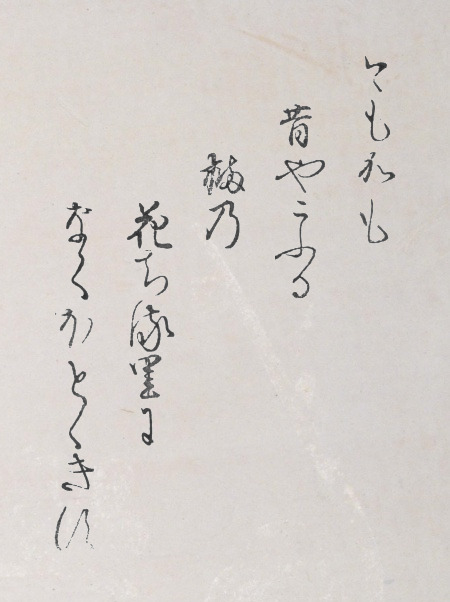
今もかも昔やこふる橘の花ちる里になく郭公

ima mo kamo
mukashi ya kouru
tachibana no
hana chiru sato ni
naku hototogisu
I wonder, is she now,
As in days gone by, beloved
Where orange
Blossom falls on the estate—
The calling cuckoo?[1]

Dharma Master Nyokan
40

Both Left and Right are of the same quality, yet I wonder about the sound of the Right poem’s final section, so the Left wins.


[1] An allusive variation on: A poem by the Governor-General of Dazai, Lord Ōtomo. 橘の花散る里の霍公鳥片恋しつつ鳴く日しぞ多き tachibana no / hana chiru sato no / hototogisu / kata koishitsutsu / naku hi shi zo ōki ‘Orange / Blossom scatters round my estate where / The cuckoo / For unrequited love / Does cry on many a day…’ Ōtomo no Tabito (MYS VIII: 1473)

Entō ōn’uta’awase 19

Round Nineteen

Left (Tie)

なれをしぞあはれとはおもふ時鳥あかず過ぎても歳のへぬれば

nare o shizo
aware to wa omou
hototogisu
akazu sugite mo
toshi no henureba
You, indeed, do
Deeply move me
O, cuckoo!
Never sated am I
Through all the passing years…

The Supernumerary Major Counsellor
37

Right

われならで何をうしとか時鳥ことしも雲のよそに鳴くらん

ware narade
nani o ushi to ka
hototogisu
kotoshi mo kumo no
yoso ni nakuran
Not I, but
What is it distresses you so,
O, cuckoo?
That this year, too, from the clouds
Yonder side you seem to sing…

Lord Nobunari
38

Both Left and Right don’t sound bad, so again this is a tie.

Entō ōn’uta’awase 18

Round Eighteen

Left (Tie)

神さぶるなげきの森の時鳥ひくしめなはもなくなくやこし

kamu saburu
nageki no mori no
hototogisu
hiku shimenawa mo
nakunaku ya koshi
In divine
Nageki’s sacred grove
Does the cuckoo to
Where the holy garlands  
Are hung not, come to sing?[1]

The Former Minister of the Centre
35

Right

さとわかずなけや五月の郭公忍びし比は恨みやはせし

sato wakazu
nake ya satsuki no
hototogisu
shinobishi koro wa
urami ya wa seshi
In every hamlet
Sing, O, Fifth Month
Cuckoo!
For when you chirped before,
I did not hate you for it…

Kozaishō
36

The Left’s poem is based on ‘Prayers / Alone I seem to hear at / This shrine, indeed, but / In the end, passion to grief’s / Grove will turn, no doubt…’ and sounds pleasant. The Right’s poem says ‘For when you chirped before, / I did not hate you for it’ and has a graceful style—thus, they tie.


[1] An allusive variation on: Topic unknown. ねぎ事をさのみききけむやしろこそはてはなげきのもりとなるらめnegigoto o / sanomi kikikemu / yashiro koso / hate wa nageki no / mori to narurame ‘Prayers / Alone I seem to hear at / This shrine, indeed, but / In the end, passion to grief’s / Grove will turn, no doubt…’ Sanuki (KKS XIX: 1055)

Entō ōn’uta’awase 17

Round Seventeen

Cuckoos

Left (Tie)

さのみやは心あるべき時鳥ね覚の空に一声もがな

sanomi ya wa
kokoro arubeki
hototogisu
nezame no sora ni
hitogoe mogana
Not much of
The heart can you know,
O, cuckoo, but
On waking from the sky
I would hear a single call.

A Court Lady
33

Right

やはた山むかひの里の郭公しのびしかたの声もかはらず

yawatayama
mukai no sato no
hototogisu
shinobishi kata no
koe mo kawarazu
By Yawata Mountain,
At the estate of Mukai,
A cuckoo,
Fondly remembers someone
With a changeless song!

Lord Ietaka
34

The Left’s poem would seem to fail to reflect the essential meaning of the topic of cuckoos by having it not yet being heard, and thus its overall technique seems dreadful. The Right’s poem also lacks any superlative elements, they must tie.

Entō ōn’uta’awase 16

Round Sixteen

Left

桜さく吉野の山の山風にふもとをこめて花にほふらし

sakura saku
yoshino no yama no
yamakaze ni
fumoto o komete
hana niourashi
Cherries bloom
In the mountains of Yoshino, where
The mountain breezes
Make even the foothills
Aglow with blossom.

Tomoshige
31

Right (Win)

花の色はあまりにけりなつくばねのこのもかのもにかかる白雲

hana no iro wa
amarinikeri na
tsukubane no
kono mo kano mo ni
kakaru shirakumo
The blossoms’ hues
Have overflowed[1]
The peak of Tsukuba—
Near and far, both,
Draped with clouds of white.[2]

Dharma Master Zenshin
32

The Left’s poem has no faults worth mentioning and, furthermore, is not particularly remarkable. The Right’s poem refers to the peak of Tsukuba; while this is generally thought of as a mountain, it is not necessarily limited to mountains and there are, I think, a bunch of instances where it means a place with lots of trees; however, because here it also conveys the conception of mountains, from the use of pleasant poetic technique, the Right should win.


[1] Zenshin is clearly referencing Ono no Komachi’s famous: Topic unknown. 花の色はうつりにけりないたづらにわが身世にふるながめせしまに hana no iro wa / utsurinikeri na / itazura ni / wa ga mi yo ni furu / nagame seshi ma ni ‘The blossoms’ hues / Have already faded away, / While in idle thoughts / My life goes by, / As I watch the long rains fall.’ (KKS II: 113).

[2] An allusive variation on: Eastern poem: a poem from Hitachi. 筑波嶺のこのもかのもに影はあれど君がみかげにます陰はなし tsukuba ne no / kono mo kano mo ni / kage aredo / kimi ga mikage ni / masu kage wa nashi ‘On the peak of Tsukuba / Here and there / Lie shadows, yet / To your shadow, my love (my Lord) / They cannot compare!’ Anonymous (KKS XX: 1095).

Entō ōn’uta’awase 15

Round Fifteen

Left (Win)

山たかみみだれてにほふ花桜人もすさめぬ春やへぬらん

yama takami
midarete niou
hanazakura
hito mo susamenu
haru ya henuran
In these mountain heights
The riotous glow of
Blooming cherries:
Is there no one to sing their praises
As spring passes by?[1]

Chikanari
29

Right

行末の山のかひより昨日みし雲もさながら桜なりけり

yukusue no
yama no kai yori
kinō mishi
kumo mo sanagara
sakura narikeri
On my way
Through mountain passes
Yesterday I saw
Clouds of white—all were
Cherries![2]

Ie’kiyo
30

The Right’s poem, having ‘mountain passes yesterday I saw’ sounds like it conveys the conception of Tsurayuki’s poem well, but isn’t it a bit pointless to end up with something that sounds like a Travel poem? The Left’s poem has the fine conception of the old poem which goes ‘In these mountain heights / There is no one to sing the praises of / You cherry blossoms’, so thus it must win.


[1] An allusive variation on: Topic unknown. 山たかみ人もすさめぬさくら花いたくなわびそ我みはやさむ yama takami / hito mo susamenu / sakurabana / itaku na wabi so / ware mihayasamu ‘In these mountain heights / There is no one to sing the praises of / You cherry blossoms. / Do not be aggrieved / For I will do it.’ Anonymous (KKS I: 50).

[2] An allusive variation on: When he was instructed by His Majesty to compose a poem, he composed this and presented it. 桜花さきにけらしもあしひきの山の峡よりみゆる白雲 sakurabana / sakinikerashi mo / ashihiki no / yama no kai yori / miyuru shirakumo ‘The cherry blossom / Seems to have bloomed, and from / The leg-wearying / Mountain passes / Appears white billowing clouds.’ Tsurayuki (KKS I: 59)

Entō ōn’uta’awase 14

Round Fourteen

Left (Win)

ちりちらず花より外の色ぞなきかさなる山の嶺の春風

chiri chirazu
hana yori hoka no
iro zo naki
kasanaru yama no
mine no harukaze
Scattered, or not,
Other than the blossoms’
Hues are there none
Layered upon the mountain
Peaks by the breeze in springtime.[1]

Shō
27

Right

かづらきやたかまの山はうづもれて空に棚引く春のしら雲

kazuragi ya
takama no yama wa
uzumorete
sora ni tanabiku
haru no shirakumo
In Kazuragi
Takama Mountain
Is buried by
Trailing across the skies
Clouds of white in springtime.

Nagatsuna
28

The Left’s poem appears fine. The Right’s poem, having ‘Takama Mountain is buried’ is both pretentious and does not link to anything. The Left must win.


[1] An allusive variation on: On a folding screen for the Kamo Virgin, for the place showing people going along a mountain path. ちりちらずきかまほしきをふるさとの花見て帰る人もあはなん chiri chirazu / kikamahoshiki o / furusato no / hana mitekaeru / hito mo awanan ‘Are they scattered, or not, is / What I would ask, but / The ancient estate’s / Blossom having seen and returned— / Those folk I would have you meet.’ Ise (SIS I: 49)

Entō ōn’uta’awase 13

Round Thirteen

Left (Win)

桜花空にあまぎる白雲の棚引きわたるかづらきの山

sakurabana
sora ni amagiru
shirakumo no
tanabikiwataru
kazuragi no yama
The cherry blossoms,
As sky-sweeping
Clouds of white
Drape all across
Kazuragi Mountain.

Takasuke
25

Right

さくらさくながらの山のながき日も昔をこひぬ時のまぞなき

sakura saku
nagara no yama no
nagaki hi mo
mukashi o koinu
toki no ma zo naki
The cherries bloom
Changeless on Nagara Mountain;
The lengthy days to
Those beloved bygone
Moments do not compare.

Shimotsuke
26

Neither Left nor Right has any faults worth mentioning. The Right’s poem appears tranquil, with an artless quality. It has a moving sensibility of longing for the past, but the Left’s poem should just about win, I think.

Entō ōn’uta’awase 12

Round Twelve

Left

うつり行く花の下道跡もなしながめも白き春の山風

utsuriyuku
hana no shita michi
ato mo nashi
nagame mo shiroki
haru no yamakaze
The shifting
Blossom on the paths beneath
Leaves no footprints there;
My gaze with whiteness filled
By spring’s breezes in the mountains.

Dōchin
23

Right (Win)

身にかへておもふもくるし桜花さかぬみ山に宿もとめてん

mi ni kaete
omou mo kurushi
sakurabana
sakanu miyama ni
yado mo tometen
It should be me instead,
I think, but even that brings pain;
Where cherry blossoms
Fail to bloom, deep within the mountains
Should I make my home.

Dharma Master Nyokan
24

The Left’s poem does not sound poor, but has ‘gaze with whiteness’—a long time ago, Lay Priest Toshinari repeatedly said that it is not appropriate to compose about looking at something specific using ‘gaze’. The initial and concluding section of the Right’s poem sound fine—it should win.

Entō ōn’uta’awase 11

Round Eleven

Left

しら雲の朝たつ山のからにしき枝に一むら春風ぞ吹く

shirakumo no
asa tatsu yama no
karanishiki
eda ni hito mura
harukaze zo fuku
Clouds of white
Arising with the morning on the mountain:
Cathay brocade
In a single bunch upon the branch
Blown by the breeze of spring! [1]

Supernumerary Major Counsellor Moto’ie
21

Right (Win)

かづらきや嶺の桜のさきしより心の空にかかるしら雲

kazuragi ya
mine no sakura no
sakishi yori
kokoro no sora ni
kakaru shirakumo
Upon Kazuragi
Peak, the cherries
Have bloomed and ever since
The heavens of my heart are
Draped with clouds of white.

Lord Nobunari
22

The Left’s poem has ‘Arising with the morning on the mountain: Cathay brocade in a single bunch upon the branch’ and, while it mentions spring breezes in its final section and does not fail to reflect the surface appearance of its source poem, conveys a feeling of scarlet leaves without mentioning blossom or cherry, which I have to say is something of a fault. The Right’s poem does not seem poor and lacks any faults worth mentioning, so it should win.


[1] An allusive variation on SIS IV: 220.