Topic unknown.
あまのとをおしあけがたの月みればうき人しもぞこひしかりける
| ama no to o oshi akegata no tsuki mireba ukibito shimo zo koishikarikeru | When against the gates of Heaven Pushing brightening The moon I see, That cruel man, truly, I long for all the more. |
Anonymous
Cogon grass and the Same
Round Fifteen
Left
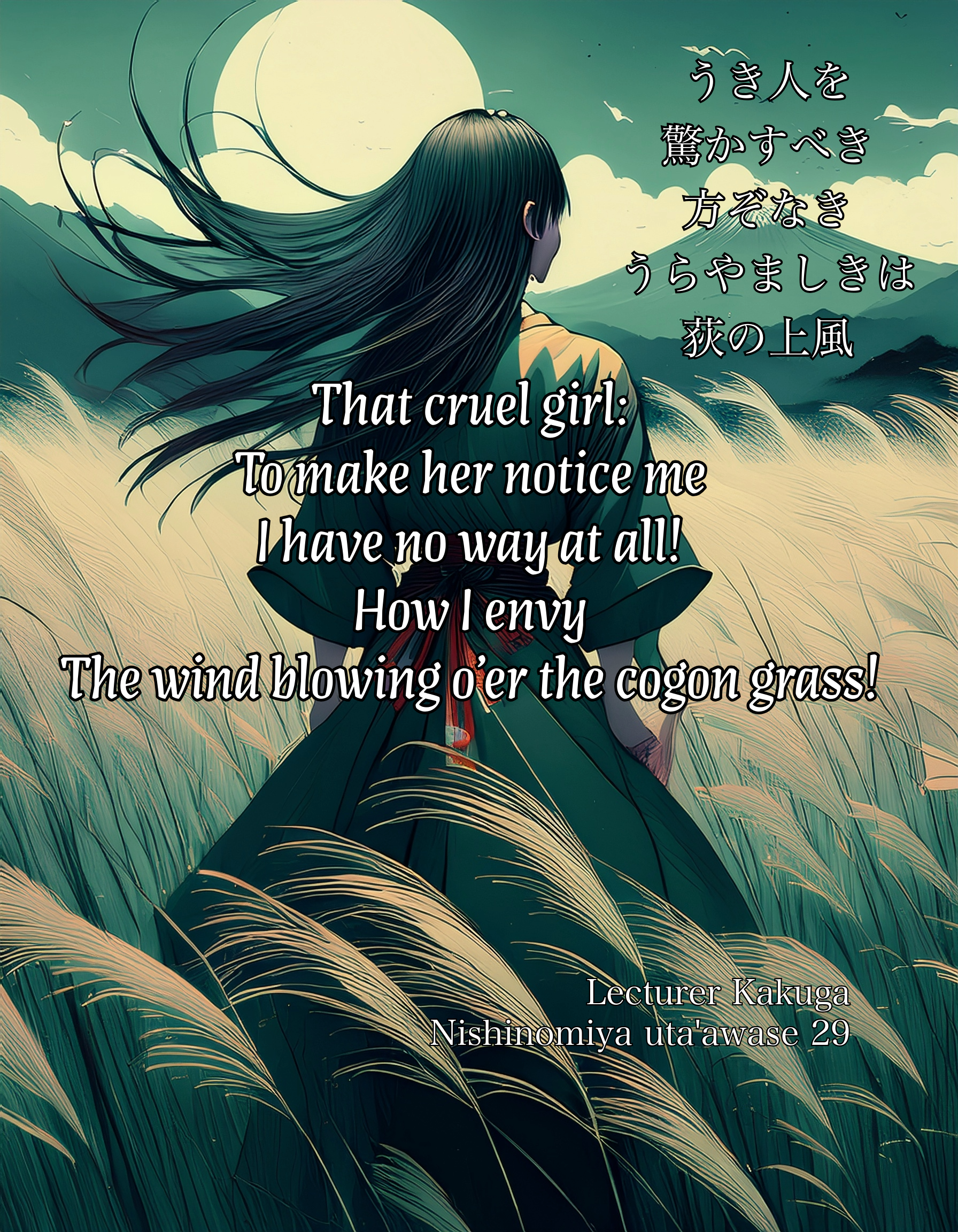
うき人を驚かすべき方ぞなきうらやましきは荻の上風
| ukibito o odorokasubeki kata zo naki urayamashiki wa ogi no uwakaze | That cruel girl: To make her notice me I have no way at all! How I envy The wind blowing o’er the cogon grass! |
Lecturer Kakuga
29
Right
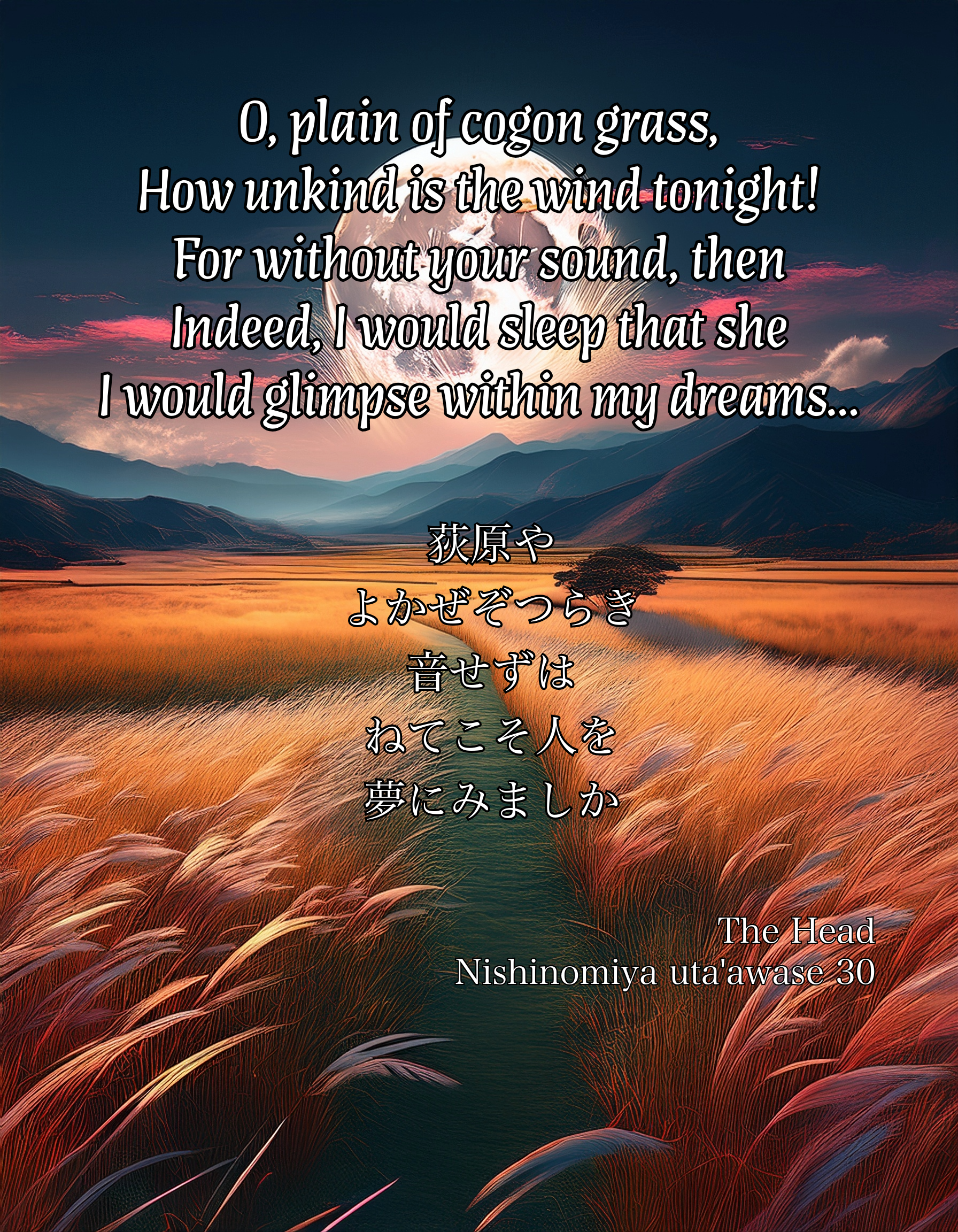
荻原やよかぜぞつらき音せずはねてこそ人を夢にみましか
| ogiwara ya yokaze zo tsuraki oto sezu wa nete koso hito o yume ni mimashika | O, plain of cogon grass, How unkind is the wind tonight! For without your sound, then Indeed, I would sleep that she I would glimpse within my dreams… |
The Head
30
The conception of love sounds superior at present in envying the ‘wind blowing o’er the cogon grass’ than it does in the ‘unkind is the wind tonight’.
Round Twelve
Left
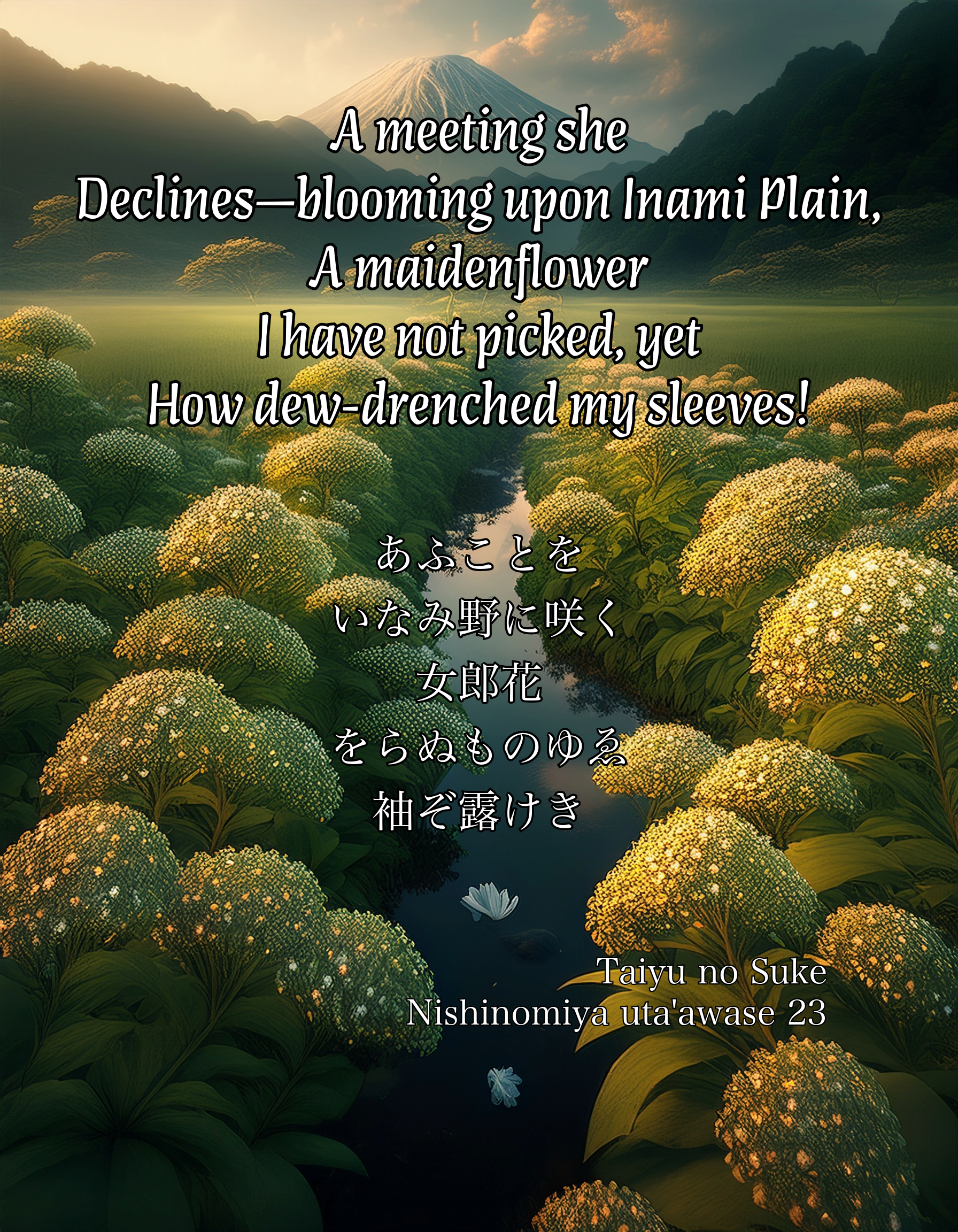
あふことをいなみ野に咲く女郎花をらぬものゆゑ袖ぞ露けき
| au koto o inamino ni saku ominaeshi oranu mono yue sode zo tsuyukeki | A meeting she Declines—blooming upon Inami Plain, A maidenflower I have not picked, yet How dew-drenched my sleeves! |
Taiyu no Suke
23
Right
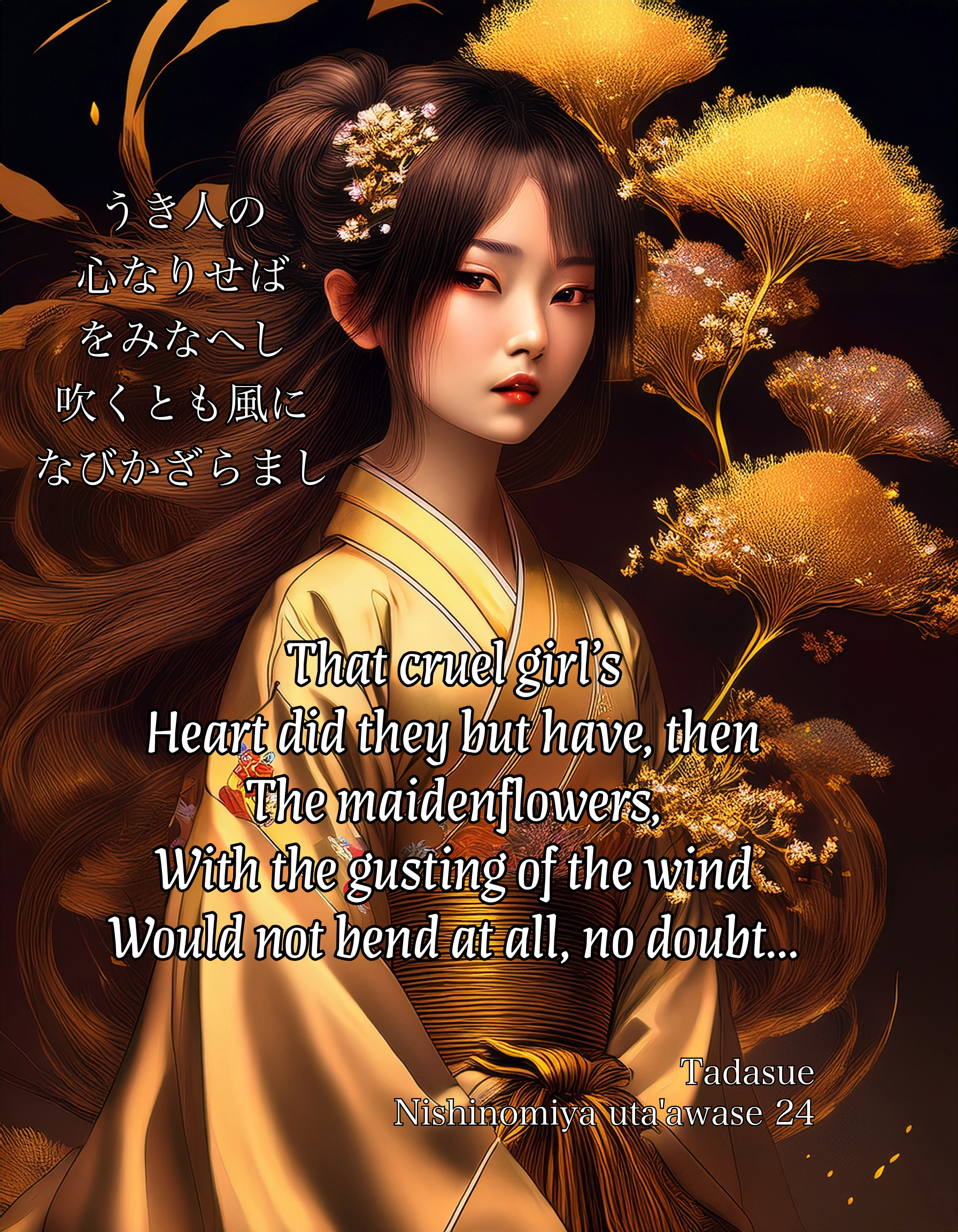
うき人の心なりせばをみなへし吹くとも風になびかざらまし
| ukibito no kokoro nariseba ominaeshi fuku tomo kaze ni nabikazaramashi | That cruel girl’s Heart did they but have, then The maidenflowers, With the gusting of the wind Would not bend at all, no doubt… |
Tadasue
24
‘With the gusting of the wind’ and so forth sounds more in keeping with the topic at present than ‘blooming upon Inami Plain, / A maidenflower’.
Round Ten
Left (T – Tie; M – Win)
憂き人をわすれはてなで忘川なにとて絶えず恋わたるらん
| ukibito o wasurehatenade wasuregawa nani tote taezu koi wataruran | That cruel girl I am unable to ever forget, Even by Wasure—Forgetting—River Why is it that endlessly My love continues on? |
Lord Tadafusa
67
Right
恋すてふこひはこれにて限りてん後にもかかる物をこそおもへ
| koisu chō koi wa kore nite kagiriten nochi ni mo kakaru mono o koso omoe | Love, they say, Of love right here Let’s make an end! But later, still such Painful feelings will I have… |
Lord Munekuni
68
Toshiyori states: the first poem has nothing special about it—poems of this quality are unremarkable. The later poem says, ‘Of love right here / Let’s make an end!’—is it saying that the poet will fall in love with someone else? It’s difficult to say that he’d do that from the following day. It’s vague and doesn’t sound clear. These poems are of the same quality, aren’t they.
Mototoshi states: while neither of these has any faults, the Right’s ‘right here let’s make an end’ seems particularly undesirable. ‘Why is it that endlessly’ is slightly more poetic in the current context, I feel.


Round Five
Left (T – Tie; M – Win)
秋はてて霜枯れぬれどきくの花残れる色は深くみえけり
| aki hatete shimogarenuredo kiku no hana nokoreru iro wa fukaku miekeri | With the end of autumn Burned by frost they are, yet The chrysanthemum blooms’ Lingering hues Appear all the deeper. |
Lady Shinano
33
Right
白ぎくも移ひにけりうき人のこころばかりとなにおもひけむ
| shiragiku mo utsuroinikeri ukibito no kokoro bakari to nani omoikemu | This white chrysanthemum, too Has faded; ‘tis simply as My cruel lady’s Heart— I wonder why would I think so? |
A Court Lady
34
Toshiyori states: the first poem has ‘With the end of autumn / Burned by frost they are’ and this gives the impression that there is nothing remaining. But saying that autumn has ended, yet one can still see the chrysanthemums, so, in the end, ‘hues appear all the deeper’ means there is a mismatch between the beginning and end of the poem. As for the second poem, it’s a commonplace style of composition to say that you despise someone who has forgotten you, but this is certainly a love poem, and it does not resemble a chrysanthemum one. Nevertheless, there’s nothing particular to point out in this poem and it has some vague parts, so I say this is a tie.
Mototoshi states: the phrase ‘Lingering hues / Appears all the deeper’ doesn’t say what these look like or how they appear. In addition, the poem’s style is not that superlative, and its diction seems halting. With that being said, however, the poem of the Right does not resemble one regretting the chrysanthemums in the slightest. It expresses the feelings of despite between a man and woman who have parted and become distant from each other using the metaphor of the chrysanthemum, and thus the conception of the topic lacks depth, so again the Left has to win.


Composed as a love poem, when she presented a hundred poem sequence.
うき人をしのぶべしとは思ひきやわが心さへなどかはるらん
| ukibito wo sinobubesi to Fa omoFiki ya wa ga kokoro saFe nado kaFaruran | Of that heartless man I would secretly be fond, I thought, so why Does my heart, too, Seem to have changed? |
Taikenmon’in Horikawa

Topic unknown.
うき人の月はなにぞのゆかりぞとおもひながらもうちながめつつ
| ukibito no tsuki wa nani zo no yukari zo to omoinagara mo uchinagamitsutsu | That cruel one: Why with the moon does She have a bond?— While wondering that Do I ever gaze upon it… |
The Gotokudaiji Minister of the Left
