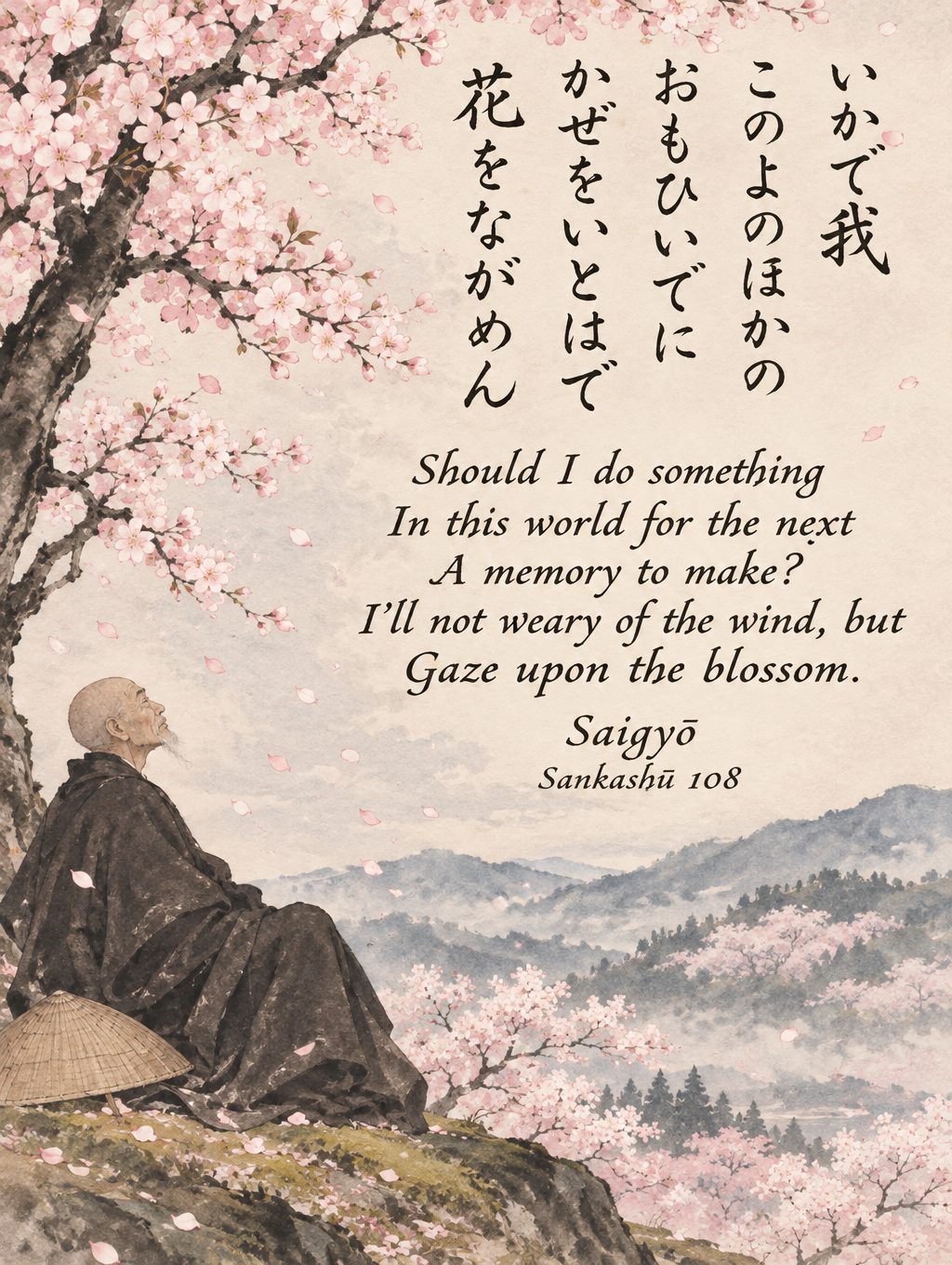
年をへてまつもをしむもやまざくら心を春はつくすなりけり
| toshi o hete matsu mo oshimu mo yamazakura kokoro o haru wa tsukusu narikeri | Through the passing years I have pined for and regretted Endlessly the mountain cherries, so My heart in springtime is Entirely used up. |
109
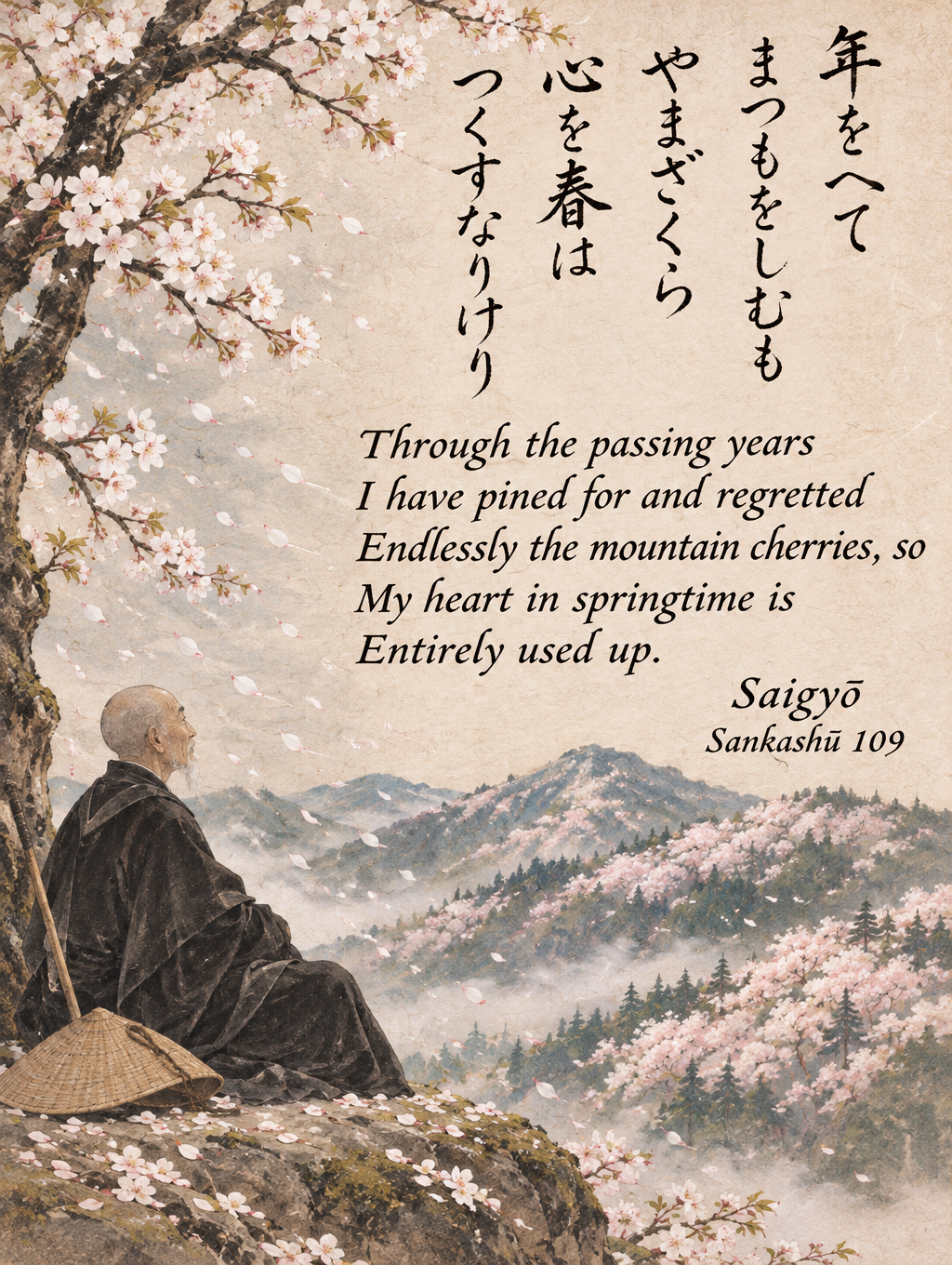
When I composed many poems about falling blossom.
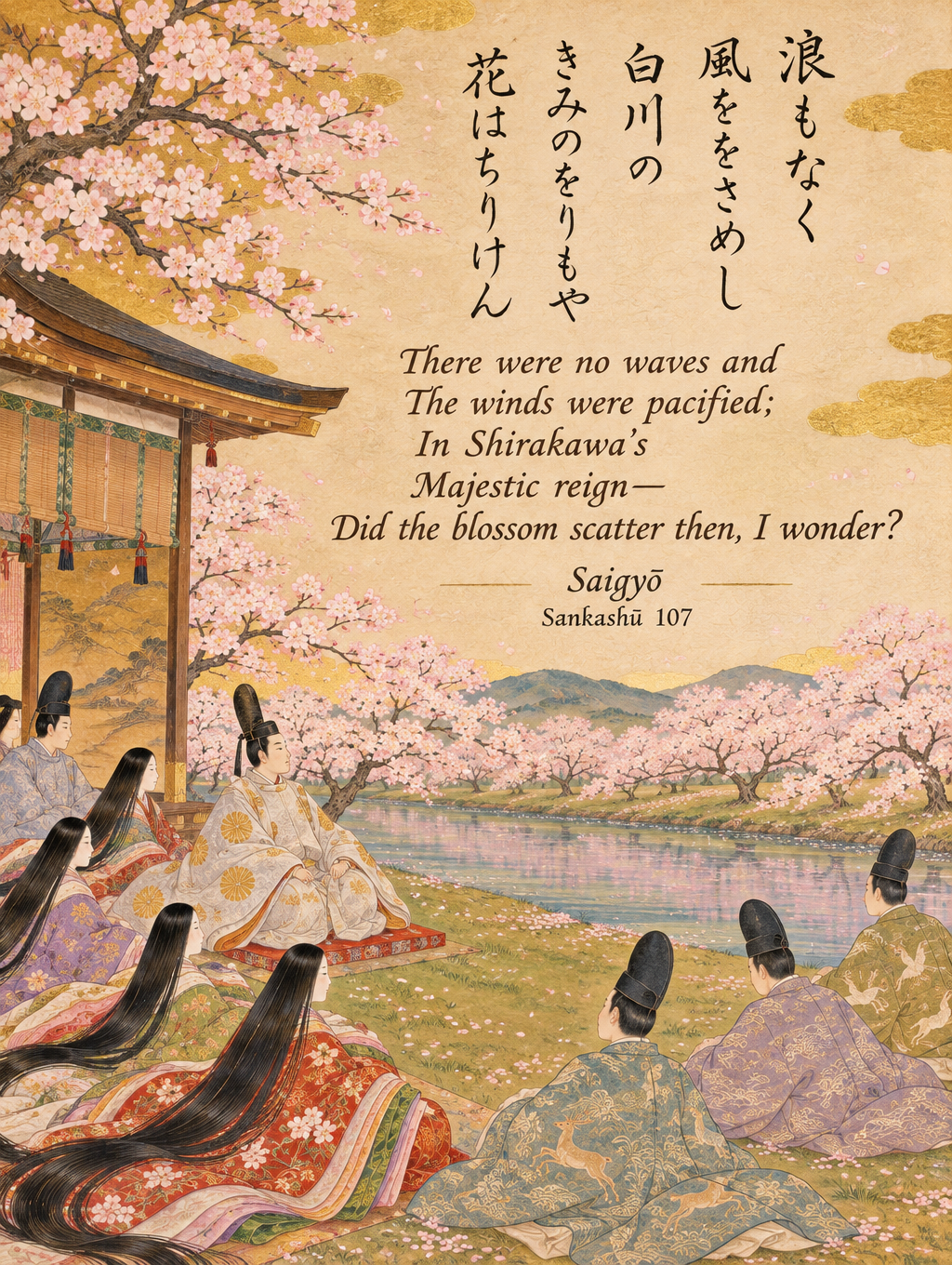
ちよくとかやくだすみかどのいませかしさらばおそれてはなやちらぬと
| choku to ka kudasu mikado no imase kashi saraba osorete hana ya chiranu to | O, that an august command To bestow a sovereign I would there be! Then out of dread The blossom might not scatter…[i] |
106
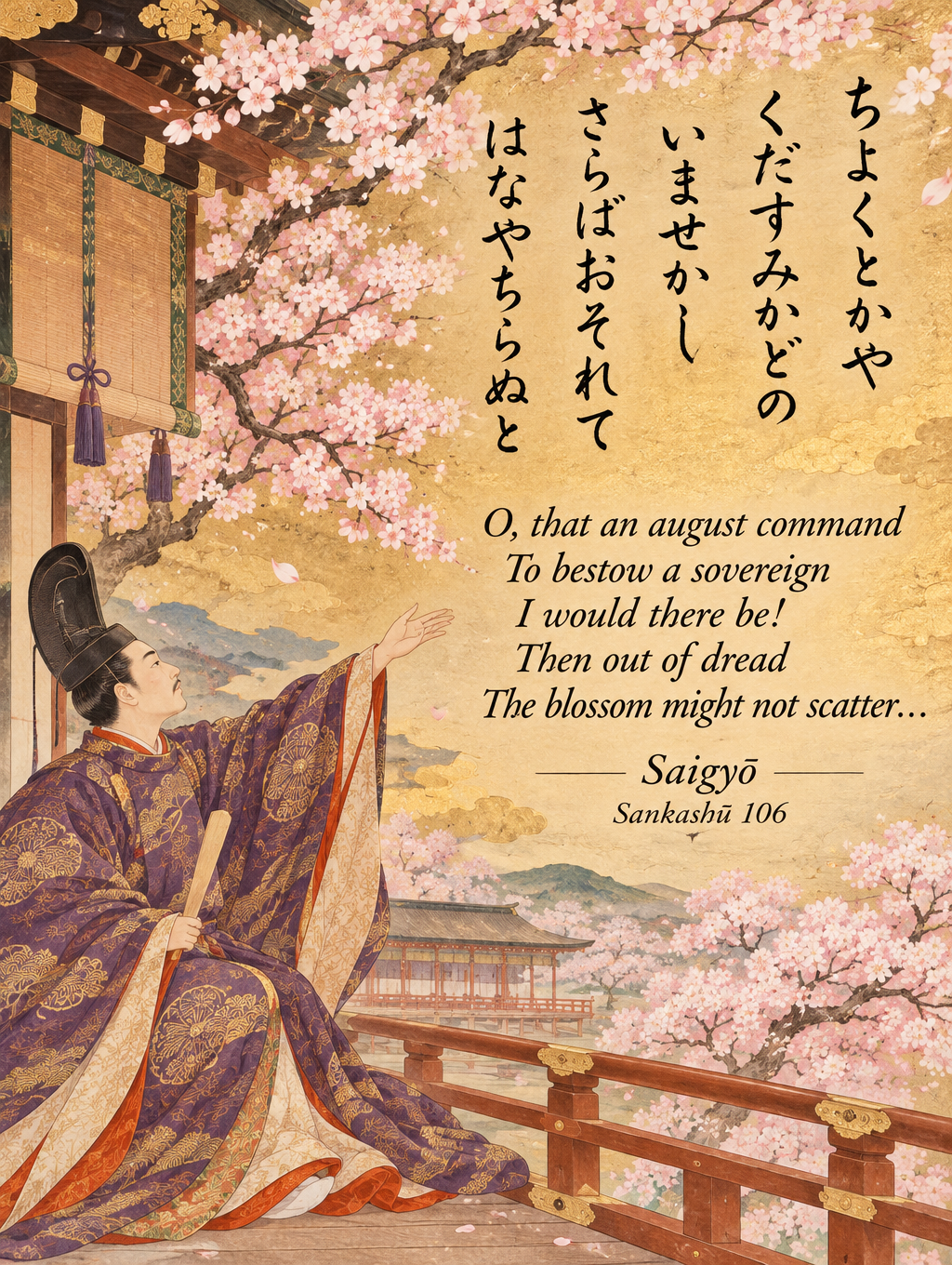
[i] Saigyō’s poem here is thought to be referring obliquely to a tale, contained in Kojidan 古事談 (‘Tales ofAncient Matters’; 1212-15), a collection of tales compiled by Minamoto no Akikane 源顕兼 (1160-1215), that Emperor Shirakawa was once caught in the rain during a Buddhist service and, stating that it was a sin for the rain to fall at such times, had the raindrops collected in a pot and ordered that they be confined there (Gotō 1982, 38).
Around the time I had withdrawn from the world and was living in Higashiyama, I was invited to see the blossom in full bloom in Shirakawa by someone so I went, and when on my way home I was thinking about the past.
ちるをみでかへるこころやさくらばなむかしにかはるしるしなるらん
| chiru o mide kaeru kokoro ya sakurabana mukashi ni kawaru shirushi naruran | Without seeing them scatter I return; that my love for Cherry blossom Has changed since bygone days Is marked by that, perhaps? |
104

To someone looking out from their carriage, having stopped it beneath the blossom when it was raining.
ぬるともとかげをたのみておもひけん人のあとふむけふにも有るかな
| nuru tomo to kage o tanomite omoiken hito no ato fumu kyō ni mo aru kana | ‘I will get wet!’ he said, so On the shade he did rely As I seem to recall; In his footsteps treading Are you today! [i] |
103

[i] See: Topic unknown.
さくらがり雨はふりきぬおなじくはぬるとも花の影にかくれむ
| sakuragari ame wa furikinu onajiku wa nuru tomo hana no kage ni kakuremu | Out hunting cherries and Caught in the rain— What e’er I do I will get wet, so in the blossoms’ Shade let me hide away! |
Anonymous
Shūishū I: 50
Her reply.
いにしへをしのぶるあめとたれかみんはなもそのよのともしなければ
| inishie o shinoburu ame to tare ka min hana mo sono yo no tomo shi nakereba | Times long gone Recollected turn to rain, but Who is it might see? For the blossom, too, their former Friend have not… |
Hyōe
102
‘Her Highness’ other ladies are all young, and an old thing like me would suffer from the wind,[i] so I didn’t go,’ she said—how kind she is!

[i] Hyōe uses the word kaze here which could ambiguously mean kaze 風 (‘wind’) or kaze 風邪 (‘cold’/ ‘fever’), so she is either saying she wanted to avoid the still cool spring breezes, or that she was unwell.
When the court ladies of Her Highness, Jōsaimon’in,[i] went to Hosshōji[ii] to view the blossom, rain began to fall as it got dark so they returned to the palace. The following day, Lady Hyōe[iii] sent to me from her chambers, saying she had been remembering the imperial progress to view the blossom,[iv] and wished me to say something about it, so I sent this to her.
見るひとに花もむかしをおもひいでてこひしかるべしあめにしをるる
| miru hito ni hana mo mukashi o omoi’idete koishikarubeshi ame ni shioruru | The folk a’viewing them and The blossoms, too, bygone days Recall, and Fond thoughts bring on The drenching rain. |
101

[i] Jōsaimon’in 上西門院 was a title awarded to Imperial Princess Muneko (Tōshi) 統子内親王 (1126-1189), the second daughter of Emperor Toba.
[ii] Hosshōshi 法勝寺 was a temple established in Shirakawa by Emperor Shirakawa in 1077. It was famous for its cherry blossoms.
[iii] Hyōe 兵衛 (?-1183/84) was the daughter of the well-known poet, Minamoto no Akinaka 源顕仲 (1058-1138). She first served, along with her sister, Taikenmon’in no Horikawa 待賢門院堀河 (dates unknown), Emperor Toba’s empress, Fujiwara no Tamako (Shōshi) 藤原璋子 (1101-1145), but then entered Muneko’s service after Tamako’s death. Like her sister, she was renowned as a poet, and she and Saigyō were known to have been on friendly terms.
[iv] This was a famous progress by former Emperors Shirakawa and Toba, accompanied by Empress Taikenmon’in (Tamako) to Shirakawa to view the cherry blossom in the Second Month, Hōan 5 [Feb./March 1124].