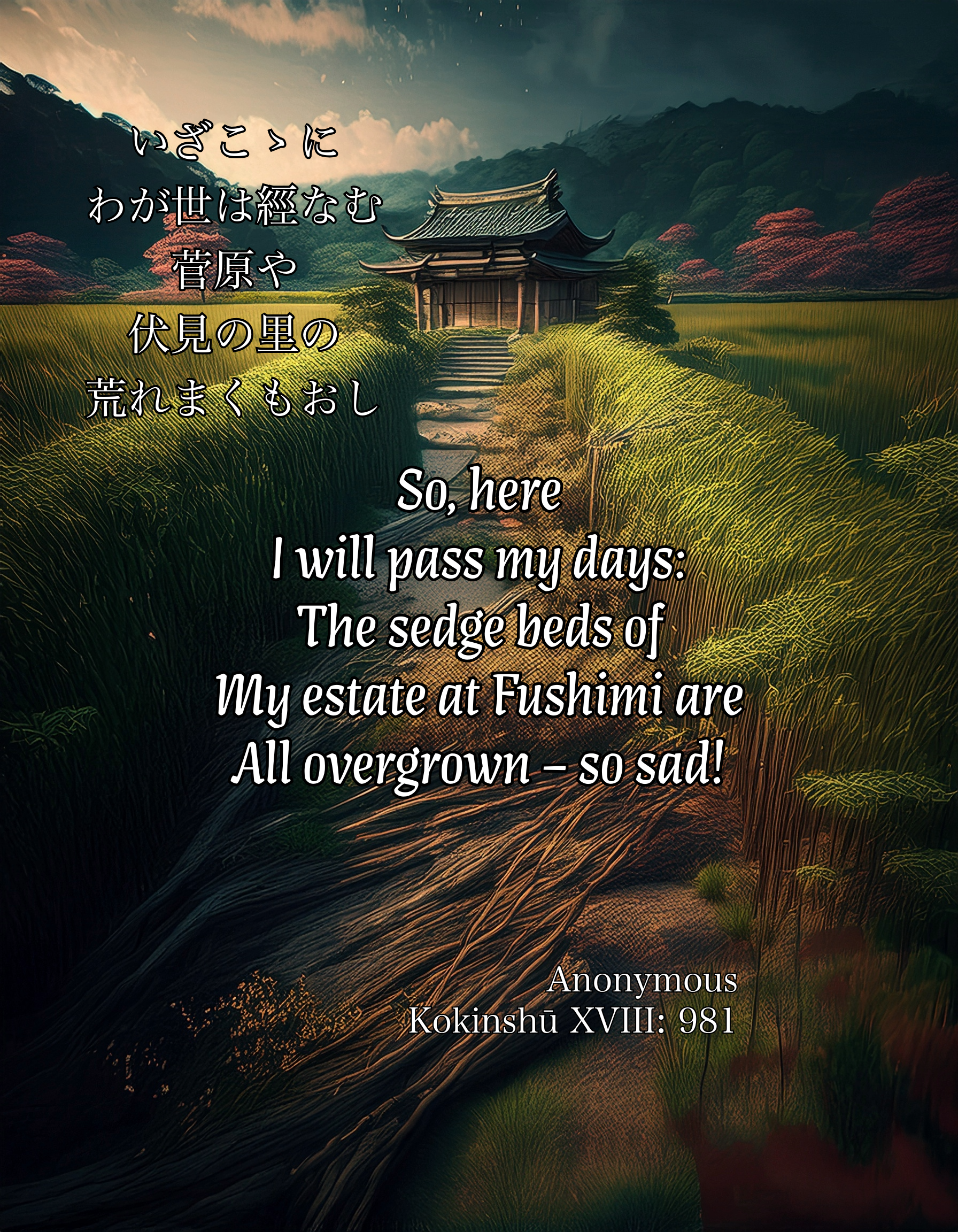
izuku nite yo oba tsukusamu sugawara ya fushimi no sato mo arenu to iu mono o
Where, indeed, Should I live my life? For among the sedge beds The estate of Fushimi Lies in ruins…[i]
690
[i] See: Topic unknown. いざこゝにわが世は經なむ菅原や伏見の里の荒れまくもおし iza koko ni / wa ga yo wa henamu / sugawara ya / fushimi no sato no / aremaku mo oshi ‘So, here / I will pass my days: / The sedge beds of / My estate at Fushimi are / All overgrown – so sad!’ Anonymous (Kokinshū XVIII: 981)
uchikirashi amagiru sora to mishi hodo ni yagate tsumoreru yuki no shirayama
Suddenly concealed By mist, the skies I glimpsed and In a moment drifted Snow covered Shira Mountain with white.
Controller’s Graduate 51
Right
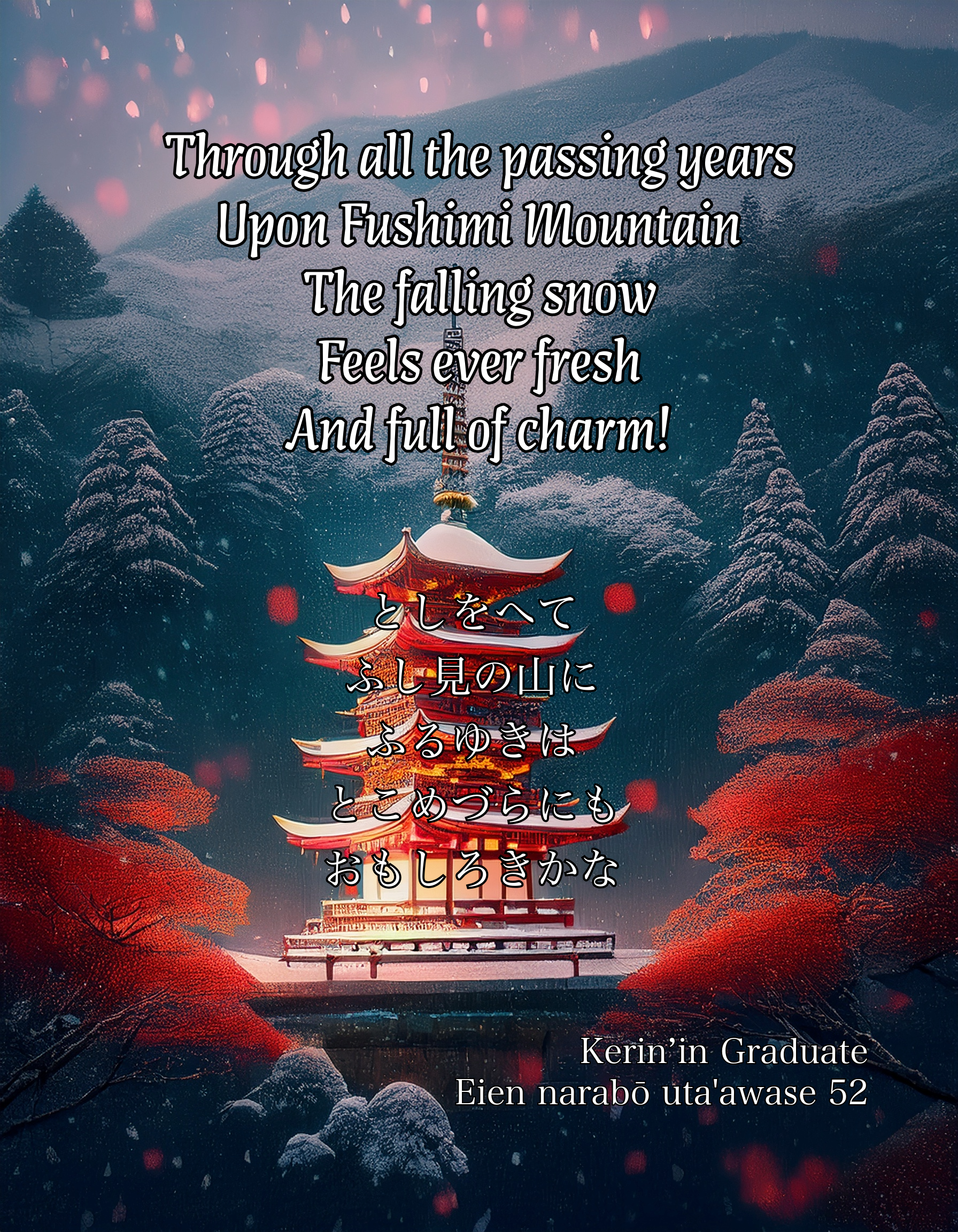
としをへてふし見の山にふるゆきはとこめづらにもおもしろきかな
toshi o hete fushimi no yama ni furu yuki wa tokomezura ni mo omoshiroki kana
Through all the passing years Upon Fushimi Mountain The falling snow Feels ever fresh And full of charm!
Kerin’in Graduate
52
The poem of the Left’s ‘Suddenly concealed / By mist, the skies’ is a clear case of repeating the same meaning. In addition, ‘snow covered Shira Mountain’ is one which is snow-capped regardless of whether it’s summer or winter. It’s not a mountain where one would be startled at seeing it ‘suddenly concealed’. The poem of the Right says that ‘through all the passing years the estate at Fushimi…feels ever fresh’, which seems as if this poem is specifying a period when this applies. It’s certainly a bit of a reach to say that this would be charming, but it’s not incongruous. Thus, I make this a tie.
I am unable to grasp the sense of the Left poem’s ‘suddenly concealed’. If it had been ‘concealed with falling’ then that would be better. In addition, I don’t understand the final ‘snow covered Shira Mountain’ either. I would have preferred it if the order had been ‘Shira Mountain’s snow’, but putting the ‘snow’ first seems to lack fluency and so, regretfully I would change this.
The Right’s ‘Fushimi Mountain’ is difficult to understand. It seems that ‘estate’ is a more standard composition, and ‘mountain’ is a novel usage. Having ‘Fushimi’ ‘feel fresh’ is evidence of thought, but even so, ‘mountain’ is vague.
The Right state, ‘There is no precedent for the addition of “fields” (tai) to “sedge-lined Fushimi” (sugawara ya fushimi). In addition, using ya at the end of both the second and third lines is grating on the ear.’ The Left merely remark, ‘“Fukakusa” is now, perhaps more commonly associated with quail.”
Shunzei’s judgement: ‘In regard to the Right’s poem, although one would really like there to be a precedent, and there are doubtless rice fields in “sedge-lined Fushimi”, I do still feel that “fields” here is a little outre, is it not? While the Left’s “sleeved lit by lonely moonlight” (sode ni tsuki moru) is superlative, I would prefer “quail” to be associated with “Fukakusa”. If snipe call for a place name, it is not Fukakusa, but Yamada, I would think. Both poems are excellent, but with faults, and for this reason the round ties.’
A man, who had been visiting a woman in the house of the Sugawara Minister of the Right [Michizane], broke off their relationship, then wrote to her again; she replied:
sugaFara ya
Fusimi no sato no
aresi yori
kayoFisi Fito no
ato mo taeniki
The Sugawara
Estate of Fushimi
Is all overgrown, and
Of him who used to come here
Every single trace has gone!