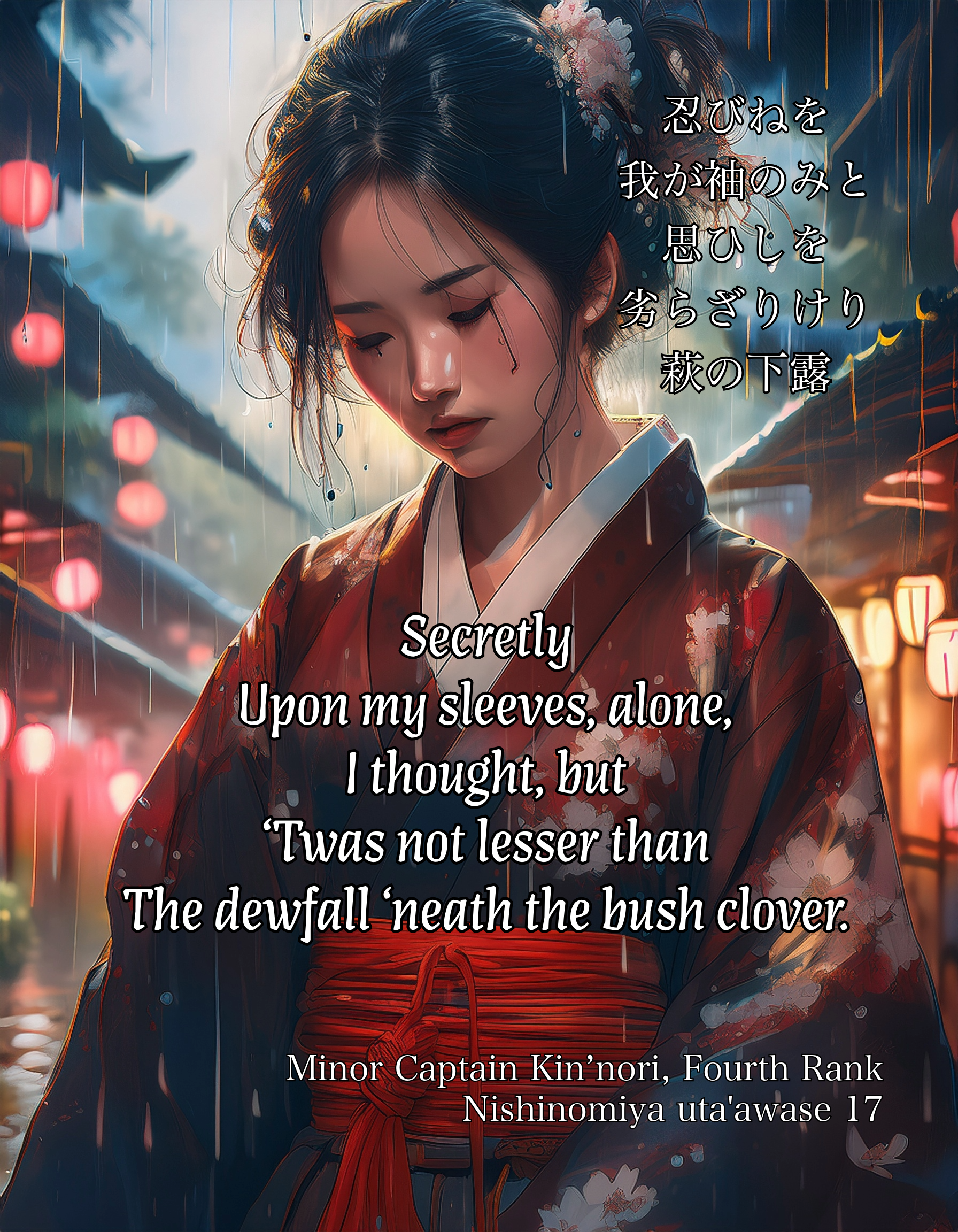
shinobine o wa ga sode nomi to omoishi o otorazarikeri hagi no shitazuyu
Secretly Upon my sleeves, alone, I thought, but ‘Twas not lesser than The dewfall ‘neath the bush clover.
Minor Captain Kin’nori, Fourth Rank 17
Right
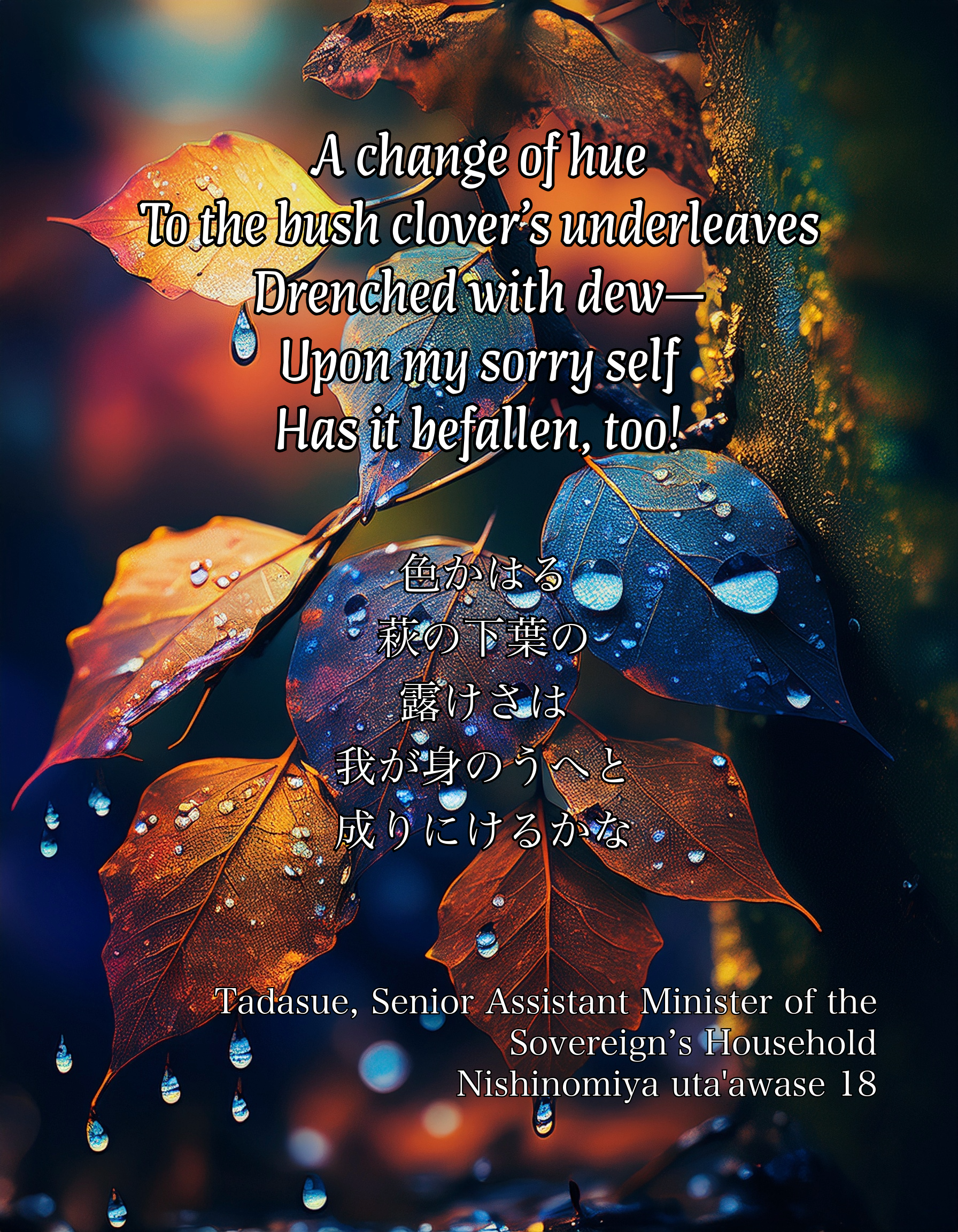
色かはる萩の下葉の露けさは我が身のうへと成りにけるかな
iro kawaru hagi no shitaba no tsuyukesa wa wa ga mi no ue to narinikeru kana
A change of hue To the bush clover’s underleaves Drenched with dew— Upon my sorry self Has it befallen, too!
Tadasue, Senior Assistant Minister of the Sovereign’s Household 18
The image of the droplets of secretly wept upon the poet’s sleeves not being less than those of the dewdrops beneath the bush clover appears extremely charming and moving. In addition, the pain expressed by one’s sorry self being as dew-drenched as the bush clover’s underleaves—this has left my own sleeves, both left and right, seeming as soaked with dewdrops from the bush clover.
kaze samumi yūkage kusa ni kakuroete hataorumushi no koe kikoyu nari
Chill the wind Upon the evening grasses, from Whence, concealed, The crickets’ Cries I hear.
Chikafusa 15
Right
誰がためとあやめも見えぬ夕ざれにはたおる虫の声聞ゆらん
ta ga tame to ayame mo mienu yūzare ni hataorumushi no koe kikoyuran
For whose sake Amidst the gloam Of eventide, might The crickets’ Cries I hear?
Lady Hȳoe 16
At present, ‘Amidst the gloam / Of eventide’ appears to have a bit more conception than ‘the evening grasses, from / Whence, concealed, / The crickets’.
hōriko ga shimeyū nobe no suzumushi wa yū tsukete koso furitatete nake
The priests have Garlanded the meadows where The bell crickets With the fall of evening Sing out so loud.
Major Archbishop 13
Right
神がきのいはねにさせる榊葉にゆふかけてなく鈴虫のこゑ
kamigaki no iwane ni saseru sakakiba ni yū kakete naku suzumushi no koe
Within the sacred precincts At the crags’ foot thrust Are leaves from the sacred tree To the garlands clinging, as crying Come the bell crickets’ songs.
Tadasue, Senior Assistant Minister of the Sovereign’s Household 14
I would say that both of these, Left and Right, are of the same quality in terms of diction and configuration.
kumo kakaru takashi no yama no akegure ni tsuma madowaseru oshika naku nari
All hung about with cloud On Takashi Mountain In the gloaming Having lost his mate A stag bells out.
Nakamasa 11
Right
山がつの先あかつきをしりがほに裾野に出でて鹿ぞ鳴くなる
yamagatsu no mazu akatsuki o shirigao ni susono ni idete shika zo naku naru
A mountain man First of all, that ‘tis dawn Knows plain upon his face, As he sets out upon the slopes As a stag bells out!
Head 12
The Left poem’s conclusion, ‘Having lost his mate / A stag bells out’ seems no different from that of a poem by Gō no Jijū in poetry match held by the First Princess.[1] As for the poem of the Right’s ‘A mountain man / Awaits the dawn / Knowing plain upon his face’—what on earth might a mountain man look like while waiting for dawn? There is the tale of Hangu Pass in Cathay, where the barrier guard was waiting for dawn and opened the gate after hearing a cock’s crow, but the expression ‘a mountain man awaits the dawn’ has never appeared before in a poem—either one of Cathay or in the words of Yamato, so I feel that both Left and Right lack any superlative qualities.
[1] Stags. をぐら山たちどもみえぬゆふぎりにつままどはせるしかぞなくなる ogurayama / tachidomo mienu / yūgiri ni / tsuma madowaseru / shika zo nakunaru ‘On gloomy Ogura Mountain / Stands unseen / Among the evening mists / Having lost his mate / A belling stag.’ (Yūshi naishinnō-ke uta’awase eishō go-nen 27). This event was held at the residence of Imperial Princess Sukeko (Yūshi) on the 5th day of the Sixth Month, Eishō 5 [26.10.1050]. The poem won its round, and was later included in Goshūishū (IV: 292).
akatsuki ni nari ya shinuran ogurayama naku shika no ne ni tsuki katabukinu
Is the dawning On its way, I wonder? On gloomy Mount Ogura Crying, a stag bell out As the moon sets.
Mototoshi, Former Assistant Captain in the Palace Guards, Left Division 9
Right
暁や声高砂になく鹿をほのかにやきく沖の舟人
akatsuki ya koe takasago ni naku shika o honoka ni ya kiku oki no funabito
At the dawning From the heights, the bell, at Takasago Of a stag Is faintly heard, perhaps, By the boatmen on the offing…
Head 10
The Left’s poem lacks any superlative diction, yet does not appear to have any glaring faults either. As for the Right’s poem, I do question the placement of ‘at’ in ‘at the dawning’ and, in addition, the order seems reversed in ‘From the heights, the bell, at Takasago / Of a stag’—so much so that I find it difficult to grasp the sense. If the poem had been composed to put ‘stag’ before ‘heights of Takasago’, the poem would feel more trustworthy, wouldn’t it.
itodoshiku teri koso masare momijiba ni hikage utsurou ama no kagoyama
All the more Brightly do shine The scarlet leaves Reflecting the sunshine On heavenly Mount Kago!
Minor Captain Lord Kin’nori, Fourth Rank 7
Right
天の原時雨にくもるけふしもぞ紅葉の色はてりまさりける
ama no hara shigure ni kumoru kyō shimo zo momiji no iro wa terimasarikeru
The plain of heaven is Clouded with showers, but Today for certain The hues of the scarlet leaves Shine most bright.
The Daughter of His Excellency, the Head 8
Considering the Left’s ‘Reflecting the sunshine / On heavenly Mount Kago’ about scarlet leaves reflecting the sun’s light, gives me the feeling that this must be a mistaken reference to the garlands of scarlet clubmoss worn by minor officiants at the Great Thanksgiving Service. In addition, among all of the many mountains in various places whose leaves turn scarlet, it seems something of a stretch to go so far as to mention Heavenly Mount Kago, considering it is an archaic expression found in the Collection of a Myriad Leaves, among other places. The Right’s ‘Clouded with showers, but / Today for certain’ is an expression perfectly in tune with the topic, making one wonder whether the leaves’ hue is the result of single drenching which has dyed them superbly.
asagiri no hareyuku mama ni momijiba wa akanesashite zo iro masarikeru
As the morning mists Are clearing away The autumn leaves Shine madder red, Their hue the best of all.
Daishin 5
Right
月草の色どる比はかへれどもははそのもみぢこころにぞしむ
tsukikusa no irodoru koro wa kaeredomo hahaso no momiji kokoro ni zo shimu
At times the moon-grass’ Fair hues Will shift, yet those of The oaks in autumn Pierce right to the heart!
His Excellency Akinaka 6
The Left poem’s sequencing isn’t bad, but ‘shining madder red’ has, since ancient times, been used of the sun in poetry, while here it is simply ‘Shine madder red, / Their hue the best of all’. It gives the impression that there is some emotion missing. In a poem for this type of poetry match, I wonder if omitting a single element like this is a grave fault? Even so, I have no recollection of a poem being composed in this manner in any poetry match which people have used for reference from days gone by. In addition, the Right’s ‘At times the moon-grass’ / Fair hues / Will shift, yet’ and what follows shows little evidence of poetic cultivation, so in sum, it’s difficult to say anything here.
hito shirezu harenu nageki no aru mono o amaneku terase aki no yo no tsuki
Unknown to all A grief which never clears I have, so Shine without restraint, O, moon this autumn night!
His Excellency, Nagazane, Former Assistant Governor General of Dazai 3
Right
山の端のうき雲晴れてすみのぼる月と共にもゆくこころかな
yama no ha no ukigumo harete suminoboru tsuki to tomo ni yuku kokoro kana
At the mountains’ edge The drifting clouds unfurl, and Clearly climbing With the moon Goes my spirit!
Lady Hyōenokami 4
In the poem of the Left, the expression following ‘A grief which never clears / I have, so’ is both forceful and lacking in gentility; in addition, the poem of the Right’s ‘drifting clouds clear away’ and what follows seems stagnant, so the light of the moon these nights seems to be of the same standard.
On the 29th day of the Eighth Month, Taiji 3,[i] Head of the Department of Shinto, His Excellency Akinaka gave a lecture before the Hirota Shrine, and various people from among his friends and relative met together in the same place.
Judge Mototoshi, Former Assistant Captain in the Palace Guards, Left Division.
Personal Grievances and the Moon
Round One
Left
難波江のあしまにやどる月みれば我が身ひとつも沈まざりけり
naniwae no ashima ni yadoru tsuki mireba wa ga mi hitotsu mo shizumazarikeri
When, at the inlet at Naniwa Between the reeds a’lodging The moon I see, My sorry self, alone, Is sunk in sadness, am I not?
Lord Akisuke, Former Governor of Mimasaka 1
Right
かがみ川影見る月にそこ澄みて沈むみくづのはづかしきかな
kagamigawa kage miru tsuki ni soko sumite shizumu mikuzu no hazukashiki kana
In the mirror of Kagami River, The shape, I see, of the moon Clear down to the bed of Sunken flotsam— How terrible that I am so!
His Excellency Akinaka, Head of the Department of Shintō 2
While both Left and Right show awareness of the conventions, I find it difficult to be beguiled more by coming to the realisation that ‘My sorry self, alone, / Is sunk in sadness, am I not’ on seeing the moon lodging between the reeds, than I am by the conception of the one who seems to have seen the moon over Mount Obasute[1], so I could say that it has a bit of conception about it at present.
[1] Topic unknown. わが心なぐさめかねつさらしなやをばすて山にてる月を見て wa ga kokoro / nagusamekanetsu / sarashina ya / obasuteyama ni / teru tsuki o mite ‘My heart / Cannot be consoled— / In Sarashina / Above Mount Obasute / On seeing the shining moon…’ Anonymous (KKS XVII: 878)
神祇伯顕仲西宮歌合 Jingi haku akinaka nishinomiya uta’awase (‘Poetry Match held by Director of the Department of Shinto, Akinaka, at the Western Shrine’)
Date
29/8/Daiji 大治 3 [25.9.1128]
Extant Poems
40
Identifiable Participants
Y
Judgements
Y
Topics
Personal Grievances and the Moon (Tsuki ni yosuru jukkai月寄述懐); Scarlet Leaves and Daytime (Momiji ni yosuru hiru 紅葉寄昼); Stags and the Dawn (Shika ni yosuru akatsuki 鹿寄暁); Insect and Evenings (Mushi ni yosuru yūgure 虫寄夕); Love and Bush Clover (Hagi ni yosuru koi 萩寄恋); Love and Maidenflowers (Ominaeshi ni yosuru koi 女郎花寄恋); Love and Silver Grass (Susuki ni yosuru koi 薄寄恋); Love and Cogon Grass (Ogi ni yosuru koi 荻寄恋); Love and Asters (Ran ni yosuru koi 蘭寄恋); Chrysanthemums and Felicitations (Kiku ni yosuru iwai 菊寄祝)
Introduction
As the headnote to the match states, it took place on the 29th day of the Eighth Month, Taiji 大治 3 [25.9.1128] and was organised by Minamoto no Akinaka 源顕仲 (1058-1138) who was at that time Head of the Department of Shintō (jingi haku 神祇伯) among his other appointments. The event was held at the Hirota Shrine (hirota jinja 広田神社) located in the north of what is now Nishinomiya between modern Osaka and Kobe. Nishinomiya literally means ‘Western Shrine’ and this was used as a sobriquet for Hirota Shrine by the residents of the capital as it lay to the west of the city, hence the event’s title of Nishinomiya uta’awase 西宮歌合 (‘Western Shrine Poetry Match’).
This event was the first of three shrine poetry matches organised by Akinaka in relatively quick succession, with the others being the Minami no miya uta’awase 南宮歌合 (‘Southern Shrine Poetry Match’) held in the same year on the 21st day of the Ninth Month [16.10.1128], at Hirota Shrine’s subordinate shrine, Hamanangū 浜南宮 (‘Southern Beach Shrine’), and the Sumiyoshi-sha uta’awase 住吉社歌合 (‘Sumiyoshi Shrine Match’), held a week later on the 28th day of the Ninth Month [23.10.1128]. These three poetry matches largely share the same topics and, to some extent, participants, as well as their organiser, and so can be seen as a unit (Hagitani 1962, 1937).
The choice of Hirota Shrine for the first two of these events was unlikely to be random: Kubota et al. (2018, 365) note that at the time this shrine was under Akinaka’s direct control in his capacity of Head of the Department of Shinto.
These events were not the first ‘shrine poetry matches’ (shatō uta’awase 社頭歌合), as records exist of five earlier such events. The earliest of these is Keta no miya uta’awase 気多宮歌合 (‘Keta Shrine Poetry Match’), held on the 19th day of the Third Month, Enkyū 延久 4 [10.4.1072], which contains only ten poems and no judgements. This is followed by four matches for which no independent text exists, but which are mentioned in Fubokushō: Daijingū negi uta’awase 太神宮禰宜歌合 (‘Poetry Match held by the Priests of Ise Grand Shrine’) (12 poems) and Daijingū negi goban uta’awase 太神宮禰宜後番歌合 (‘Later Poetry Contest held by the Priests of Ise Grand Shrine’) (3 poems) – both of these seem to have been held in the autumn, Eikyū 永久 2 [1114]. These are followed by two identically titled matches, the first of which appears to have been held in the Fifth Month, Eikyū 3 [May 1115] (5 poems), while the second took place in the Tenth Month of the same year [November 1115] (10 poems). None of these matches have judgements or named poets either, making assessment of their organisational principles difficult.
This means that Akinaka’s matches are our first detailed examples of shatō uta’awase and were probably regarded as a model to follow by subsequent sponsors of shrine matches, such as Dōin 道因 (1090-1182?) for the Sumiyoshi-sha uta’awase 住吉社歌合 (‘Sumiyoshi Shrine Match’) (Kaō 嘉応 2 [1170]) and the Hirota-sha uta’awase 広田社歌合 (‘Hirota Shrine Match’) (Jōan 承安 2 [1172]), or Kamo no Shigeyasu 賀茂重保 (1119-1191) for the Wake’ikazuchi-sha uta’awase 別雷社歌合 (‘Wake’ikazuchi Shrine Poetry Match’) (Jishō 治承 2 [1178]) (Hagitani 1962, 1937). It is probably also due to Akinaka’s shrine matches that participation by the organiser’s relations was a characteristic of these later matches, too (Kubota et al. 2018, 365).
Exactly why Akinaka visited the shrine with his ‘friends and relatives’ remains unclear, although Kubota et al. (2018, 308) note that there are a number of other attested examples of visits by senior nobles to shrines accompanied by their blood relatives, so it does not seem that this was unusual. Given that, as noted above, poetry matches had been held at shrines before, the fact that Akinaka chose to mark this visit with an uta’awase is not unprecedented either.
The match’s novelty derives from its choice of topics:
Personal Grievances and the Moon Chrysanthemums and Felicitations
Scarlet Leaves and Daytime Stags and the Dawn Insects and Evenings
Love and Bush Clover Love and Maidenflowers Love and Silver Grass Love and Cogon Grass Love and Asters
As can be seen from the above, all of these are combined topics linking two elements together. The match is begun with a negative emotion (personal grievance) linked with the moon, symbolic of early-to-mid-autumn. It is ended by a positive emotion (felicitation) linked with chrysanthemums (late autumn-early winter). In between come three rounds linking different times of day with different autumn topics, and five topics late seasonal flowers with love. Kubota et al. (2018, 366) note that topics combining a human element with either a seasonal one, or one specific to the timing of the match, were standard choices, while the combination of felicitation with a seasonal element was not unprecedented.
The choice of ‘Personal Grievances and the Moon’, however, must have been a conscious decision on Akinaka’s part to explore new poetic possibilities. The inclusion of ‘personal grievance’ (jukkai 述懐) as a topic was controversial, or perhaps one might want to say courageous. A few years earlier, when Fujiwara no Akinaka 藤原顕仲 (1059-1129) offered the following poem as part of Naidaijin-ke uta’awase 内大臣家歌合 (‘Poetry Match held at the House of the Palace Minister’) held on the 13th day of the Seventh Month, Gen’ei 元永 2 [20.8.1119]:
山の端にいそぎないりそ夕月夜うき身だにこそ世には住みけれ
yama no ha ni isogi na iri so yūzukuyo ukimi dani koso yo ni wa sumikere
Behind the mountains’ edge Don’t hurry to set, O, moon this eve! For my sorry self Within this world must dwell…
Naidaijin-ke uta’awase 25
The judge for this match, Akinaka’s father, Akisue remarked, ‘The Left’s poem has the conception of a personal grievance. I have heard that one does not compose these for poetry matches’ (Hagitani 1962, 1809), so Akinaka would certainly have been aware the disapprobation of this topic. This was to remain a part of uta’awase criticism: participants in Roppyakuban uta’awase 六百番歌合 (‘Poetry Contest in Six Hundred Rounds’; 1193-94) remark negatively about poems which can be read as jukkai in several rounds in the contest. The judge, Fujiwara no Shunzei 藤原俊成 (1114-1204) also provide qualified support for this vew, stating ‘…while it is true that one does not normally compose personal laments for poetry competitions, it is not the case that there are absolutely no examples of this’ (McAuley 2020, 520). Nevertheless, it is likely that Akinaka’s inclusion of jukkai as a topic here was a substantial step in legitimising it as permissible in uta’awase composition.
For reasons which remain unknown, the three matches have an imbalance between the teams of the Left and Right, with more poets in the former than the latter. As can be seen below, not every poet is equally represented, however, so it may simply have been that some poets had more poems available than others.
Poets
Left
Poets
Right
Nishinomiya
Minami no miya
Sumiyoshi
Nishinomiya
Minami no miya
Sumiyoshi
Akinaka
8
7
3
Gyoson
3
4
1
Head’s Daughter
3
3
2
Taiyu no suke
2
3
1
Lady Hyōe
3
3
2
Chikafusa
2
3
1
Tadasue
5
2
Akisuke
2
1
1
Shigemichi
2
2
Nakafusa
1
2
1
Horikawa
1
Masakane
1
2
Echigo
1
In no Daishin
1
1
San no miya Daishin
1
Mototoshi
1
1
Kanemasa
1
Nakamasa
1
1
Kakuga
1
1
Kin’nori
2
Nagazane
2
Tametaka
1
Tamezane
Yukimune
1
Michitsune
1
Sadanobu
1
Unknown
1
Source: Hagitani (1962, 1938-39)
This theory is given further weight by what is known of the matches’ organisation: (Hagitani 1962, 1938) remarks that a note attached to the Minami no miya uta’awase states ‘accordingly people sometimes dreamt “while there could have been varying topics [for this match], take them from prior poems which remain.”’. He interprets this as indicating that these uta’awase were not ones where poems were composed extemporaneously, but instead where ones where the topics were provided in advance and the poets composed a number of poems, the best of which were selected for inclusion in the matches, although they may have been recited when the poets were gathered together at the shrine, or shrines. It may simply have been that the more experienced, or senior, poets produced more and better work, while lesser individuals may have only been able to manage one quality poem.
If the poems were composed prior to the holding of the matches—some possibly considerably before—then this may be a further explanation for the fact that none of them display many features tied to the specific context of the match: there are no uses of utamakura tied to Settsu province where Hirota Shrine was located; nor do the poems pay respect to the shrine and its deity (Kubota et al. 2018, 366). This is in contrast to the poems composed for later shatō uta’awase.
As previously mentioned, Nishinomiya uta’awase and its two subsequent matches are historically significant as the first complete shrine matches of which we have texts, and also for Akinaka’s introduction of jukkai as a topic. In some sense they also mark a passing of the torch in waka circles, from the influence of Minamoto no Toshiyori (1055-1129) to that of the poetic circle focused on Akinaka and his compatriots (Hagitani 1962, 1940). Toshiyori was to die only a few months after these matches were held and had probably already withdrawn from public life due to illness at this point, so while his critical influence remained, Mototoshi was freed from the stress of having to resist his critical opinions directly, which may explain why he does not take a particularly ‘rigorously positivist’ [genkaku na jisshō shugi 厳格な実証主義] (Hagitani 1962, 1941) stance in his judgements in Nishinomiya uta’awase. One further point worth noting, however, is that just as the poets do not produce works tied to the match’s context, Mototoshi does not remark on it in his judgements either (Kubota et al. 2018, 366): that is he does not criticize any of the poems as being unsuited in conception or diction for a ‘shrine match’, unlike, for example, Fujwara no Shunzei in his judgements on the Sumiyoshi-sha uta’awase held in Kaō 2 [1170].