saohime no kasumi no koromo oritekeri asobu itoyū tatenuki ni shite
Princess Sao Of mist a gown Has woven; The threads of haze Make the warp and weft…
Naganori 17
Right
難波がたかすみたな引く春の夜は澳こぐ舟のみえみみえずみ
naniwagata kasumi tanabiku haru no yo wa oki kogu fune no mie mizu mi
At Naniwa Inlet The haze lies o’er all On a night in springtime Boats rowing into the offing Appear and disappear…
Narinaka 18
The Left’s haze, the conception of ‘threads of haze make the warp and weft’, puts me in mind of the line ‘touching the sky, they weave and set adrift their emerald netting of silk’, [1]and mentioning Princess Sao seems skillful; the poem is entrancing and charming. As for the Right, the configuration of saying ‘a boat rowing out into the haze of Naniwa Bay’, too, this entrances me so much that it’s something I would wish to show to folk with some sensitivity. I don’t feel there’s much between these, so, once more the round ties.
[1] The translation here comes from Rimer and Chaves (1997, 33) translation of a Sinitic poem in Wakan rōeishū (I: 22).
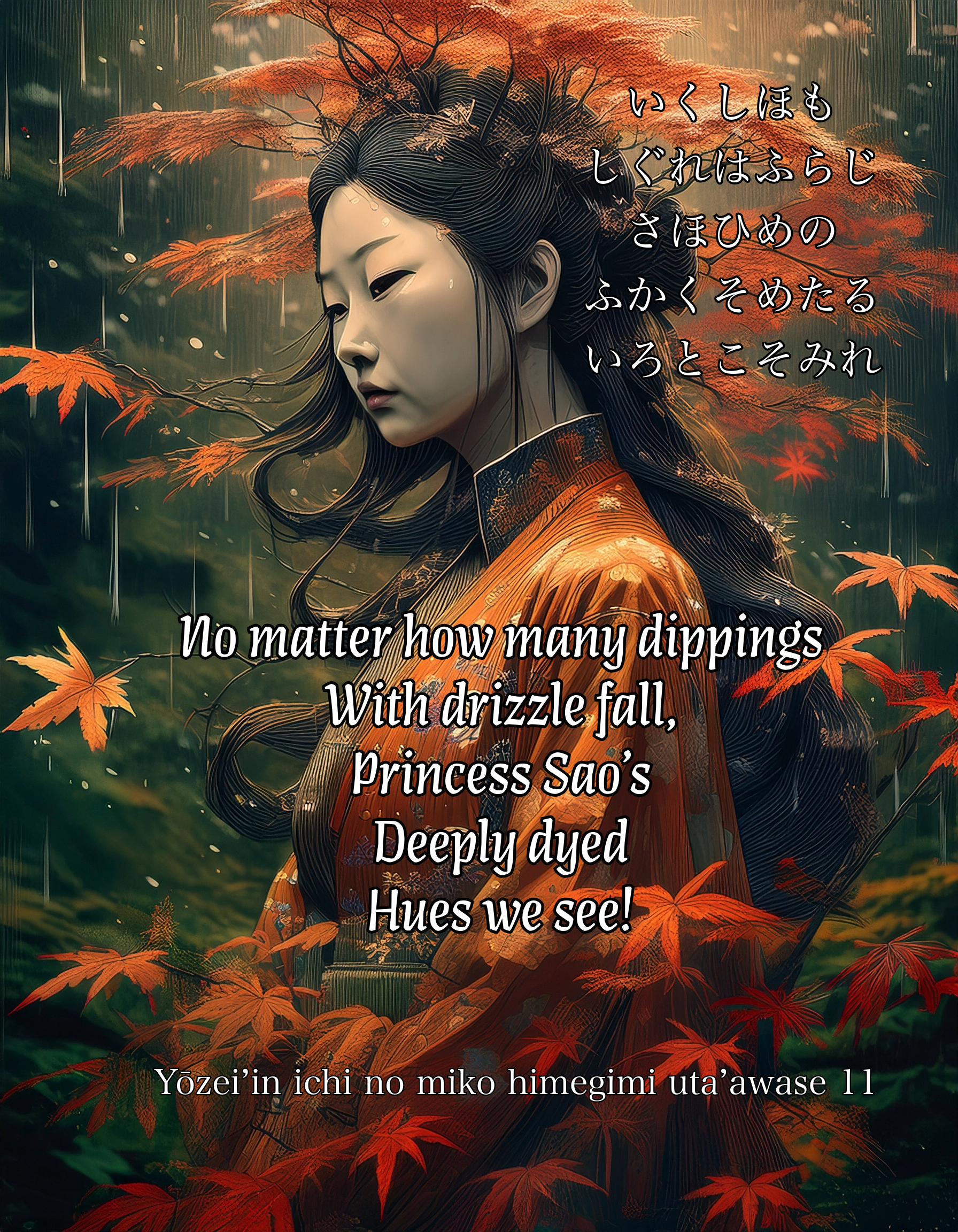
saohime no ito somekakuru aoyagi o fuki na midari so haru no yamakaze
Princess Sao Has dyed the dangling threads of Green willow— O, don’t blow them into tangles, Spring breeze from the mountains!
Kanemori 6
Warblers should have appeared here, but this is a poem about willows, so it loses.
しろたへの雪ふりやまぬ梅がえにいまぞうぐひす花となくなる
shirotae no yuki furiyamanu ume ga e ni ima zo uguisu hana to nakunaru
White as mulberry cloth The snow falls unceasing— Upon the branch of plum, Now, indeed, the warbler, Sings of the blossom!
Kanemori 7
Despite the mistaken composition, His Majesty required the original poem and it was located and recited.
Lord Hiromasa, the Reciter for the Right, mistakenly recited the willow poem. The Left raised an objection, saying, ‘He should have recited the warbler poem but, instead, erroneously recited the willow poem. Should he really be allowed to recite the correct poem now?’ The substance of the Left’s objection was conveyed to His Majesty, who instructed, ‘Provide a report based on prior precedent.’
This minor official advised His Majesty, ‘The Left’s objection is not unreasonable. However, matters such as this are best determined according to the circumstance of the occasion. As this was simply human error, why discriminate against the poem?’
Thus, His Majesty ordered that the poem be recited.
When he did so, Lord Hiromasa turned pale and was unable to recite the poem straight away. Although he finally managed to do so, his voice trembled and the Left laughed at him. Furthermore, the poem’s diction contained the nonsensical expression ‘sings of the blossom’, and thus this was still a loss.
[i] An allusive variation on: A poem from the Empress’ poetry competition held in the Kanpyō period. 花の香を風のたよりにたぐへてぞ鶯さそふしるべにはやる hana no ka o / kaze no tayori ni / taguete zo / uguisu sasou / shirube ni wa yaru ‘The blossoms’ scent / Messaged on the breeze / Brings / An invitation to the warbler / To try and bring him forth!’ Ki no Tomonori (Kokinshū I: 13)
[ii] This poem was included in Gyokuyōshū (I: 42), attributed to Asatada, with the headnote ‘On warblers, from the Palace Poetry Match in Tentoku 4’.