Eien narabō uta’awase 28

Round Seven

Left (Win)

しらゆきのふりしきぬればかづらきやくめのいはばしそことしられず

shirayuki no
furishikinureba
kazuraki ya
kume no iwabashi
soko to shirarezu
Snow, so white
Has fallen, scattering
Upon Kazuraki, that
The broken stone bridge of Kume
Is there no one knows at all.

Lady Kazusa
55

Right

まきもくのあなしひばらもうづもれてかかるみゆきもふればふりけり

makimoku no
anashi hibara no
uzumorete
kakaru miyuki mo
fureba furikeri
In Makimoku
Anashi’s cypress groves
Are buried,
Such a fair fall of snow
Has there been.

Lady Shikibu
56

The Left has neither positives nor negatives. Up to ‘the broken stone bridge of Kume’ shows some imagination. It feels overly remote. The Right’s ‘Anshi’s cypress groves’ is something I’ve not encountered in a poem before. The standard usage is ‘cypress groves of Anashi’. Compared to this, I feel the expression is more unsatisfactory. ‘Such a fair fall of snow / Has there been’ is surprising, too, and not something I’m accustomed to seeing, so the Left seems a bit better at present.

The Left does not appear to have any significant faults. ‘That’ in ‘upon Kazuraki, that’ sounds a bit distant. If you’re talking about a bridge, you should say that you can see across it, shouldn’t you. It is a bridge which it’s impossible to cross, so that’s difficult to say. The Right’s expression ‘Anashi’s cypress groves’ is pedestrian so I would have preferred it omitted. In addition, the final ‘has there been’ feels commonplace. A win for the Left, perhaps.

Eien narabō uta’awase 27

Round Six

Left

ふるゆきに山のほそみちうづもれてまれにとひこし人もかよはず

furu yuki ni
yama no hosomichi
uzumorete
mare ni toikoshi
hito mo kayowazu
With the falling snow
The mountain’s narrow pathways
Are buried;
But rarely did he visit and now
Cannot make his way at all.

Cell of Fragrant Cloud
53

Right

あしたつるみわのひばらにゆきふかみみやぎひくをのかよひぢもなし

ashi tatsuru
miwa no hibara ni
yuki fukami
miyagi hiku o no
kayoiji mo nashi
Reeds stand tall in
Miwa, where the cypress groves
Are deep with snow;
To cut sacred timber, the woodsman
Has no path to tread at all.

Cell of Compassionate Light
54

The Left’s poem, in terms of style and diction, entirely grasps the way someone might feel. What a sense of grief! The Right’s poem is composition that fairly drips and delves into playfulness, but in so doing lacks feeling. Truly, the former poem has superlative qualities, resembling a black dragon’s pearl![i] Thus, the Left must win.

The Left does seem to have been composed but simply stated. It possesses a calm elegance. The Right seems to have been created after a great deal of thought. This poem shows effort and the former such calm that I wish to declare them a tie. This may enrage the poets, but the ignorant may give the appearance of being knowledgeable, as they say. I wonder who composed these…


[i] Riju 驪珠 as an abbreviation of riryū no tama 驪龍の珠 (‘black dragon’s pearl’). Mototoshi uses this analogy deliberately as black dragons were associated with winter. The pearl, which they were often depicted as holding or being located in their throat, was a symbol of the dragon’s spiritual development and a marker of its immortality. This is thus an effusive statement of praise for Shōchō’s poem.

Eien narabō uta’awase 26

Round Five

Left (Tie)

うちきらしあまぎるそらと見しほどにやがてつもれる雪の白山

uchikirashi
amagiru sora to
mishi hodo ni
yagate tsumoreru
yuki no shirayama
Suddenly concealed
By mist, the skies
I glimpsed and
In a moment drifted
Snow covered Shira Mountain with white.

Controller’s Graduate
51

Right

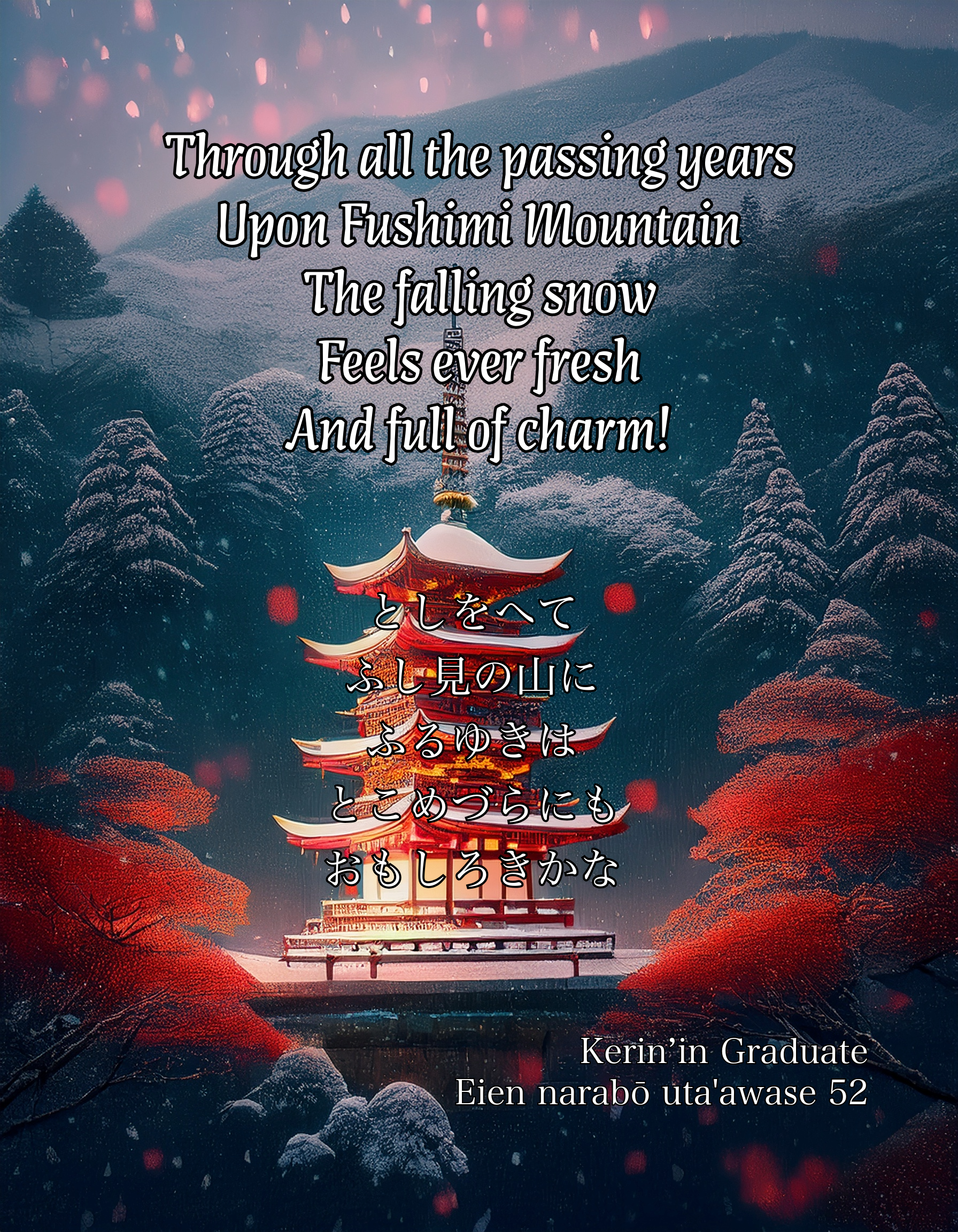
としをへてふし見の山にふるゆきはとこめづらにもおもしろきかな

toshi o hete
fushimi no yama ni
furu yuki wa
tokomezura ni mo
omoshiroki kana
Through all the passing years
Upon Fushimi Mountain
The falling snow
Feels ever fresh
And full of charm!

Kerin’in Graduate

52

The poem of the Left’s ‘Suddenly concealed / By mist, the skies’ is a clear case of repeating the same meaning. In addition, ‘snow covered Shira Mountain’ is one which is snow-capped regardless of whether it’s summer or winter. It’s not a mountain where one would be startled at seeing it ‘suddenly concealed’. The poem of the Right says that ‘through all the passing years the estate at Fushimi…feels ever fresh’, which seems as if this poem is specifying a period when this applies. It’s certainly a bit of a reach to say that this would be charming, but it’s not incongruous. Thus, I make this a tie.

I am unable to grasp the sense of the Left poem’s ‘suddenly concealed’. If it had been ‘concealed with falling’ then that would be better. In addition, I don’t understand the final ‘snow covered Shira Mountain’ either. I would have preferred it if the order had been ‘Shira Mountain’s snow’, but putting the ‘snow’ first seems to lack fluency and so, regretfully I would change this.

The Right’s ‘Fushimi Mountain’ is difficult to understand. It seems that ‘estate’ is a more standard composition, and ‘mountain’ is a novel usage. Having ‘Fushimi’ ‘feel fresh’ is evidence of thought, but even so, ‘mountain’ is vague.