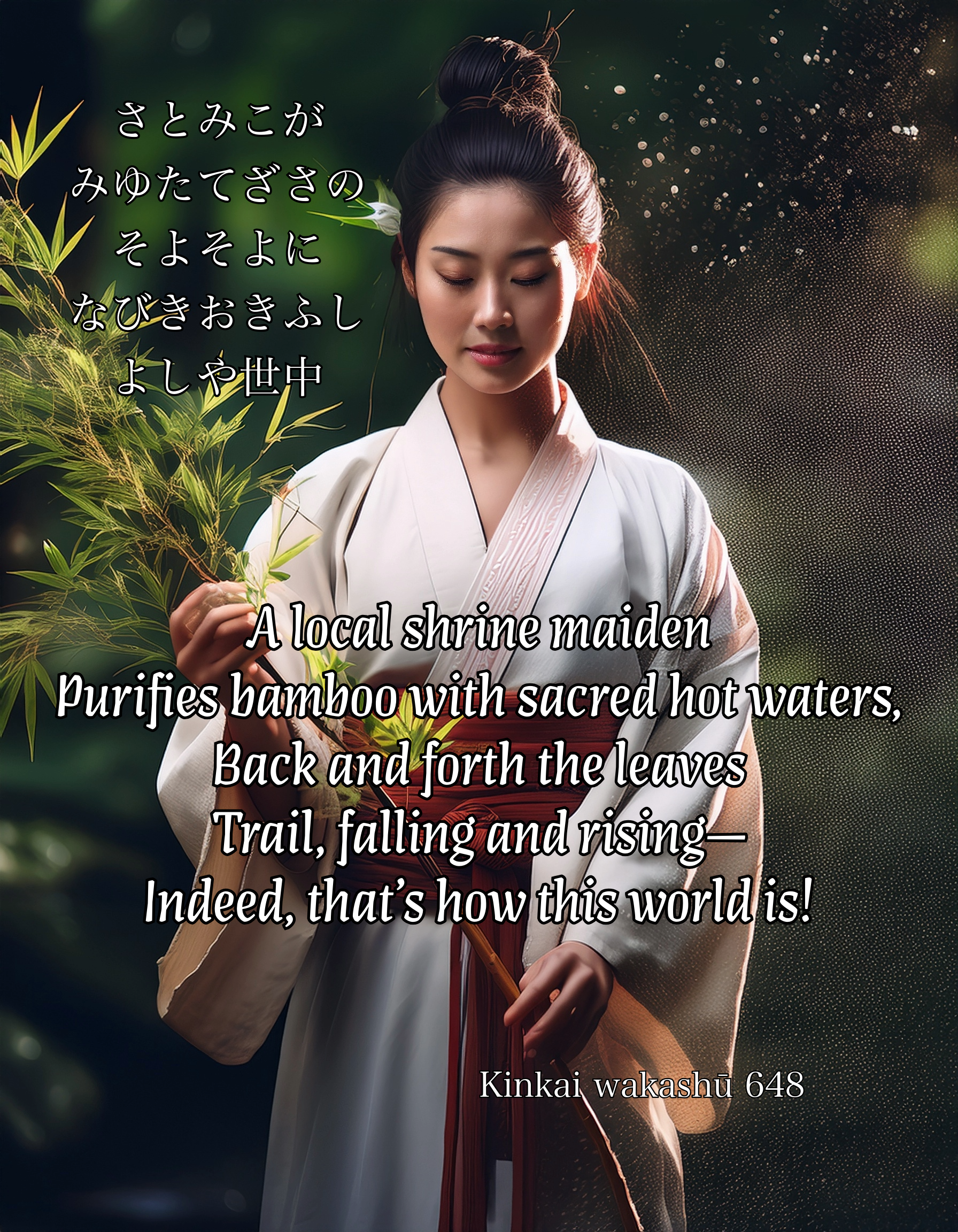
satomiko ga miyu tatezasa no soyosoyo ni nabiki okifushi yoshi ya yo no naka
A local shrine maiden Purifies bamboo with sacred hot waters, Back and forth the leaves Trail, falling and rising— Indeed, that’s how this world is![i]
648
[i] There was a shrine purification ritual whereby a shrine maiden (miko 巫女) would soak a branch of dwarf bamboo (sasa 笹) in water which she had heated, and then shake the water from the leaves, moving the branch up and down, scattering the droplets over both herself and pilgrims to the shrine. Sanetomo’s poem uses a description of this ritual as a preface (jo 序), before pivoting at the end of the fourth stanza to say that everyday life is just a sequence of both getting up and then going back to sleep (lying down) again and again (Higuchi 2016, 148).
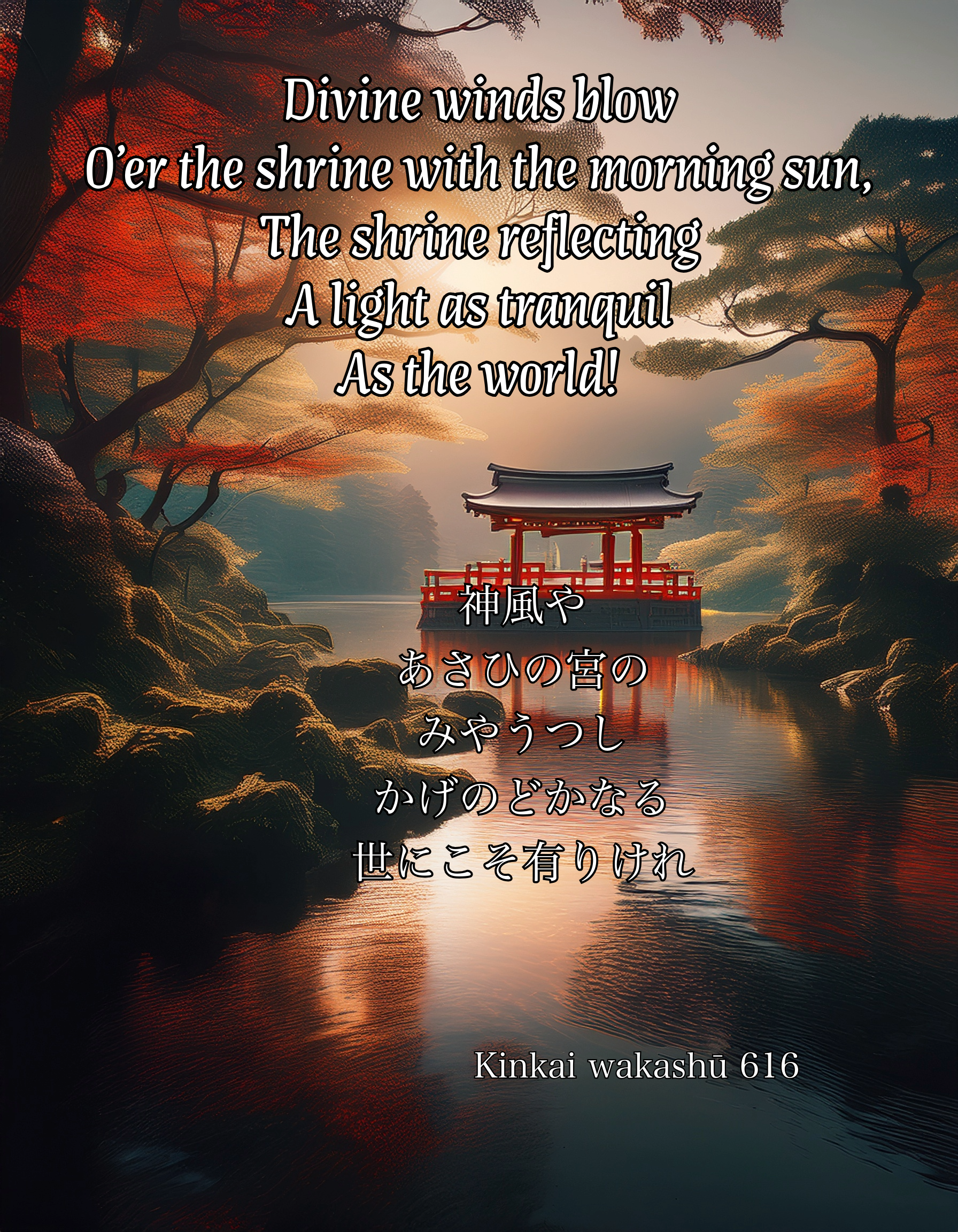
A poem composed during the year when the Ise Shrine was renewed.[i]
神風やあさひの宮のみやうつしかげのどかなる世にこそ有りけれ
kamikaze ya asahi no miya no miya utsushi kage nodokanaru yo ni koso arikere
Divine winds blow O’er the shrine with the morning sun, The shrine reflecting A light as tranquil As the world![ii]
616
[i] The Grand Shrine at Ise was demolished and rebuilt approximately every twenty years. The occasion Sanetomo is referring to here took place in the Ninth Month, Jōgen 3 [1209] (Higuchi 2016, 188).
[ii] See: In reply. 神風やいすずかは浪かずしらずすむべきみよに又かへりこん kamikaze ya / isuzukawanami / kazu shirazu / sumubeki miyo ni / mata kaerikon ‘Divine winds blow / Waves upon the Isuzu River / In numbers unknown, / So bright this age that / Ever will I return.’ Supernumerary Master of the Crown Prince’s Household Kintsugu (Shinkokinshū XIX: 1874)
When the heart of a woman whom he had been visiting frequently showed no sign of melting, he sent this to her to say that months and years had passed and they were still in such a state.
なにはがたみぎはのあしのおいがよに怨みてぞふる人の心を
naniFagata migiFa no asi no oFi ga yo ni uramite zo Furu Fito no kokoro wo
In Naniwa’s tidelands By the waterside the reeds Growing old within this world How I despise the passing time– And your hard heart…
wa ga koi wa takashi no hama ni iru tazu no tazuneteyukan kata mo oboezu
My love is Upon Takashi Beach A resting crane— He will go a’visting, but Where? No one knows…
Lord Tamezane 71
Right (M – Win)
あふことのたのむる人のなきときはよをうき物と思ひぬるかな
au koto no tanomuru hito no naki toki wa yo o uki mono to omoinuru kana
To meet with me Is there no one I can trust— At such times The world is such a cruel place I feel!
Lord Tokimasa 72
Toshiyori states: the poems of both Left and Right seem to be of about the same standard. The first poem displays slightly better technique, but there’s nothing to point out about it. The later poem doesn’t do anything. I would say ‘A resting crane— / He will go a’visiting’ wins.
Mototoshi states: as for the poem about ‘My love is / Upon Takashi Beach’: it really seems to me that if you mention Takashi – heights – then you need to mention waves. After all, in reply to Tadafusa Tsurayuki composed, ‘The waves offshore / Rise high; on the beach at Takashi’, and while there are many beaches, I recklessly feel its mistaken not to have waves linked with Takashi Beach—although, of course, this may be a failing of my elderly mind. The poem of the Right’s ‘feeling in a cruel place’ seems a bit smoother in the current context.
taezu taku muro no yashima no keburi ni mo nao tachimasaru koi mo suru kana
Endlessly kindled, At Muro no Yashima The smoke Yet rising more Is my love for you!
Lady Settsu 49
Right (M – Win)
杯のしひてあひみむとおもへども恋しきことのさむるよもなき
sakazuki no shiite aimimu to omoedomo koishiki koto no samuru yo mo naki
Over a cup of wine To press you to meet I thought, yet My love for you Will never cool in this world!
Lord Akikuni
50
Toshiyori states: the first poem’s ‘endlessly kindled’ is an error. Fires are not actually kindled at Muro no Yashima—vapour rising from clear waters in the land appears to be smoke, so I wonder about the use of ‘kindled’ in this context. Nevertheless, if one was referring to real smoke, why wouldn’t you compose in this way? The tone of the poem isn’t bad. The second poem is an interesting display of technique, but it doesn’t appear that one would have to compose like this. Saying ‘cup’ leads to ‘wine’ and emphasises the drinking of it, but then if there were no wine and no drinking, how could one press someone to do something? In addition, I wonder whether it’s appropriate to begin with ‘cup’? This is an excess of technique over substance. The Left is more poetic, so I say it’s the winner.
Mototoshi states: what are we to make of ‘Endlessly kindled, / At Muro no Yashima / The smoke’? And what do the fires kindled at this location resemble? There are two senses of ‘Muro no Yashima’: one is a location in Shimotsuke; the second refers to people’s dwellings—we know from earlier treatises that forges are described as ‘Muro’. Which of these two senses is being used here? Whichever it is, ‘endlessly’ does not appear to have been previously associated with either of them. For example, there’s Koreshige’s poem:
風ふけば室のやしまの夕煙心のうちに立ちにけるかな
kaze fukeba muro no yashima no yūkeburi kokoro no uchi ni tachinikeru kana
When the wind blows Across Muro no Yashima At eventide as smoke, Within my heart, My passion soars…
It does not appear that the smoke rises endlessly here. Exemplars of endlessly rising smoke are the peak of Asama, or Mount Fuji, and these seem to have long been the subject of compositions. It seeming that this poem sought to express the essential meaning of ‘endlessly kindled’, such enquiries need to be made and, if I may be so bold, do not appear, do they? The Right’s poem has ‘Over a cup of wine / To press you to meet / I thought, yet’—while the conception of ‘press’ here sounds extremely unusual, what does it mean that ‘My love for you / Will never cool in this world’? It seems that ‘cool’ as a piece of diction is being used to make drunkenness a metaphor for being in love. If that’s the case, then, well, there are many foundational texts on this. So, even if one gets drunk, what then happens? Is there a world where this never ‘cools’? There was the case of man in Cathay who spent a thousand nights drunk, but that was only three years and not without end. In the sutras there is the drunkenness of ignorance and that might be a world in which one would not find sobriety, but there is no way to make this applicable in this poem. It is a little better than the Left poem’s endless kindling and extremely charming.
kazu naranu mi koso omoeba ureshikere uki ni tsukete zo yo o mo itowamu
Not even numbered among folk Am I, thinking that Fills me with joy, but All the cruelties of this world Make me wish to leave it.
Asamune 141
Right
ながらへばかくてのみやははてむとてすぎにしかたはなぐさみもしき
nagaraeba kakute nomi ya wa hatemu tote suginishi kata wa nagusami mo shiki
Should I live on, then Being simply as I am Would I reach my end, I wonder? In days gone by I had some hope of consolation…
Kanetsuna 142
The sequencing of the Left’s ‘Am I, thinking that’ appears elegant. The Right, starting with ‘Would I reach my end, I wonder?’ sounds overly forceful, yet the conception of saying ‘in days gone by’ is still pleasant. Thus, once again, I make this a tie.