Tag Archives: sorry self

Reikeiden no nyōgo uta’awase 13

Left (Win)

はるのよのちよをひとよになしてしかあくやあかずやねでこころみむ

haru no yo no
chiyo o hitoyo ni
nashiteshika
aku ya akazu ya
nede kokoromimu
Spring nights
By the thousand, into a single night
Have been made—
Am I satisfied or not,
Sleepless, how will I know?

25

Right

あひみてもなほなぐさまぬこひなればわがみなれどももてぞわづらふ

ai mite mo
nao nagusamanu
koi nakereba
wagami naredomo
mote zo wazurau
Seeing and meeting you
Has not eased
My yearning, but without it
My sorry self would yet
Suffer from your treatment!

26

Reikeiden no nyōgo uta’awase 11

Love without meeting

Left (Win in a certain book)

かひもなきこひをのみしてよのなかにあはぬためしをわれやのこさむ

kai mo naki
koi o nomi shite
yo no naka ni
awanu tameshi o
ware ya nokosamu
Pointlessly
Yearning is all I do—
In this mundane world, that
We never meet: will that habit
Be all that is left to me?

Tadami

21[i]

Right (Win)

人をよにこひにこがるるわがみよりいくらのなみだここらいづらん

hito o yo ni
koi ni kogaruru
wagami yori
ikura no namida
kokora izuran
For her within the night
My yearning smoulders on, yet
From my sorry self
How many tears
Might burst out in floods?

22


[i] An almost identical poem is included in Saigū nyōgo kishi joō uta’awase (21).

Nishinomiya uta’awase 09

Round Nine

Left

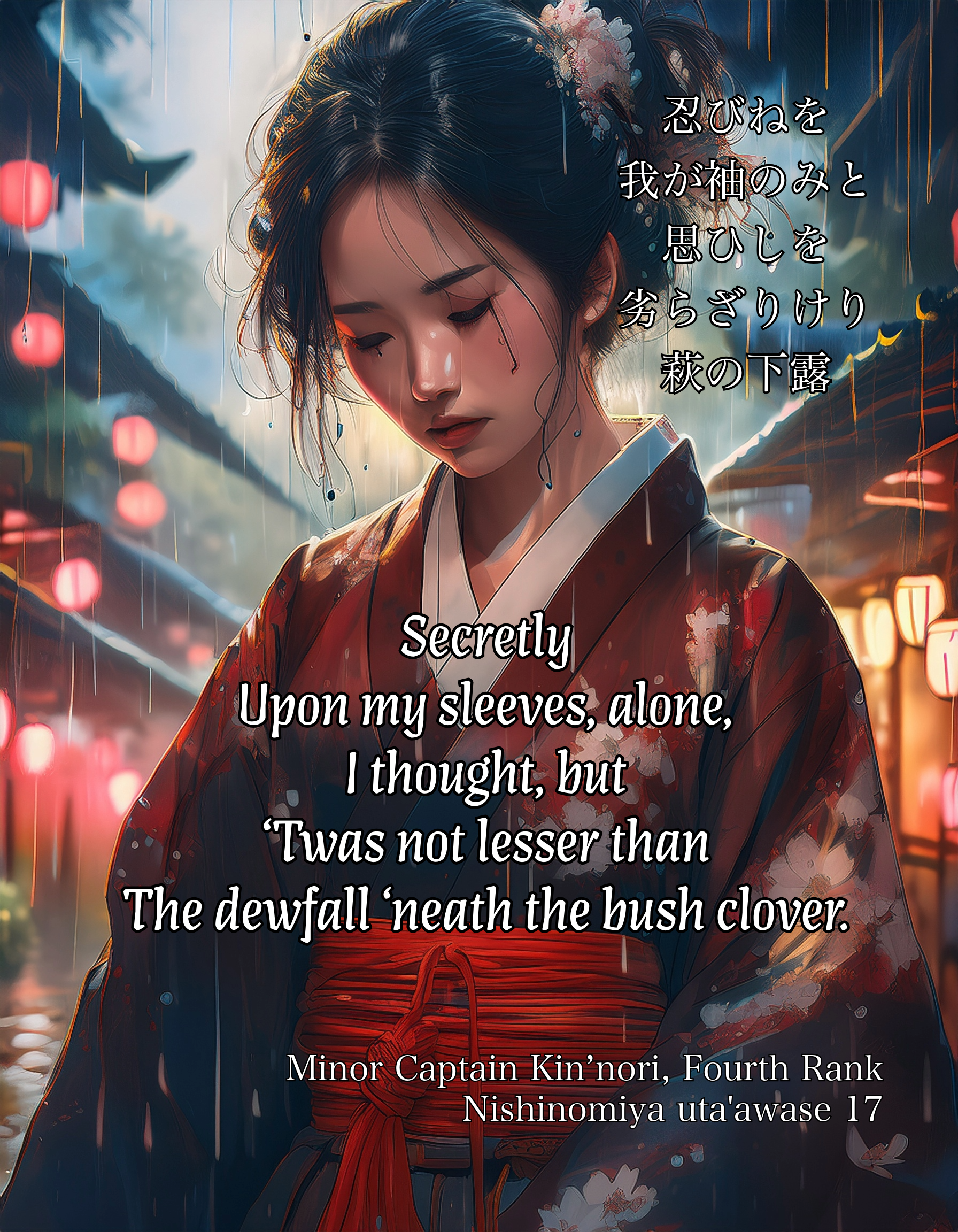
忍びねを我が袖のみと思ひしを劣らざりけり萩の下露

shinobine o
wa ga sode nomi to
omoishi o
otorazarikeri
hagi no shitazuyu
Secretly
Upon my sleeves, alone,
I thought, but
‘Twas not lesser than
The dewfall ‘neath the bush clover.

Minor Captain Kin’nori, Fourth Rank
17

Right

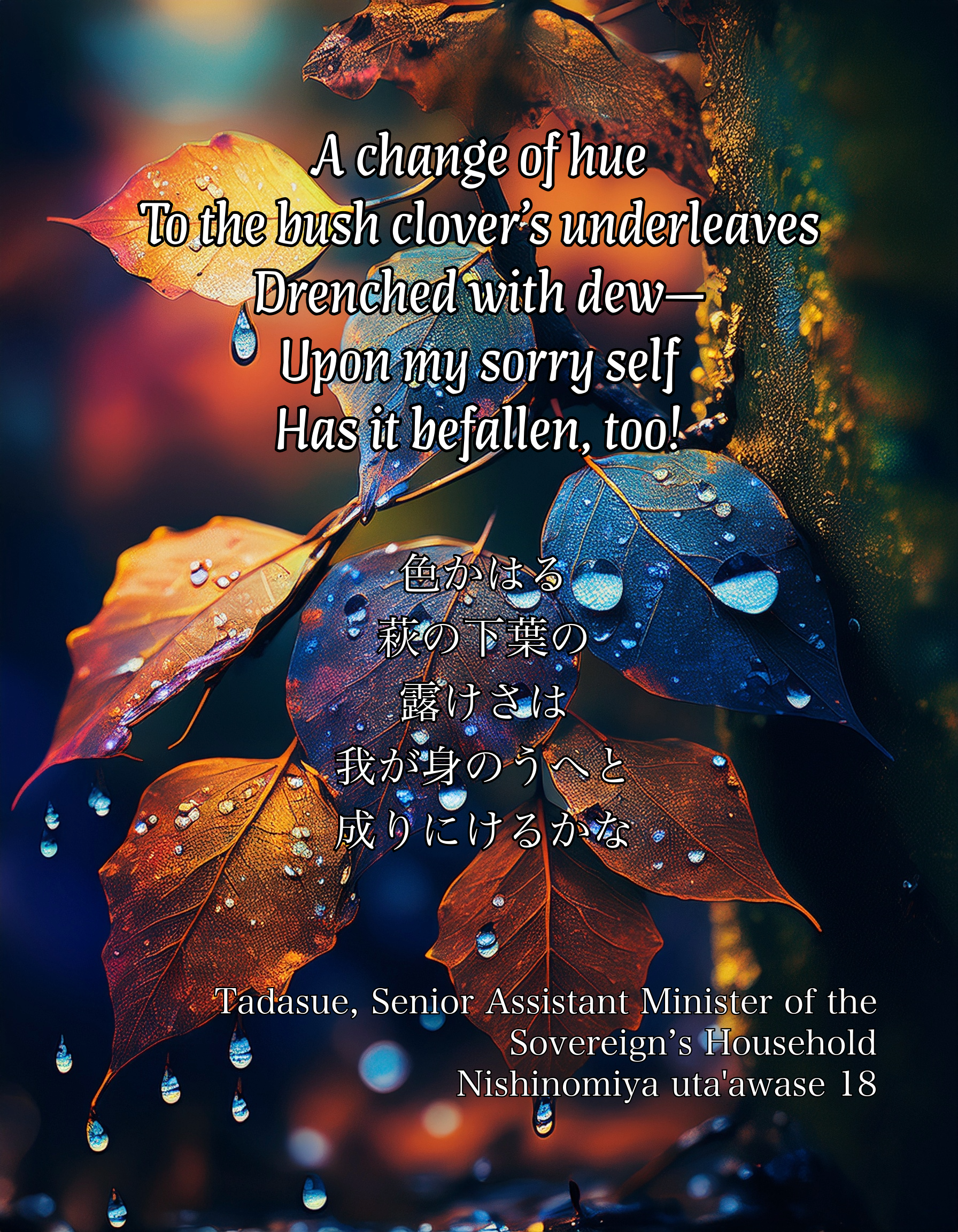
色かはる萩の下葉の露けさは我が身のうへと成りにけるかな

iro kawaru
hagi no shitaba no
tsuyukesa wa
wa ga mi no ue to
narinikeru kana
A change of hue
To the bush clover’s underleaves
Drenched with dew—
Upon my sorry self
Has it befallen, too!

Tadasue, Senior Assistant Minister of the Sovereign’s Household
18

The image of the droplets of secretly wept upon the poet’s sleeves not being less than those of the dewdrops beneath the bush clover appears extremely charming and moving. In addition, the pain expressed by one’s sorry self being as dew-drenched as the bush clover’s underleaves—this has left my own sleeves, both left and right, seeming as soaked with dewdrops from the bush clover.
Sumiyoshi-sha uta’awase kaō ni-nen 58

Round Eight

Left

よのなかをうみわたりつつとしへぬることはつもりのかみやたすけむ

yo no naka o
umiwataritsutsu
toshi henuru
koto wa tsumori no
kami ya tasukemu
In this mundane world,
An endless sea of suffering,
Have my years gone by;
Might Tsumori’s
Deity save me, I wonder?

Dharma Master Shun’e
115

Right (Win)

いへのかぜわがみのうへにすずしかれかみのしるしをあふぐとならば

ie no kaze
wa ga mi no ue ni
suzushikare
kami no shirushi o
augu to naraba
My house’s breeze of fortune
To my sorry self
I would bring cool, if
For a sign from the God
I were to seek…

Lord Sanekuni
116

The Left’s conception is charming, beginning with ‘An endless sea of suffering’ and following this with ‘Might Tsumori’s / Deity save me, I wonder?’, but ‘endless sea of suffering’ does not sound like acceptable diction. The Right’s conception of ‘For a sign from the God / I were to seek’ sounds charming, so I make it the winner.

KYS IX: 518

Composed when viewing the blossom at the Enshūji and recalling former Emperor Gosanjō.

うゑおきしきみもなきよにとしへたる花は我が身のここちこそすれ

ueokishi
kimi mo naki yo ni
toshi hetaru
hana wa wa ga mi no
kokochi koso sure
You planted them here,
My Lord, though gone from this world,
These many years past—
The flowers and my sorry self
Both feel the same…

The Third Prince
三の宮

Sumiyoshi-sha uta’awase kaō ni-nen 52

Round Two

Left (Tie)

すみよしときこゆるさとにいとはずはおきどころなきみをやどさばや

sumiyoshi to
kikoyuru sato ni
itowazu wa
okidokoro naki
mi o yadosaba ya
A pleasant place to live is Sumiyoshi’s
Estate, or so I’ve heard, but
If it provide no comfort, then
My restless
Self might it attract…

Lord Kinshige
103

Right

すぎていにしあきにおくれてしもがるるきくやわがみのたぐひなるらむ

sugite inishi
aki ni okurete
shimogaruru
kiku ya wa ga mi no
tagui naruramu
Past and gone is
Autumn, but lingering,
Frost-burned
Chrysanthemums—is my sorry self
Just like them, I wonder?

Enjitsu
104

Neither the poem of the Left, nor of the Right, sound as if they have any particular faults. Nevertheless, in the case of such poems the assessment varies depending upon the speaker. While the poem of the Left is, indeed, pitiful, it also sounds a bit crude. It would be elegant, I think, if it were a woman’s poem. As for the Right’s poem, if we take it as an expression of grief over orphanhood, then in the final analysis it’s charming as it matches the conception of a scion of a noble house picturing himself as the monarch of the flowers. Then again, we do have the poem by the Enkyū Third Prince:

うゑおきしきみもなきよにとしへたる花は我が身のここちこそすれ

ueokishi
kimi mo naki yo ni
toshi hetaru
hana wa wa ga mi no
kokochi koso sure
You planted them here,
My Lord, though gone from this world,
These many years past—
The flowers and my sorry self
Both feel the same…[1]

This would seem to be in the same vein. Given that the speaker of both poems is unclear, for the moment, these tie.


[1] Composed when viewing the blossom at the Enshūji and recalling former Emperor Gosanjō (KYS IX: 518).