Tag Archives: tears

Entō ōn’uta’awase 27

Round Twenty-Seven

Left (Tie)

高砂のすそ野の真萩露ふかし嶺の秋風ふかずもあらなむ

takasago no
susono no ma’hagi
tsuyu fukashi
mine no akikaze
fukazu mo aranamu
On Takasago’s
Slopes the fair bush clover is
Deep in dew—
O, that the autumn winds from the peak
Would fail to blow…

The Supernumerary Major Counsellor
53

Right

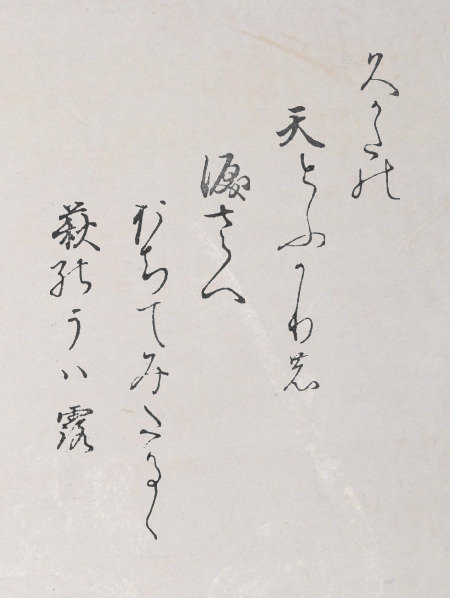
久かたの天とぶかりの涙さへおちてみだるる萩のうは露

hisakata no
ama tobu kari no
namida sae
ochite midaruru
hagi no uwazuyu
From the eternal
Heavens flying, even the goose
Tears
Drop in confusion
Overlaying the dew upon the bush clover.[1]

Nobunari
54

Both Left and Right seem particularly pleasant. Thus, they tie.


[1] An allusive variation on: Topic unknown. なきわたるかりの涙やおちつらむ物思ふやどの萩のうへのつゆ nakiwataru / kari no namida ya / ochitsuran / mono’omou yado no / hagi no ue no tsuyu ‘Calling across / Did the geese let tears / Fall? / My dwelling, lost in thought, / Has dew upon the bush clover.’ Anonymous (KKS IV: 221)

Entō ōn’uta’awase 20

Round Twenty

Left (Win)

あけぼのは涙やもろき時鳥なくねにおつる杜の下露

akenbono wa
namida ya moroki
hototogisu
naku ne ni otsuru
mori no shitazuyu
With the dawn
Are you swiftly to tears moved
By the cuckoo’s
Calling cries, falling from
The forest drip dewdrops?

Dōchin
39

Right

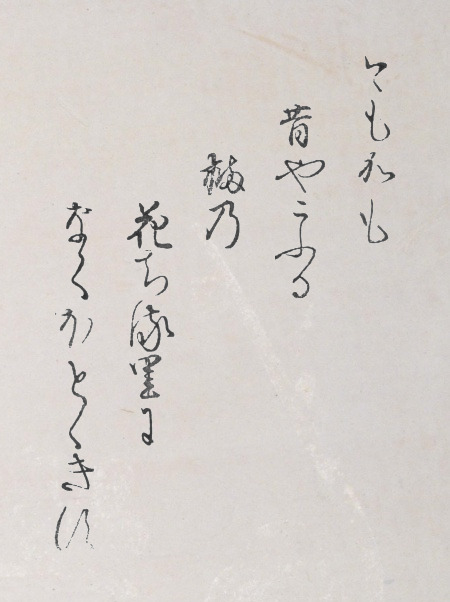
今もかも昔やこふる橘の花ちる里になく郭公

ima mo kamo
mukashi ya kouru
tachibana no
hana chiru sato ni
naku hototogisu
I wonder, is she now,
As in days gone by, beloved
Where orange
Blossom falls on the estate—
The calling cuckoo?[1]

Dharma Master Nyokan
40

Both Left and Right are of the same quality, yet I wonder about the sound of the Right poem’s final section, so the Left wins.


[1] An allusive variation on: A poem by the Governor-General of Dazai, Lord Ōtomo. 橘の花散る里の霍公鳥片恋しつつ鳴く日しぞ多き tachibana no / hana chiru sato no / hototogisu / kata koishitsutsu / naku hi shi zo ōki ‘Orange / Blossom scatters round my estate where / The cuckoo / For unrequited love / Does cry on many a day…’ Ōtomo no Tabito (MYS VIII: 1473)

Naidaijin-ke uta’awase 33

Round Nine

Left (M – Win)

逢ふことの今はかたのとなりぬればかりに問ひこし人もとひこず

au koto no
ima wa katano to
narinureba
kari ni toikoshi
hito mo toikozu
Meeting
Now hard as crossing Katano
Has become, so he who once
Briefly hunted me out
Never comes to call.

Lord Michitsune
65

Right (T – Win)

おさふればあまる涙はもる山のなげきにあたる雫なりけり

osaureba
amaru namida wa
moruyama no
nageki ni ataru
shizuku narikeri
I hold them in, but,
Overflowing, my tears
Drip down—on Mount Moru
Gathering kindling—grief is plain
In every droplet.

Lord Tadataka
66

Toshiyori states: the first poem says ‘hard as crossing Katano has become’, but emphasizes that the lover did come briefly. It’s a mistake to then say that he ‘never comes’. The second poem has ‘Overflowing, my tears / Drip down—on Mount Moru’—it’s certainly not the case that feeling is lacking in the conception here, and it does sound like this is what one feels, so it’s not difficult at all to say this is the winner.

Mototoshi states: neither of these poems has any particular faults or anything outstanding between them, but that there is no one to visit the poet briefly appears, at present, to be slightly more desolate.

MYS V: 798

伊毛何美斯 阿布知乃波那波 知利奴倍斯 和何那久那美多 伊摩陁飛那久尓

いもがみし あふちのはなは ちりぬべし わがなくなみた いまだひなくに

imo ga misi
aputi no pana pa
tirinubesi
wa ga naku namida
imada pinaku ni
My darling’s eyes
Met chinaberry blooms,
All scattered now, though
The tears I weep
Have yet to dry…

Tabito

Sumiyoshi-sha uta’awase kaō ni-nen 38

Round Thirteen

Left

しぐれもるたびねのとこははなぞめのたもとぞさきにまづかへりける

shigure moru
tabine no toko wa
hanazome no
tamoto zo saki ni
mazu kaerikeru
A shower drips upon me
As I doze upon my journey-bed;
Blossom-dyed,
My sleeves, before me,
Have first returned to what they were!

Masahira
75

Right (Win)

はなれゆくみやこをおもふひとりねのなみだをさそふはつしぐれかな

hanareyuku
miyako o omou
hitorine no
namida o sasou
hatsushigure kana
Distant has grown
The capital, but it fills my thoughts,
Sleeping solo,
My tears invited by
The first shower!

Chikashige
76

The configuration of the Left’s poem appears charming, but it would have sounded more so had there been a reason why ‘my sleeves, before’ had returned to the capital on the journey. The diction and conception of the Right’s poem, beginning with ‘distant has grown’ and leading to ‘tears invited’, is extremely pleasant. It seems the Right wins.

Sumiyoshi-sha uta’awase kaō ni-nen 35

Round Ten

Left (Tie)

くさまくらしぐれもそでをぬらしけりみやこをこふるなみだならねど

kusamakura
shigure mo sode o
nurashikeri
miyako o kouru
namida naranedo
On a pillow of grass
The showers, too, my sleeves
Have soaked;
Longing for the capital
These tears are not, yet…

Hiromori
69

Right

かりいほさすならのからはのむらしぐれあはれはまきのおとばかりかは

kari’io sasu
nara no karawa no
murashigure
aware wa maki no
oto bakari ka wa
Erecting a crude hut,
The withered leaves of oak are
Struck by cloudbursts;
Does sadness in the evergreens’
Sound solely lie?

Dharma Master Chikyō
70

Both Left and Right appear to have elegant configuration and diction, but the Left seems to presents the soaking of sleeves by showers as something novel, while the Right gives a feeling that it is only the sound of evergreens that makes one sad. Thus, these tie.

Sumiyoshi-sha uta’awase kaō ni-nen 29

Round Four

Left (Tie)

たびねするあれたるやどのしぐれにはなみだもともにもるにぞありける

tabinesuru
aretaru yado no
shigure ni wa
namida mo tomo ni
moru ni zo arikeru
Sleeping on my travels
In a ruined hut,
The showers
And my tears, both,
Do leave me drenched!

Minamoto no Munenaga
(formerly Michikiyo)
57

Right

ちぎらねどさよのねざめにおとづれてしぐれぞたびのともとなりける

chigiranedo
sayo no nezame ni
otozurete
shigure zo tabi no
tomo to narikeru
It made no vow, yet
On awaking from a brief night’s sleep,
I am visited by the sound
Of showers—my journey’s
Companion, have they become.

Fujiwara no Noritsune
58

The Left conception and configuration appear pleasant, but after saying that one is ‘sleeping on my travels’ to then have ‘a ruined hut’—this does not really sound like somewhere a person would take lodging on their journey. As for the Right, it seems like the only reason the poet has begun with ‘it made no vow, yet’ is because he wished to use ‘companion’, but these pieces of diction are too far apart. Still, it does seem to have some conception, so I make these a tie.