Category Archives: Poetry Competitions

Eien narabō uta’awase 01

Topics

CherryCuckoosMoonSnowFelicitations

Poets

LeftRight
Lord Dainagon [Kōkaku]Lord Chūnagon [Kyōen]
Lord SaburōUshigimi
Retired from the world on Mount Uji [Eien]Senior Assistant Minister Past Lecturer [Kakuyo]
Cell of the Fragrant Elephant [Shin’ei]Cell of the Everlasting Truth [Tanshū]
Controller’s Graduate [Shinkei]Kerin’in Graduate [Yūzen]
Cell of Fragrant Cloud [Shōchō]Cell of Compassionate Light [Sōen]
Lady KazusaLady Shikibu

Judge

Mototoshi

Former Director of the Bureau of Carpentry, Toshiyori[i]

Cherry

Round One

Left

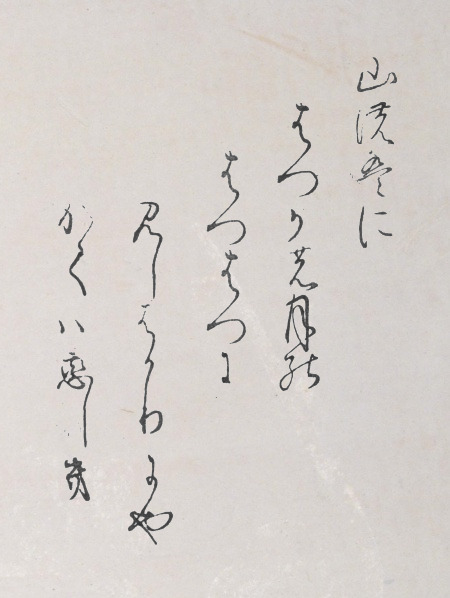
みやまにはしひがかざをれはやけれどふもとのはなはことしさくめり

miyama ni wa
shii ga kaza’ore
hayakeredo
fumoto no hana wa
kotoshi sakumeri
Deep within the mountains,
Brushwood is broken by the wind
So swiftly, yet
In the foothills the blossom
Will bloom this year, it seems.[ii]

Lord Dainagon
1

Right

ちるはなをさそふとみつるはる風のうはのそらにもすててけるかな

chiru hana o
sasou to mitsuru
harukaze no
uwa no sora ni mo
sutetekeru kana
The scattered blossoms
Look to be beckoned by
The spring breezes,
Even high up in the skies
To be abandoned!

Lord Chūnagon
2

I would say there’s no reason to say that the poem of the Left is superb, yet it does have a little bit of interest. The poem of the Right’s ‘Even high up in the skies /To be abandoned!’ completely fails to exceed vulgar diction. Thus, I make the Left the winner.

The poem of the Left’s ‘Brushwood is broken by the wind’ and so forth cannot be called ordinary and is an extremely charming use of diction. However, if the branches are broken and lost, then it would appear difficult for them to bloom, yet the addition of ‘yet’ to ‘swiftly’ gives the impression that there are branches remaining, thus following this with ‘Will bloom this year, it seems’ appears clumsy.

The poem of the Right has nothing remarkable about it, and no particular errors. Even so, because except in exceptional circumstances, the Left must win the first round, I make the Left the winner.


[i] This match was initially judged by Fujiwara no Mototoshi, but at some point after this, one of the participants, Sōen, submitted an ‘Appeal’ (chinjō) claiming these were unfair, and Toshiyori was asked to re-judge the match. The result is that there are two manuscript traditions for this event, one with Mototoshi’s judgements and one with Toshiyori’s. I am including both sets of judgements here.

[ii] The end of winter-beginning of the Twelfth Month. みやまにははやまのあらしあらげなりしひのかざをれいくそかかれり miyama ni wa / hayama no arashi / aragenari / shii no kaza’ore / ikuso kakareri ‘Deep within the mountains / Across the timber slopes the storm wind / Rages; / Brushwood is broken by the wind / O’er countless tens of trees.’ Sone no Yoshitada (Yoshitada-shū 342)

Eien narabō uta’awase

Shinpen kokka taikan no.147
Heian-chō uta’awase taisei no.311
Title永縁奈良房歌合
Romanised TitleEien narabō uta’awase
Translated TitleEien’s Nara Cell Poetry Match
Alternative Title(s)Gon-sōjō eien kerin’in uta’awase 権僧正永縁花林院歌合 Supernumerary Archbishop Eien’s Kerin’in Poetry Match
DateSpring Tenji 1 [1124]
Extant Poems70
Identifiable ParticipantsY
JudgementsY
TopicsCherry [blossom] (sakura 桜); cuckoos (hototogisu 郭公); the moon (tsuki 月); snow (yuki 雪); felicitations (iwai 祝)

Naidaijin-ke uta’awase 36

Round Twelve

Left (T – Win)

わが恋はたかしの浜にゐる田鶴の尋ねてゆかん方もおぼえず

wa ga koi wa
takashi no hama ni
iru tazu no
tazuneteyukan
kata mo oboezu
My love is
Upon Takashi Beach
A resting crane—
He will go a’visting, but
Where? No one knows…

Lord Tamezane
71

Right (M – Win)

あふことのたのむる人のなきときはよをうき物と思ひぬるかな

au koto no
tanomuru hito no
naki toki wa
yo o uki mono to
omoinuru kana
To meet with me
Is there no one I can trust—
At such times
The world is such a cruel place
I feel!

Lord Tokimasa
72

Toshiyori states: the poems of both Left and Right seem to be of about the same standard. The first poem displays slightly better technique, but there’s nothing to point out about it. The later poem doesn’t do anything. I would say ‘A resting crane— / He will go a’visiting’ wins.

Mototoshi states: as for the poem about ‘My love is / Upon Takashi Beach’: it really seems to me that if you mention Takashi – heights – then you need to mention waves. After all, in reply to Tadafusa Tsurayuki composed, ‘The waves offshore / Rise high; on the beach at Takashi’, and while there are many beaches, I recklessly feel its mistaken not to have waves linked with Takashi Beach—although, of course, this may be a failing of my elderly mind. The poem of the Right’s ‘feeling in a cruel place’ seems a bit smoother in the current context.

Naidaijin-ke uta’awase 35

Round Eleven

Left (T – Win; M – Tie)

逢ふことをその年月と契らねば命や恋の限なるらむ

au koto o
sono toshitsuki to
chigiraneba
inochi ya koi no
kagiri naruramu
That we might meet
For months and years
She has not promised, so
My life will my love’s
Limit be, no doubt!

Lord Shigemoto
69

Right

よとともにもえこそわたれ我が恋は不二の高根のけぶりならねど

yo to tomo ni
moe koso watare
wa ga koi wa
fuji no takane no
keburi naranedo
With the coming of the night
Ever burning is
My love, though
From Fuji’s peak
Smoke it is not…

Lord Toshitaka
70

Toshiyori states: the first poem doesn’t seem bad. The second poem nothing but cliched. Thus, the first poem should win.

Mototoshi states: while love lasting lifelong without even a promise to meet over years and months is a painfully moving conception, someone burning every night is dear, too. Thus, it’s not inferior and these are of the same quality.

Naidaijin-ke uta’awase 34

Round Ten

Left (T – Tie; M – Win)

憂き人をわすれはてなで忘川なにとて絶えず恋わたるらん

ukibito o
wasurehatenade
wasuregawa
nani tote taezu
koi wataruran
That cruel girl
I am unable to ever forget,
Even by Wasure—Forgetting—River
Why is it that endlessly
My love continues on?

Lord Tadafusa
67

Right

恋すてふこひはこれにて限りてん後にもかかる物をこそおもへ

koisu chō
koi wa kore nite
kagiriten
nochi ni mo kakaru
mono o koso omoe
Love, they say,
Of love right here
Let’s make an end!
But later, still such
Painful feelings will I have…

Lord Munekuni
68

Toshiyori states: the first poem has nothing special about it—poems of this quality are unremarkable. The later poem says, ‘Of love right here / Let’s make an end!’—is it saying that the poet will fall in love with someone else? It’s difficult to say that he’d do that from the following day. It’s vague and doesn’t sound clear. These poems are of the same quality, aren’t they.

Mototoshi states: while neither of these has any faults, the Right’s ‘right here let’s make an end’ seems particularly undesirable. ‘Why is it that endlessly’ is slightly more poetic in the current context, I feel.

Naidaijin-ke uta’awase 33

Round Nine

Left (M – Win)

逢ふことの今はかたのとなりぬればかりに問ひこし人もとひこず

au koto no
ima wa katano to
narinureba
kari ni toikoshi
hito mo toikozu
Meeting
Now hard as crossing Katano
Has become, so he who once
Briefly hunted me out
Never comes to call.

Lord Michitsune
65

Right (T – Win)

おさふればあまる涙はもる山のなげきにあたる雫なりけり

osaureba
amaru namida wa
moruyama no
nageki ni ataru
shizuku narikeri
I hold them in, but,
Overflowing, my tears
Drip down—on Mount Moru
Gathering kindling—grief is plain
In every droplet.

Lord Tadataka
66

Toshiyori states: the first poem says ‘hard as crossing Katano has become’, but emphasizes that the lover did come briefly. It’s a mistake to then say that he ‘never comes’. The second poem has ‘Overflowing, my tears / Drip down—on Mount Moru’—it’s certainly not the case that feeling is lacking in the conception here, and it does sound like this is what one feels, so it’s not difficult at all to say this is the winner.

Mototoshi states: neither of these poems has any particular faults or anything outstanding between them, but that there is no one to visit the poet briefly appears, at present, to be slightly more desolate.

Naidaijin-ke uta’awase 32

Round Eight

Left (T – Tie; M – Win)

山のはにはつかの月のはつはつにみしばかりにやかくは恋しき

yama no ha ni
hatsuka no tsuki no
hatsuhatsu ni
mishi bakari ni ya
kaku wa koishiki
By the mountains’ edge
The Twentieth’s moon
Just for a moment
Did I simply see, so how
Am I so in love?

Lord Morikata
63

Right

恋すてふ皆人ごとにとひみばやいと我ばかりあらじとぞおもふ

koisu chō
mina hito goto ni
toimiba ya
ito ware bakari
araji to zo omou
Saying they are in love—
To all those folk
Would I enquire, for
Surely, I, alone
Do not endure such feelings?

Lord Nobutada
64

Toshiyori states: I may be mistaken, but I get the feeling the first poem resembles an earlier work, with only the ending changed somewhat. The second poem sounds stilted. They are of the same quality.

Mototoshi states: the poem of Left lacks originality, being based earlier poems from the emergence ‘the Twentieth’s moon’ at the beginning, then continuing with ‘for coarse cloth a bobbin turning’ and then finally ‘here at Isonokami, in the ancient’ at the end, yet this is more poetic than ‘To all those folk’, so this is still win for the Left.

Naidaijin-ke uta’awase 31

Round Seven

Left

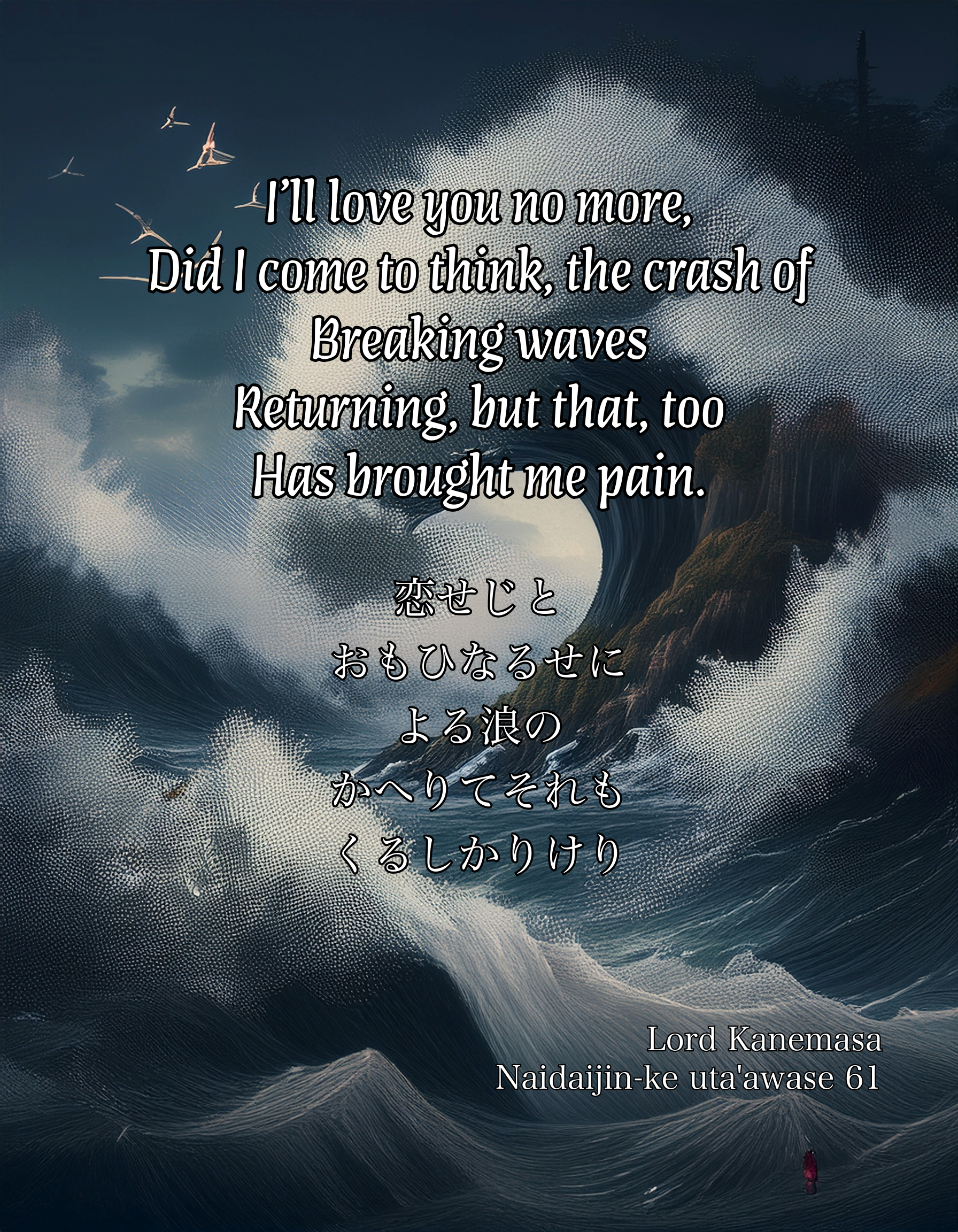
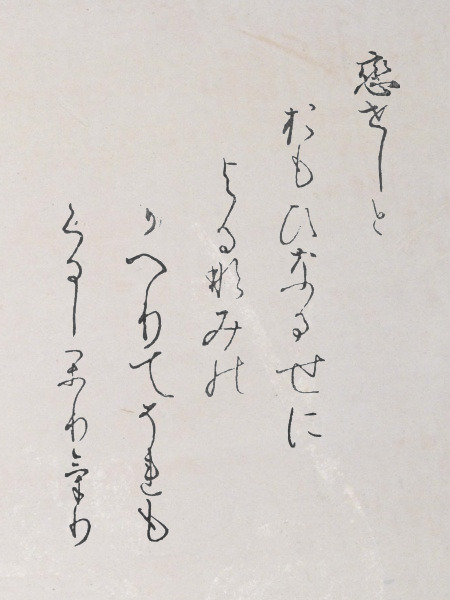
恋せじとおもひなるせによる浪のかへりてそれもくるしかりけり

koiseji to
omoinaru se ni
yoru nami no
kaerite sore mo
kurushikarikeri
I’ll love you no more,
Did I come to think, the crash of
Breaking waves
Returning, but that, too
Has brought me pain.

Lord Kanemasa
61

Right (Both Judges – Win)

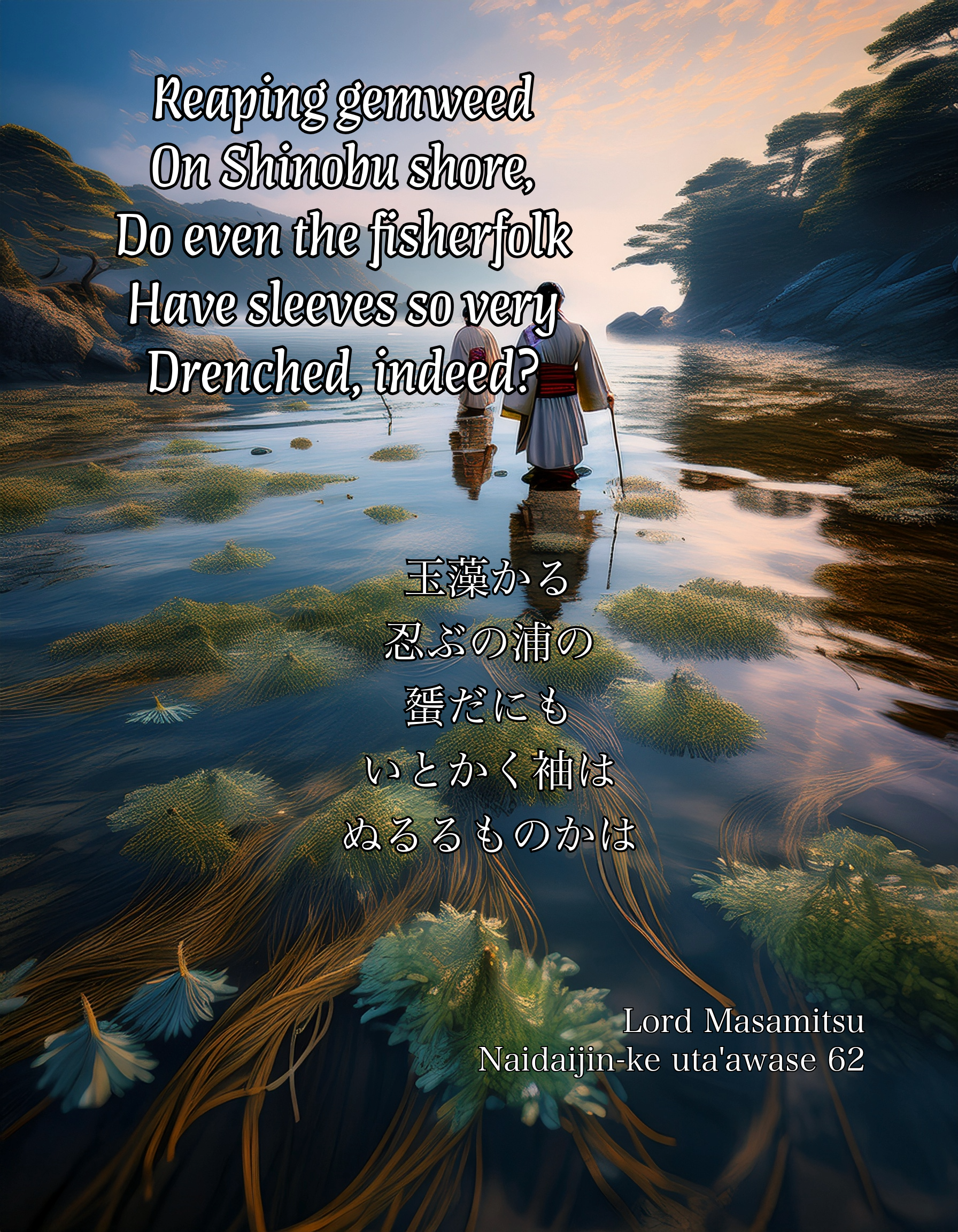
玉藻かる忍ぶの浦の蜑だにもいとかく袖はぬるるものかは

tamamo karu
shinobu no ura no
ama dani mo
ito kaku sode wa
nururu mono ka wa
Reaping gemweed
On Shinobu shore,
Do even the fisherfolk
Have sleeves so very
Drenched, indeed?

Lord Masamitsu
62

Toshiyori states: both of these are charming, however, a line from a famous poem is used for as the initial section, and in such cases the new poem should not closely evoke the source. Someone once said something similar, a long time ago. It’s a bit inferior, isn’t it.

Mototoshi states: neither of these contain any errors, yet the section following the central ‘crash of / Breaking waves’ seems intermittently painful, with sleeves damper than those of the fisherfolk on Shinobu shore. It seems a bit better at present.

Naidaijin-ke uta’awase 30

Round Six

Left (T – Tie)

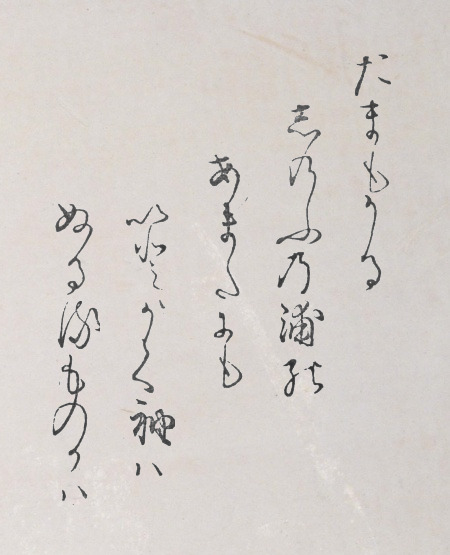
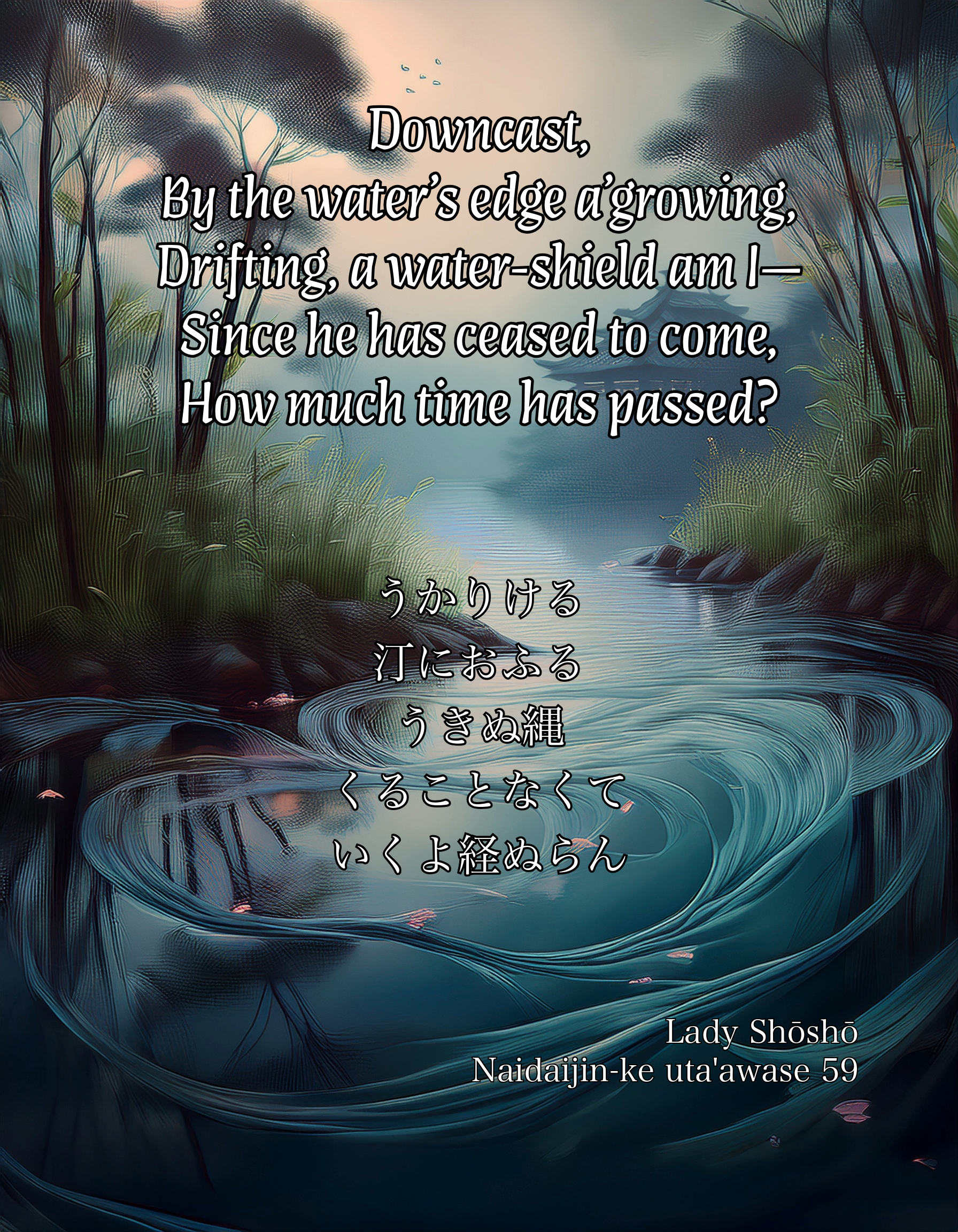
うかりける汀におふるうきぬ縄くることなくていくよ経ぬらん

ukarikeru
migiwa ni ouru
uki nunawa
kuru koto nakute
ikuyo henuran
Downcast,
By the water’s edge a’growing,
Drifting, a water-shield am I—
Since he has ceased to come,
How much time has passed?

Lady Shōshō
59

Right (M – Win)

夜とともに袖のみぬれて衣川こひこそわたれ逢瀬なければ

yo to tomo ni
sode nomi nurete
koromogawa
koi koso watare
ause nakereba
With the coming of night
My sleeves are simply soaked—
The River Robe
Goes on does my love,
Though meetings are there not…

Lady Shinano
60

Toshiyori states: neither Left nor Right appears to have any faults. They are, as expected,  somewhat trite, so I would say they are equivalent.

Mototoshi says: both of these poems seem pleasant. ‘Love going on without a meeting’ is particularly charming.