Love and gold.
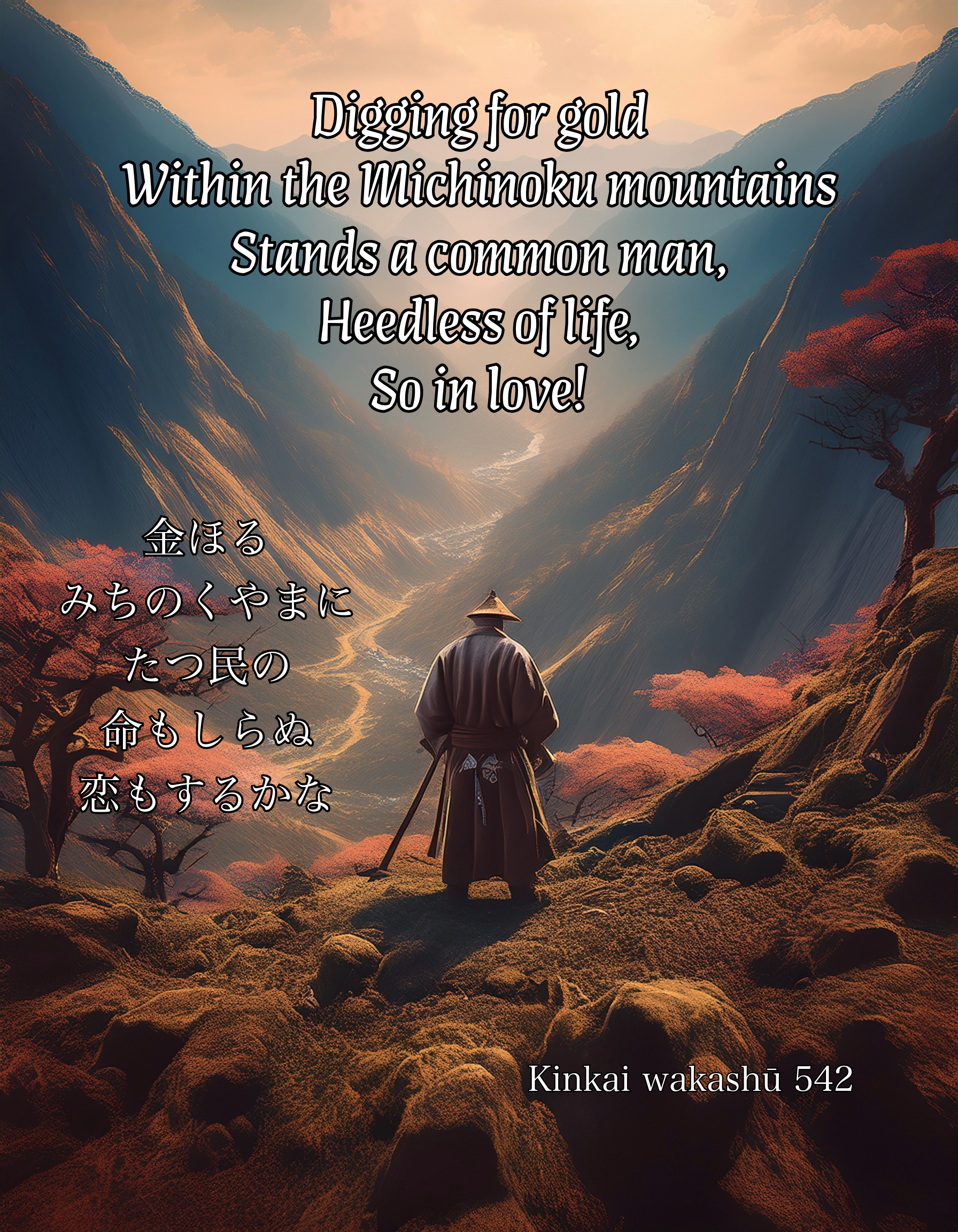
| kogane horu michinokuyama ni tatsu tami no inochi mo shiranu koi mo suru kana | Digging for gold Within the Michinoku mountains Stands a common man, Heedless of life, So in love! |
542
Round Eleven
Left (T – Win; M – Tie)
逢ふことをその年月と契らねば命や恋の限なるらむ
| au koto o sono toshitsuki to chigiraneba inochi ya koi no kagiri naruramu | That we might meet For months and years She has not promised, so My life will my love’s Limit be, no doubt! |
Lord Shigemoto
69
Right
よとともにもえこそわたれ我が恋は不二の高根のけぶりならねど
| yo to tomo ni moe koso watare wa ga koi wa fuji no takane no keburi naranedo | With the coming of the night Ever burning is My love, though From Fuji’s peak Smoke it is not… |
Lord Toshitaka
70
Toshiyori states: the first poem doesn’t seem bad. The second poem nothing but cliched. Thus, the first poem should win.
Mototoshi states: while love lasting lifelong without even a promise to meet over years and months is a painfully moving conception, someone burning every night is dear, too. Thus, it’s not inferior and these are of the same quality.


Left – Chrysanthemums
きくをうゑて花おもほゆるけふよりはながづきをこそまちわたりけれ
| kiku o uete hana omohoyuru kyō yori wa nagazuki o koso machiwatarikere | I planted chrysanthemums, and Wondering about the blooms From today For the Longest Month Will I always be awaiting. |
13a
きくをうゑて花おもほゆる今よりはながづきをこそまちわたりけれ
| kiku o uete hana omohoyuru ima yori wa nagazuki o koso machiwatarikere | I planted chrysanthemums, and Wondering about the blooms From this moment For the Longest Month Will I always be awaiting. |
13b
Right
よにふれどおいもしられぬものなればいまよりうゑつながづきのきく
| yo ni furedo oi mo shirarenu mono nareba ima yori uetsu nagazuki no kiku | My life goes by, yet Old age I know not So From this moment have I planted Chrysanthemums in the Longest Month. |
14a
よにふれどおいもしられぬものなればいまよりうつすながづきのきく
| yo ni furedo oi mo shirarenu mono nareba ima yori utsusu nagazuki no kiku | My life goes by, yet Old age I know not So From this moment fading are Chrysanthemums in the Longest Month |
14b


Round Twenty
Left (Tie)
みのうさをわすれぐさこそきしにおふれむべすみよしとあまもいひけれ
| mi no usa o wasuregusa koso kishi ni oure mube sumiyoshi to ama mo iikere | The misery of my life I forget among the day lilies Growing on the shore— No wonder, Sumiyoshi is a pleasant place Say the fisherfolk, too! |
Kunisuke
139
Right
よをわたるみちをたがへてまどふかないづれのかたにゆきかくれまし
| yo o wataru michi o tagaete madou kana izure no kata ni yukikakuremashi | Passing through this world My path I have mistaken and Lost become! Which way should I go to hide myself away? |
Horikawa
140
The Left has the poem ‘For folk forget among the day lilies / Growing there, or so they say.’[1] in mind and its conception, drawing upon ‘The misery of my life’ is pleasant, I have to say. The Right has a charming configuration for such a poem, but its similarity to the poem by Lord Toshiyori, ‘Deep in depression on Mount Wabuka / On my path through the world / Have I mis-stepped’[2] means that I feel it sounds hackneyed, yet the final section ‘Which way should I’ and what follows, does sound moving. I should say that these tie.


[1] Composed and sent to someone he knew who had gone to Sumiyoshi. 住吉とあまはつぐともながゐすな人忘草おふといふなり sumiyoshi to / ama wa tsugu tomo / nagai su na / hito wasuregusa / ou to iu nari ‘Sumiyoshi is a pleasant place to stay, / So say the fisher-folk, yet / Do not stay there long, in Nagai; / For folk forget among the day lilies / Growing there, or so they say.’ Mibu no Tadamine (KKS XVII: 917)
[2] [One of] a hundred poem sequence on feeling regret and shame over one’s fate. わぶか山よにふるみちをふみたがへまどひつたよふ身をいかにせん wabukayama / yo ni furu michi o / fumitagae / madoitsu tayou / mi o ika ni sen ‘Deep in depression on Mount Wabuka / On my path through the world / Have I mis-stepped, and / Wandering lost, / O, what am I to do?’Minamoto no Toshiyori (Sanboku kikashū 1427)
Round Thirty-Three
Left (Tie)
人数にあらずなるみのうらに又老の浪さへよるぞかなしき
| hito kazu ni arazu narumi no ura ni mata oi no nami sae yoru zo kanashiki | Numbered among proper folk I am not, as at Narumi Bay, yet again do cruel Waves of age Break—so sad! |
Lord Kinshige
65
Right
うきながらなほをしまるる命かな後の世とてもたのみなければ
| ukinagara nao oshimaruru inochi kana nochi no yo tote mo tanominakereba | In constant suffering Still do I regret This life! For even in the world to come Can I place no trust… |
Moromitsu
66
Neither has any parts I can’t understand.


Round Twenty-Six
Left
恋ひしなんいのちを誰にゆづりおきてつれなき人のはてをみせまし
| koishinan inochi o tare ni yuzuri’okite tsurenaki hito no hate o misemashi | Likely dying of love, My life, to whom should I Consign? That cruel girl’s Ending—would that show it to her? |
Shun’e
51
Right (Win)
つれもなき人はおもひもすてられでうき身のみこそなげまほしけれ
| tsure mo naki hito wa omoi mo suterarede ukimi no mi koso nagemahoshikere | So cruel is That girl, but my passion for her I cannot abandon; It is my pitiful self that I would wish to throw away! |
Kenshō
52
The Left isn’t bad, but it’s a bit cliched. As for the Right, having both ‘abandon’ and ‘throw away’ could be a fault and yet the conception of one ‘abandoning passion’ is different. Whichever way you look at it, it wins.


Round Eight
Left (Tie)
うき世をば又なににかはなぐさめん花にさきだついのちともがな
| ukiyo oba mata nani ni ka wa nagusamen hana ni sakidatsu inochi to mogana | In this cruel world Is there yet anything else To console me? Before the blossoms’ departure I would my life do the same… |
Court Lady Taifu
15
Right
桜さく春の山風みねこせば雪ふりつもる谷のほそみち
| sakura saku haru no yamakaze mine koseba yuki furitsumoru tani no hosomichi | When in cherry-blooming Spring, the mountain breezes Cross the peaks Snow falls and piles high Upon the narrow valley paths. |
Moromitsu
16
Both poems are smooth, and on that basis, I would say that the Right is superior, but it has an archaic element, while the Left lacks anything unusual about it, so this is a tie of quality.


Topic unknown.
おもひわびさてもいのちはあるものをうきにたへぬは涙なりけり
| omoi’wabi sate mo inoti Fa aru mono wo uki ni taenu Fa namida narikeri | Burning with the pain of love, At least life is Something that I have, but Unable to endure her cruelty Are my tears. |
Monk Dōin

I had asked that Master of Discipline Kōkaku be accorded the honour of the role of reader at the ceremony for the recitation of the Vimalakīrti nirdeśa Sutra, and when he was constantly passed over, had complained to the Hosshōji Lay Priest and former Palace Minister; even though he mentioned ‘Shimeji plain’, the following year Kōkaku was once more passed over, so I composed this and sent it to him.
契りおきしさせもが露をいのちにてあはれことしの秋もいぬめり
| tigiri okisi sasemo ga tuyu wo inoti nite aFare kotosi no aki mo inumeri | A promise dropped, as Dewfall on the mugwort— Such is life, so Miserable, this year’s Autumn must arrive. |
Fujiwara no Mototoshi
