saohime no ito somekakuru aoyagi o fuki na midari so haru no yamakaze
Princess Sao Has dyed the dangling threads of Green willow— O, don’t blow them into tangles, Spring breeze from the mountains!
Kanemori 6
Warblers should have appeared here, but this is a poem about willows, so it loses.
しろたへの雪ふりやまぬ梅がえにいまぞうぐひす花となくなる
shirotae no yuki furiyamanu ume ga e ni ima zo uguisu hana to nakunaru
White as mulberry cloth The snow falls unceasing— Upon the branch of plum, Now, indeed, the warbler, Sings of the blossom!
Kanemori 7
Despite the mistaken composition, His Majesty required the original poem and it was located and recited.
Lord Hiromasa, the Reciter for the Right, mistakenly recited the willow poem. The Left raised an objection, saying, ‘He should have recited the warbler poem but, instead, erroneously recited the willow poem. Should he really be allowed to recite the correct poem now?’ The substance of the Left’s objection was conveyed to His Majesty, who instructed, ‘Provide a report based on prior precedent.’
This minor official advised His Majesty, ‘The Left’s objection is not unreasonable. However, matters such as this are best determined according to the circumstance of the occasion. As this was simply human error, why discriminate against the poem?’
Thus, His Majesty ordered that the poem be recited.
When he did so, Lord Hiromasa turned pale and was unable to recite the poem straight away. Although he finally managed to do so, his voice trembled and the Left laughed at him. Furthermore, the poem’s diction contained the nonsensical expression ‘sings of the blossom’, and thus this was still a loss.
[i] An allusive variation on: A poem from the Empress’ poetry competition held in the Kanpyō period. 花の香を風のたよりにたぐへてぞ鶯さそふしるべにはやる hana no ka o / kaze no tayori ni / taguete zo / uguisu sasou / shirube ni wa yaru ‘The blossoms’ scent / Messaged on the breeze / Brings / An invitation to the warbler / To try and bring him forth!’ Ki no Tomonori (Kokinshū I: 13)
[ii] This poem was included in Gyokuyōshū (I: 42), attributed to Asatada, with the headnote ‘On warblers, from the Palace Poetry Match in Tentoku 4’.
toshi tsumoru koshi no shirayama shirazu tomo kashira no yuki o aware to wa miyo
How years has it drifted upon The mountains white at Shirayama in Koshi I know not, but The snow above my brow, O, behold with pity![i]
636
[i] See: Composed at Hiroshi Marōdo Shrine, recalling a visit to Shirayama, when he was Governnor of Kaga. としふともこしの白山わすれずはかしらのゆきをあはれともみよ toshi futomo / koshi no shirayama / wasurezu wa / kashira no yuki o / aware tomo miyo ‘The years have passed, yet / The mountains white at Shirayama in Koshi / Never will I forget! So, / The snow above my brow, / O, behold with pity!’ Master of the Left Capital Office Akisuke (Shinkokinshū XIX: 1912)
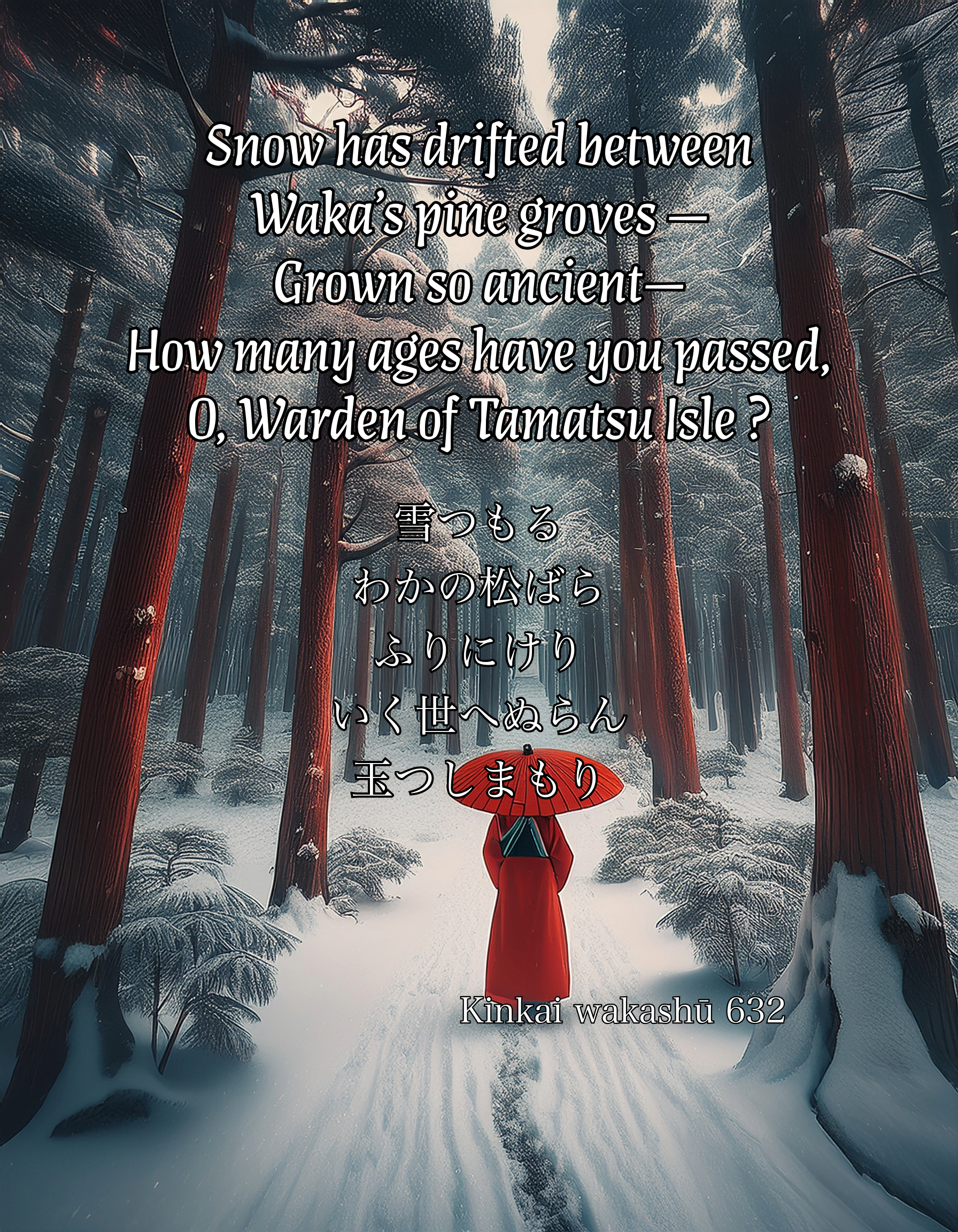
yuki tsumoru waka no matsubara furinikeri ikuyo henuran tamatsushimamori
Snow has drifted between Waka’s pine groves[i]— Grown so ancient— How many ages have you passed, O, Warden of Tamatsu Isle[ii]?[iii]
632
[i] The ‘pine groves of Waka’ (waka no matsubara 和歌の松原) were located in Ise, but Sanetomo mistakenly associates them with Waka Bay (waka no ura 和歌浦) in Kii—hence his reference to Tamatsushima in the poem.
[ii] In this context, ‘Tamatsu Isle’ (Tamatsushima 玉津島) is understood as referring to Tamatsushima Shrine which is located near the coast in Wakayama. One of the deities venerated at this shrine is Sōtorihime-no-mikoto 衣通姫尊, one of the patron gods of waka poetry, which Sanetomo evokes with his reference the ‘pine groves of Waka’.