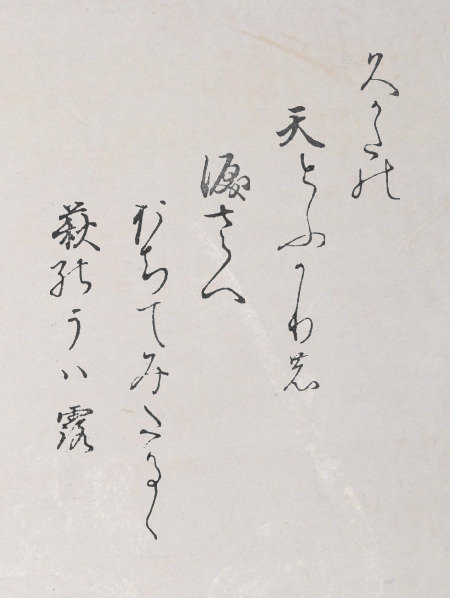
When Dharma Master Sosen (he known as Taneyuki at the time) had gone to Shimōsa, I sent this to him in the Eleventh Month, Kenpō 6 [1218] to say he should return.
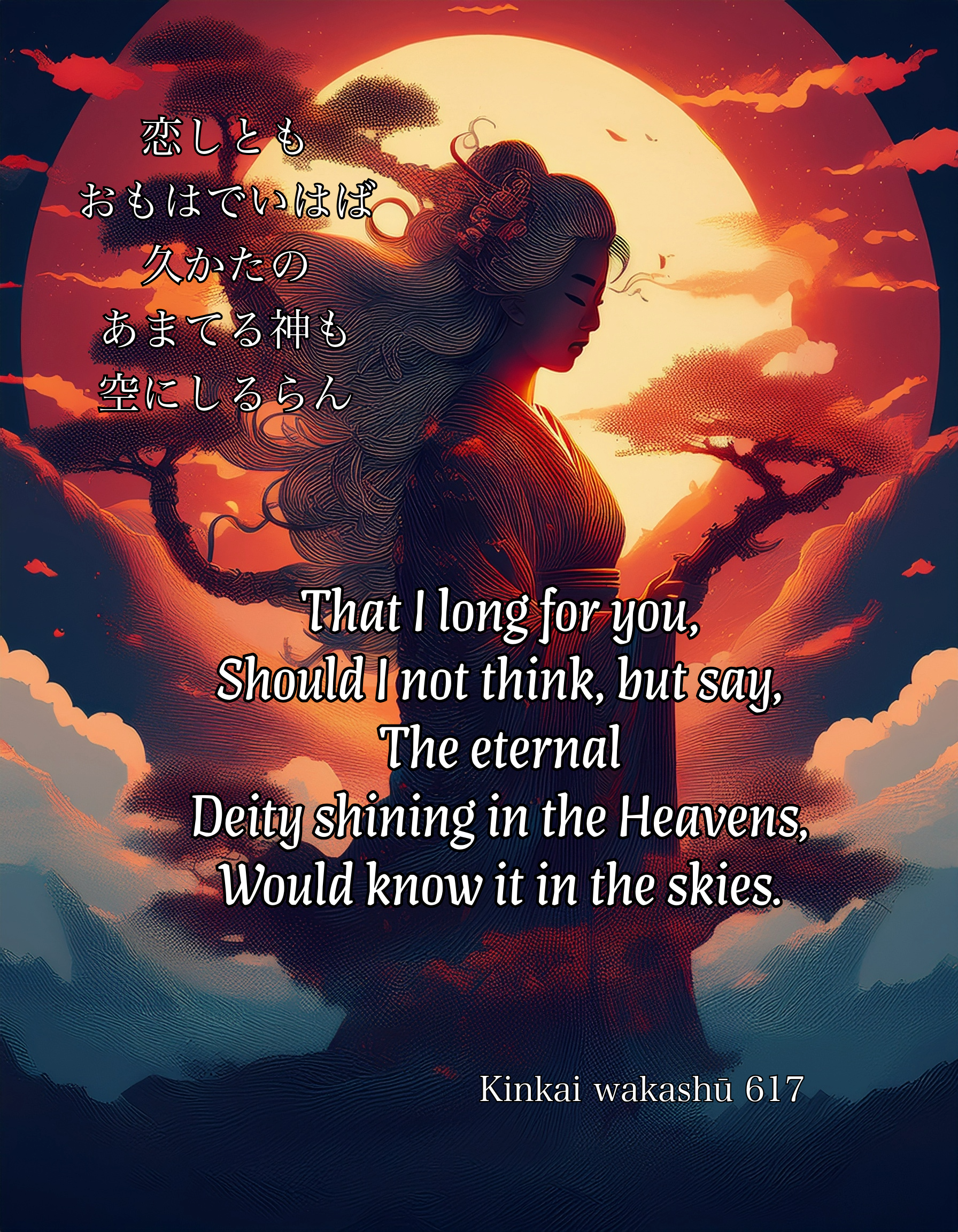
恋しともおもはでいはば久かたのあまてる神も空にしるらん
koishi to mo omowade iwaba hisakata no ama teru kami mo sora ni shiruran
That I long for you, Should I not think, but say, The eternal Deity shining in the Heavens, Would know it in the skies.[i]
617
[i] See: Composed on the conception of felicitation for the poetry match held at the residence of His Excellency, Saneyuki. みづがきのひさしかるべき君が代をあまてる神やそらにしるらん mizugaki no / hisashikarubeki / kimi ga yo o / ama teru kami ya / sora ni shiruran ‘As sacred precincts, / Eternal shall be / My Lord’s reign, as / Shining in the Heavens the deity / In the skies must know!’ Fujiwara no Tametada (Kin’yōshū V: 328)
hisakata no katsura no kage ni naku shika wa hikari o kakete koe zo sayakeki
In the eternal Silver trees’ glow The belling stag Is limned with light, and His voice sounds clear, indeed!
A Court Lady 65
Right (Win)
天川秋の一夜のちぎりだにかた野に鹿の音をや鳴くらん
ama no kawa aki no hitoyo no chigiri dani katano ni shika no ne o ya nakuran
By the River of Heaven For a single autumn night’s Brief bond— Is that why a stag at Katano Does cry out so?
Ietaka 66
The Right’s poem, by beginning with ‘By the River of Heaven / For a single autumn night’s / Brief bond’ and then continuing with ‘a stag at Katano’ sounds particularly refined, evoking memories of bygone days when Prince Koretaka sought lodging from the Weaver Maid when hunting at Katano—how charming it is.[2] The Left’s poem overall is not particularly bad and seems to lack any obvious faults, but the Right’s poem surpasses it in every way: it is not one of the normal run of compositions and thus, it must win.
[1] 夜鹿 – there are early examples of poems on related topics in Kin’yōshū and Senzaishū.
[2] Gotoba is referring to a pair of poems in Kokinshū which are contextualized by an account of a hunting expedition by Prince Koretaka 惟喬 (844-897): Once, when he had gone hunting in the company of Prince Koretaka, they dismounted by the banks of a river called Ama no Gawa (River of Heaven), and while they were tippling, the Prince commanded that Narihira offer him a wine cup with a poem expressing the feelings of a hunter arriving at the river of Heaven, so he composed the following: かりくらしたなばたつめにやどからむあまのかはらに我はきにけり kari kurashi / tanabatatsume ni / yado karamu / ama no kawara ni / ware wa kinkeri ‘While hunting night is falling, / So from the Weaver Maid / Let us beg lodging / For to the Riverbank of Heaven / Have we come!’ Ariwara no Narihira (KKS IX: 418); The prince recited the above poem many times, but was unable to think of a reply so, being one of the party, Aritsune composed this: ひととせにひとたびきます君まてばやどかす人もあらじとぞ思ふ hito tose ni / hito tabi kimasu / kimi mateba / yado kasu hito mo / araji to zo omou ‘In a single year / But once comes / The Lord she awaits, so / One who provides lodging / She is not, I’d say!’ Ki no Aritsune (KKS IX: 419). These poems were famously incorporated into chapter 82 of Ise monogatari with four others to provide an expanded context. See Horiuchi and Akiyama (1997, 157-160) for the original text and Mostow and Tyler (2010, 175-179) for an English translation and commentary.
takasago no susono no ma’hagi tsuyu fukashi mine no akikaze fukazu mo aranamu
On Takasago’s Slopes the fair bush clover is Deep in dew— O, that the autumn winds from the peak Would fail to blow…
The Supernumerary Major Counsellor 53
Right
久かたの天とぶかりの涙さへおちてみだるる萩のうは露
hisakata no ama tobu kari no namida sae ochite midaruru hagi no uwazuyu
From the eternal Heavens flying, even the goose Tears Drop in confusion Overlaying the dew upon the bush clover.[1]
Nobunari 54
Both Left and Right seem particularly pleasant. Thus, they tie.
[1] An allusive variation on: Topic unknown. なきわたるかりの涙やおちつらむ物思ふやどの萩のうへのつゆ nakiwataru / kari no namida ya / ochitsuran / mono’omou yado no / hagi no ue no tsuyu ‘Calling across / Did the geese let tears / Fall? / My dwelling, lost in thought, / Has dew upon the bush clover.’ Anonymous (KKS IV: 221)
hisakata no tsuki mo hikari o yawaragete shime no uchi ni wa sumu ni ya aruramu
The eternal Moon, too, his light Has softened, that Within the sacred grounds Should be more clear, perhaps?
Lord Fujiwara no Asamune Supernumerary Governor of Suruga Junior Fifth Rank, Lower Grade[1] 41
Right (Win)
月かげをゆきかとみればすみよしのあけのたまがきいろもかくれず
tsukikage o yuki ka to mireba sumiyoshi no ake no tamagaki iro mo kakurezu
When, upon the moonlight, I looked and wondered if ‘twas snow, At Sumiyoshi The vermillion jewelled fences’ Hues were not concealed at all.
Lord Fujiwara no Kanetsuna Junior Fifth Rank, Lower Grade Without Office[2] 42
The Left’s ‘Moon, too, his light / Has softened’ and so forth seems a charming configuration, but it is unclear from this whether the moon is shining more gently within the sacred grounds. Although I do wonder about the sound of beginning with ‘I looked and wondered if ‘twas snow’ and abruptly ending with ‘Hues were not concealed at all’, the conception seems clearly expressed in the diction and so I make the Right the winner.