shitaba ni wa iro naru tama ya kudakuramu kaze no fukishiku hagi no ue no tsuyu
From the underleaves Hues have the gemlets taken In their shattering? Spread by the gusting wind Are the dewdrops on the bush clover…
A Court Lady 49
Right (Win)
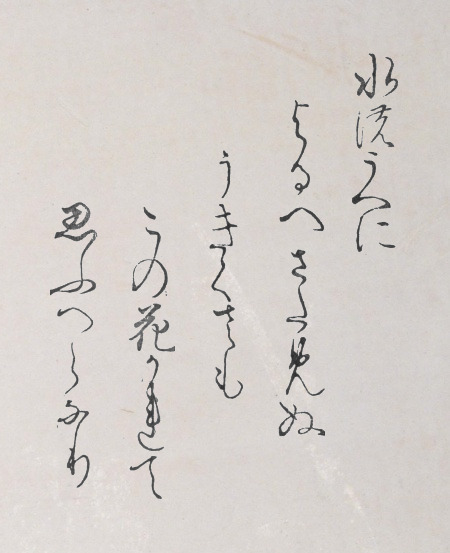
又やみむ又や見ざらん白露の玉おきしける秋萩の花
mata ya mimu mata ya mizaran shiratsuyu no tama okishikeru akihagi no hana
Will I see again, or Will I not Silver dewdrop Pearls spread upon The autumn bush clover blooms?
Ietaka 50
The Left’s poem does not seem to have a particularly superlative style. The Right’s poem, saying ‘will I see again, or will I not silver dewdrops’ is particularly charming and moving. Thus, it wins.
akenbono wa namida ya moroki hototogisu naku ne ni otsuru mori no shitazuyu
With the dawn Are you swiftly to tears moved By the cuckoo’s Calling cries, falling from The forest drip dewdrops?
Dōchin 39
Right
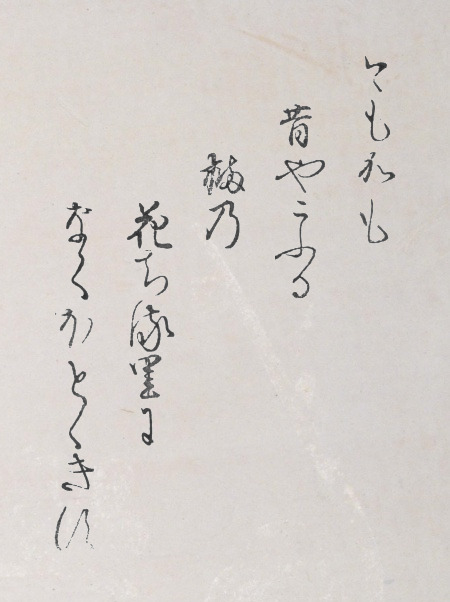
今もかも昔やこふる橘の花ちる里になく郭公
ima mo kamo mukashi ya kouru tachibana no hana chiru sato ni naku hototogisu
I wonder, is she now, As in days gone by, beloved Where orange Blossom falls on the estate— The calling cuckoo?[1]
Dharma Master Nyokan 40
Both Left and Right are of the same quality, yet I wonder about the sound of the Right poem’s final section, so the Left wins.
[1] An allusive variation on: A poem by the Governor-General of Dazai, Lord Ōtomo. 橘の花散る里の霍公鳥片恋しつつ鳴く日しぞ多き tachibana no / hana chiru sato no / hototogisu / kata koishitsutsu / naku hi shi zo ōki ‘Orange / Blossom scatters round my estate where / The cuckoo / For unrequited love / Does cry on many a day…’ Ōtomo no Tabito (MYS VIII: 1473)
ochikochi no chiru hana goto ni taguitsutsu haru wa kokoro no akugaruru kana
Here and there Every single scattered blossom Enthralls me; Spring within my heart I hold so dear.
Lord Saburō 3
Right (Win)
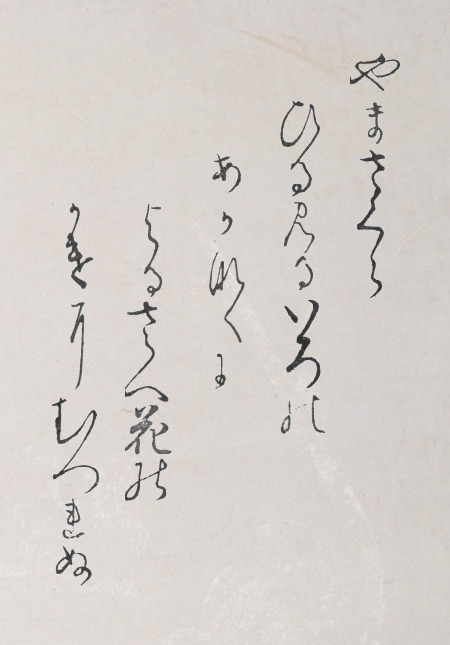
やまざくらひる見るいろのあかなくによるさへ花のかげにむつれぬ
yamazakura hiru miru iro no akanaku ni yoru sae hana no kage ni mutsurenu
Mountain cherry, Viewed in daytime has hues That will not sate, so Even at night the blossoms’ Glow entangles me.
Ushigimi 4
The Left’s poem has nothing remarkable about it. I say that, but it also has no particular faults. The Right’s phrase ‘’ feels curt, so I make the Left the winner.
The Left’s poem does not appear to have any particular faults—it describes the world as it is, so it seems to lack any novel phrasing.
The diction of the Right’s ‘Viewed in daytime has hues’ is extremely immature. With that being said, being entangled and lingering unsated has some conception to it.. I should say this is the winner.
Former Director of the Bureau of Carpentry, Toshiyori[i]
Cherry
Round One
Left
みやまにはしひがかざをれはやけれどふもとのはなはことしさくめり
miyama ni wa shii ga kaza’ore hayakeredo fumoto no hana wa kotoshi sakumeri
Deep within the mountains, Brushwood is broken by the wind So swiftly, yet In the foothills the blossom Will bloom this year, it seems.[ii]
Lord Dainagon 1
Right
ちるはなをさそふとみつるはる風のうはのそらにもすててけるかな
chiru hana o sasou to mitsuru harukaze no uwa no sora ni mo sutetekeru kana
The scattered blossoms Look to be beckoned by The spring breezes, Even high up in the skies To be abandoned!
Lord Chūnagon 2
I would say there’s no reason to say that the poem of the Left is superb, yet it does have a little bit of interest. The poem of the Right’s ‘Even high up in the skies /To be abandoned!’ completely fails to exceed vulgar diction. Thus, I make the Left the winner.
The poem of the Left’s ‘Brushwood is broken by the wind’ and so forth cannot be called ordinary and is an extremely charming use of diction. However, if the branches are broken and lost, then it would appear difficult for them to bloom, yet the addition of ‘yet’ to ‘swiftly’ gives the impression that there are branches remaining, thus following this with ‘Will bloom this year, it seems’ appears clumsy.
The poem of the Right has nothing remarkable about it, and no particular errors. Even so, because except in exceptional circumstances, the Left must win the first round, I make the Left the winner.
[i] This match was initially judged by Fujiwara no Mototoshi, but at some point after this, one of the participants, Sōen, submitted an ‘Appeal’ (chinjō) claiming these were unfair, and Toshiyori was asked to re-judge the match. The result is that there are two manuscript traditions for this event, one with Mototoshi’s judgements and one with Toshiyori’s. I am including both sets of judgements here.
[ii] The end of winter-beginning of the Twelfth Month. みやまにははやまのあらしあらげなりしひのかざをれいくそかかれり miyama ni wa / hayama no arashi / aragenari / shii no kaza’ore / ikuso kakareri ‘Deep within the mountains / Across the timber slopes the storm wind / Rages; / Brushwood is broken by the wind / O’er countless tens of trees.’ Sone no Yoshitada (Yoshitada-shū 342)
[i] This poem is included in Kokin rokujō (4268), with the headnote ‘Sand Pear’, and also in Mandaishū (2812) with the headnote, ‘From the Poetry Match at the Residence of the Ōmi Lady of the Bedchamber’.