Tag Archives: asajū

Nishinomiya uta’awase 10

Round Ten

Left

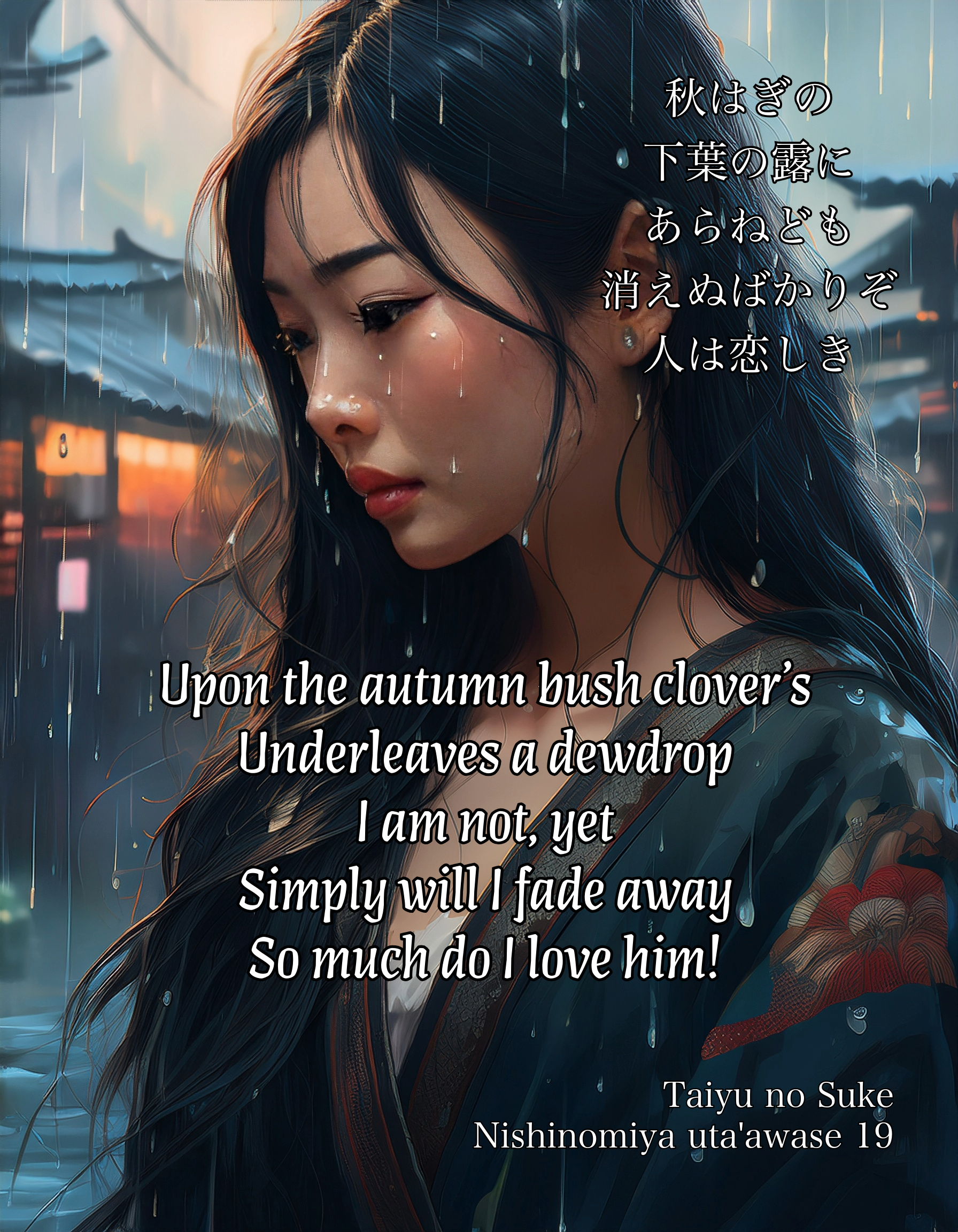
秋はぎの下葉の露にあらねども消えぬばかりぞ人は恋しき

akihagi no
shitaba no tsuyu ni
aranedomo
kienu bakari zo
hito wa koishiki
Upon the autumn bush clover’s
Underleaves a dewdrop
I am not, yet
Simply will I fade away
So much do I love him!

Taiyu no Suke
19

Right

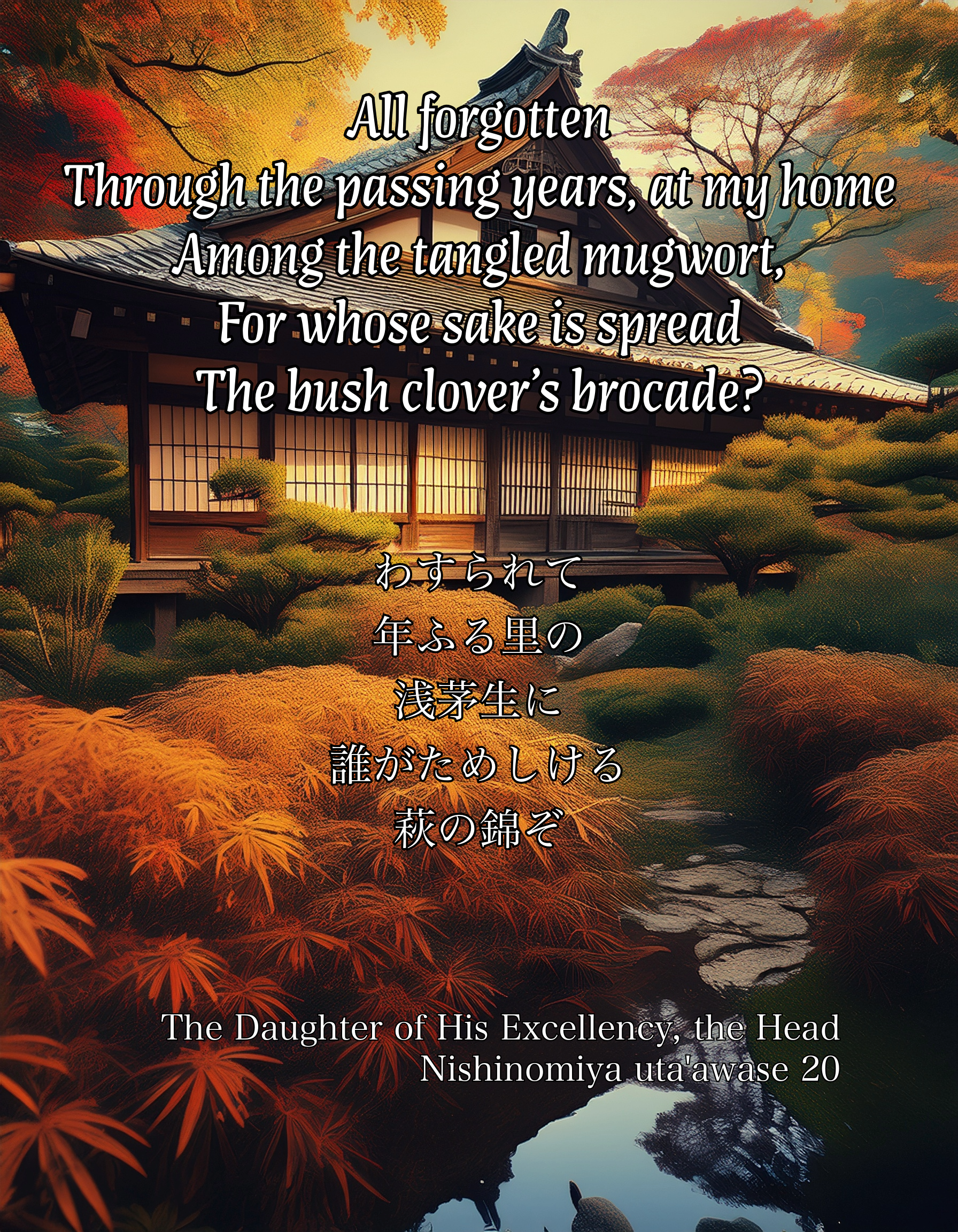
わすられて年ふる里の浅茅生に誰がためしける萩の錦ぞ

wasurarete
toshi furu sato no
asajū ni
ta ga tame shikeru
hagi no nishiki zo
All forgotten
Through the passing years, at my home
Among the tangled mugwort,
For whose sake is spread
The bush clover’s brocade?

The Daughter of His Excellency, the Head

20

I feel that the poem of the Left is conspicuously poetic, saying ‘Simply will I fade away / So much do I love him!’ while the poem of the Right’s ‘Through the passing years, at my home / Among the tangled mugwort, / For whose sake is spread / The bush clover’s brocade?’ makes me want to ask the bush clover the same question! The pull my heart in more than one direction, so here, too, I feel it’s not possible to decide on a winner or loser.
Sumiyoshi-sha uta’awase kaō ni-nen 27

Round Two

Left (Win)

ならしばのたびのいほりにおとづれてしぐれもいまぞやまめぐりする

narashiba no
tabi no iori ni
otozurete
shigure mo ima zo
yama megurisuru
Oak boughs make
My traveller’s hut, where
I am visited by the sound of
Showers—they, too, now
Are on pilgrimage through the mountains.[1]

Shōkaku
53

Right

たびごろもうらがなしかるあさぢふによはのしぐれよいかにせよとぞ

tabigoromo
uraganashikaru
asajū ni
yowa no shigure yo
ika ni seyo to zo
In my traveller’s garb and
Sad at heart among
The clumps of cogon grass,
O, midnight shower,
Tell me, what I am I to do?[2]

Jakuchō
54

While both Left and Right sound pleasant, I make the Left the winner, because it sounds slightly more moving at present, with a traveller’s hut being visited by showers.


[1]Alluding to: Composed when caught in a shower, while making a pilgrimage to one hundred temples in Higashiyama.  もろともに山めぐりするしぐれかなふるにかひなき身とはしらずや morotomo ni / yamamegurisuru / shigure kana / furu ni kainaki / mi to wa shirazu ya  ‘Together with me / On my mountain pilgrimage are / The showers! / ‘Tis pointless to fall / On my sorry self, don’t you know!’ Master of the Left Capital Office Michimasa (SKS IV: 149)

[2] Alluding to: 旅ごろもうらがなしさにあかしかね草の枕は夢もむすばず tabigoromo / uraganashisa ni / akashikane / kusa no makura wa / yume mo musubazu  ‘In my traveller’s garb / My heart-sickness / I cannot lift, for / My grassy pillow / Brings no dreams, at all…’ Hikaru Genji (Genji monogatari 223)

Yōzei-in uta’awase (Engi jūsan-nen kugatsu kokonoka) 02

Left (Win)

あだなりと人やみるらん年毎にとまらぬあきををしむこころは

ada nari to
hito ya miruran
toshigoto ni
tomaranu aki o
oshimu kokoro wa
Deceitful does it
Appear to her?
Every single year
When autumn lingers not, that
My heart is filled with regret…

3

Right

よそ人も秋はをしきを浅茅生のむべもこゑごゑ鹿やなくらん

yosobito mo
aki wa oshiki o
asajū no
mube mo koegoe
shika ya nakuran
Does even a stranger
Feel regret in autumn, when
From among the cogon grass,
Indeed, the belling of
The stags seems to sound?

4

Love VIII: 5

Left
人待ちし庭の淺茅生茂りあひて心にならす道芝の露

hito machishi
niwa no asajū
shigeriaite
kokoro ni narasu
michishiba no tsuyu
Awaiting him,
The cogon-grass in my garden
Has grown lush, indeed;
And I have taken to my heart
The dew that falls upon my lawn!

A Servant Girl
1029

Right (Win)
秋風になびく淺茅の色よりもかはるは人の心なりけり

akikaze ni
nabiku asaji no
iro yori mo
kawaru wa hito no
kokoro narikeri
With the autumn wind
Waves the cogon grass,
Colours
Changing less than her
Heart’s passions…

Ietaka
1030

The Gentlemen of the Right state: the Left’s poem has no faults to mention. The Gentlemen of the Left state: the intial part of the Right’s poem is derived from an old poem, and so does the end!

In judgement: I wonder whether the cogon-grass (asajū), mentioned initially, is as clearly conceived as the ‘lawn’ (michishiba) mentioned at the end? The Right’s poem refers to ‘So full are my thoughts,  what am I to do? With the autumn wind’, but reverses the beginning and end of that poem; it is extremely old-fashioned in style, but pleasant as it is plainly intended to be understood as a variant of its model. Thus, the Right wins over the combination of ‘cogon-grass’ and ‘lawn’.

Autumn III: 22

Left.

蟲の音の弱るもしるく淺茅生に今朝は寒けくはだれ霜降る

mushi no ne no
yowaru mo shiruku
asajū ni
kesa wa samukeku
hadare shimo furu
The insects’ cries
Have plainly weakened;
Cogon grass, where
On this chilly morning
Patchy frost has fallen.

Lord Ari’ie.

463

Right.

思ふより又あはれは重ねけり露に霜置く庭の蓬生

omou yori
mata aware wa
kasanekeri
tsuyu ni shimo oku
niwa no yomogyū
I feel
Yet more sadness
Laid upon me:
Upon the dew has frost fallen
In my tangled mugwort garden…

Jakuren.

464

The Right find no fault with the Left’s poem. The Left wonder about the appropriateness of ‘upon the dew has frost fallen’ (tsuyu ni shimo oku).

The Right respond, ‘This refers to when frost falls upon something where dew has already fallen.’ In reply, the Left say, ‘Surely, it is when both of them fall together. We do wonder about frost falling on top of dew.’

Shunzei’s judgement: The Left’s poem has an unclear link between its initial and final sections. On the matter of the Right’s ‘frosty dew’, this has the same sense as in the Right’s poem in the previous round. The dew has frozen into frost, surely? However, as the Left’s poem is not worthy of a victory, the round must tie.