Love in the summer
五月やま木のしたやみの暗ければおのれまどひて鳴くほととぎす
| satsuki yama ko no shitayami no kurakereba onore madoite naku hototogisu | In the Fifth Month mountains The dark beneath the trees Is full of gloom, so I wander lost, A crying cuckoo. |
509


Round Two
Left
をちかたやくも井の山のほととぎすあまつよそにもなきわたるかな
| ochikata ya kumoi no yama no hototogisu ama tsu yoso ni mo nakiwataru kana | From the distant Mount within the clouds A cuckoo In yonder heavens Sings his song! |
Lord Saburō
17
Right
ほととぎすしのだのもりのしのびねをたづねざりせばいかできかまし
| hototogisu shinoda no mori no shinobine o tazunezariseba ikade kikamashi | A cuckoo In Shinoda’s sacred grove Lets out a hushed cry; Had I not come to visit here, How might I have heard it? |
Ushigimi
18
In regards the poem of the Left’s ‘from the distant’ and what follows, extremely recently and colloquially, at the Nakatomi purification ceremony it seems there was a composition, ‘in the distance, below the trees so lush’. This diction is contrary to the expected style of waka and something which occurs only extremely rarely. Truly, one does not compose using such diction in a poetry match. The poem of the Right has nothing of interest about it, yet it also lack faults to mention, so it wins.
This round, neither poem appears bad. The Left has a novel style, while the Right seems cliched, but its expression is smooth. I wonder if we could see these as a tie.


Cuckoos
Round One
Left
ほととぎすまきのとばかりまちつれどなかであけぬる夏のしののめ
| hototogisu maki no to bakari machitsuredo nakade akenuru natsu no shinonome | O, cuckoo, Briefly by my door of cedar wood Did I await you, yet No song, at all, brightened This summer edge of dawn. |
Lord Dainagon
15
Right (Win)
ほととぎすなくうれしさをつつめどもそらにはこゑもとまらざりけり
| hototogisu naku ureshisa o tsutsumedomo sora ni wa koe mo tomarazarikeri | At the cuckoo’s Song, my joy To hold fast did I try, yet In the skies, his cry Lingered not. |
Lord Chūnagon
16
The Left’s poem, after careful consideration, has a graceful style. The diction of the Right’s poem is superb, and there is an excess of conception. Reading and reciting these leaves my aged heart at a loss. Thus, they tie.
In the Left’s poem, ‘briefly’ is an expression which means ‘just for a short time’, I think, and thus the sentiments are lacking. Saying ‘brightened…edge of dawn’ sounds as if the poet has only begun waiting at daybreak. One does see, apparently, a number of poems in prior matches where the poet has not heard the cuckoo. Nevertheless, I do wonder about whether this is appropriate, given that poems where the cuckoo has been heard are faultless. The Right’s poem is not that good, but it is poetic. Thus, it has to win.


Round Twenty-Four
Left (Tie)
覚束なたれきけとてか時鳥さよふけ方の雲に鳴くらん
| obotsukana tare kike tote ka hototogisu sayo fukegata no kumo ni nakuran | I do not understand— Who is it that you demand hears you, O, cuckoo? Toward brief night’s dawn, Calling from within the clouds… |
Tomoshige
47
Right
待ちかねしよはも昔にかはらねばことしもつらし山時鳥
| machikaneshi yowa mo mukashi ni kawaraneba kotoshi mo tsurashi yamahototogisu | Eagerly awaiting Midnight, to find—as long before— It all unchanged, so This year, too, how cruel is The mountain cuckoo! |
Dharma Master Zenshin
48
Both Left and Right sound suitable. So, they should tie.


Round Twenty-Three
Left (Tie)
時鳥山よりをちの里人はまたでや夜半の初音きくらん
| hototogisu yama yori ochi no satobito wa matade ya yowa no hatsune kikuran | O, cuckoo, Far from the mountains, Will villagers Without waiting, at midnight Ever hear your first cry? |
Chikanari
45
Right
うちしめる花橘の五月雨に軒もる夜半のほととぎすかな
| uchishimeru hanatachibana no samidare ni noki moru yowa no hototogisu kana | When utterly drenched is The orange blossom by The summer showers. Dripping from the eaves at midnight is A cuckoo’s call! |
Ie’kiyo
46
The Right’s poem has ‘Dripping from the eaves at midnight is a cuckoo’s call!’—this sounds like it conveys the conception, but yet is stylistically unclear. The Left’s poem takes up the conception of ‘On the leg-wearying / Mountains’ far side / Folk dwell—I wonder / Do they not have to wait for the autumn / Moon to fill their gaze?’,[1] doesn’t it? Neither has any real point worth making, so they tie.


[1] This poem is: Topic unknown. あしびきの山のあなたにすむ人はまたでや秋の月をみるらんashihiki no / yama no anata ni / sumu hito wa / matade ya aki no / tsuki o miruran Former Emperor Sanjō (SKKS IV: 382).
Round Twenty-Two
Left (Win)
五月雨にやすらふ暮の時鳥そなたの雲に声なへだてそ
| samidare ni yasurau kure no hototogisu sonata no kumo ni koe na hedate so | In a summer shower, Hesitating, at twilight, O, cuckoo, Let not the intervening clouds Interrupt your song! |
Shō
43
Right
過ぎぬなりさやはちぎりし時鳥なく音ばかりはこぞにかはらで
| suginunari saya wa chigirishi hototogisu naku ne bakari wa kozo ni kawarade | And so you’ve flown by— Is that what you vowed, O, cuckoo? For only the sound of your song Is unchanged from the year before… |
Nagatsuna
44
The Left’s poem doesn’t seem bad. The Right poem’s ‘For only the sound of your song is unchanged from the year before’ is somewhat difficult to grasp—if the cuckoo’s call has not changed, then what has? After all, cuckoos have ‘the voice of yesteryear’[1]—among other references—so it’s obvious that their calls don’t change, so the Left is somewhat better, I think.


[1] KKS III: 137
Round Twenty-One
Left (Win)
しがらきの外山の末の郭公たが里ちかき初音なるらん
| shigaraki no toyama no sue no hototogisu ta ga sato chikaki hatsune naruran | In Shigaraki At the foothills’ end A cuckoo By whose estate Might let out his first cry? |
Takasuke
41
Right
橘のにほひを空に尋ねきて山時鳥なかぬ日ぞなき
| tachibana no nioi o sora ni tazunekite yamahototogisu nakanu hi zo naki | Orange blossom’s familiar Scent within the skies I seek out, while The mountain cuckoo Fails to sing on not a single day… |
Shimotsuke
42
The Left poem’s ‘near whose estate does it first call’ does not sound bad. The Right’s poem, too, seems to have no faults to mention, yet the Left still wins by a hair.


Round Twenty
Left (Win)
あけぼのは涙やもろき時鳥なくねにおつる杜の下露
| akenbono wa namida ya moroki hototogisu naku ne ni otsuru mori no shitazuyu | With the dawn Are you swiftly to tears moved By the cuckoo’s Calling cries, falling from The forest drip dewdrops? |
Dōchin
39
Right
今もかも昔やこふる橘の花ちる里になく郭公
| ima mo kamo mukashi ya kouru tachibana no hana chiru sato ni naku hototogisu | I wonder, is she now, As in days gone by, beloved Where orange Blossom falls on the estate— The calling cuckoo?[1] |
Dharma Master Nyokan
40
Both Left and Right are of the same quality, yet I wonder about the sound of the Right poem’s final section, so the Left wins.


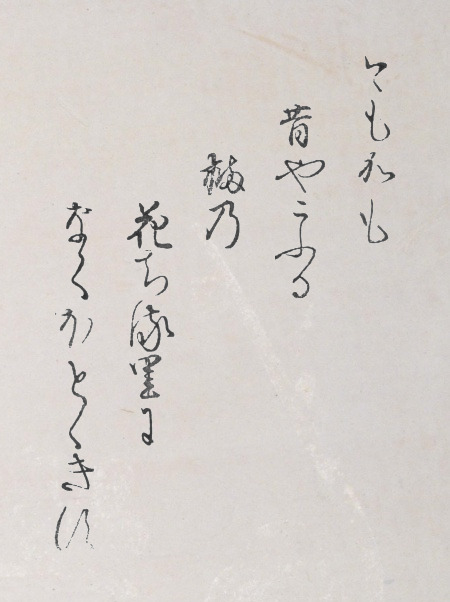
[1] An allusive variation on: A poem by the Governor-General of Dazai, Lord Ōtomo. 橘の花散る里の霍公鳥片恋しつつ鳴く日しぞ多き tachibana no / hana chiru sato no / hototogisu / kata koishitsutsu / naku hi shi zo ōki ‘Orange / Blossom scatters round my estate where / The cuckoo / For unrequited love / Does cry on many a day…’ Ōtomo no Tabito (MYS VIII: 1473)