Topic unknown.
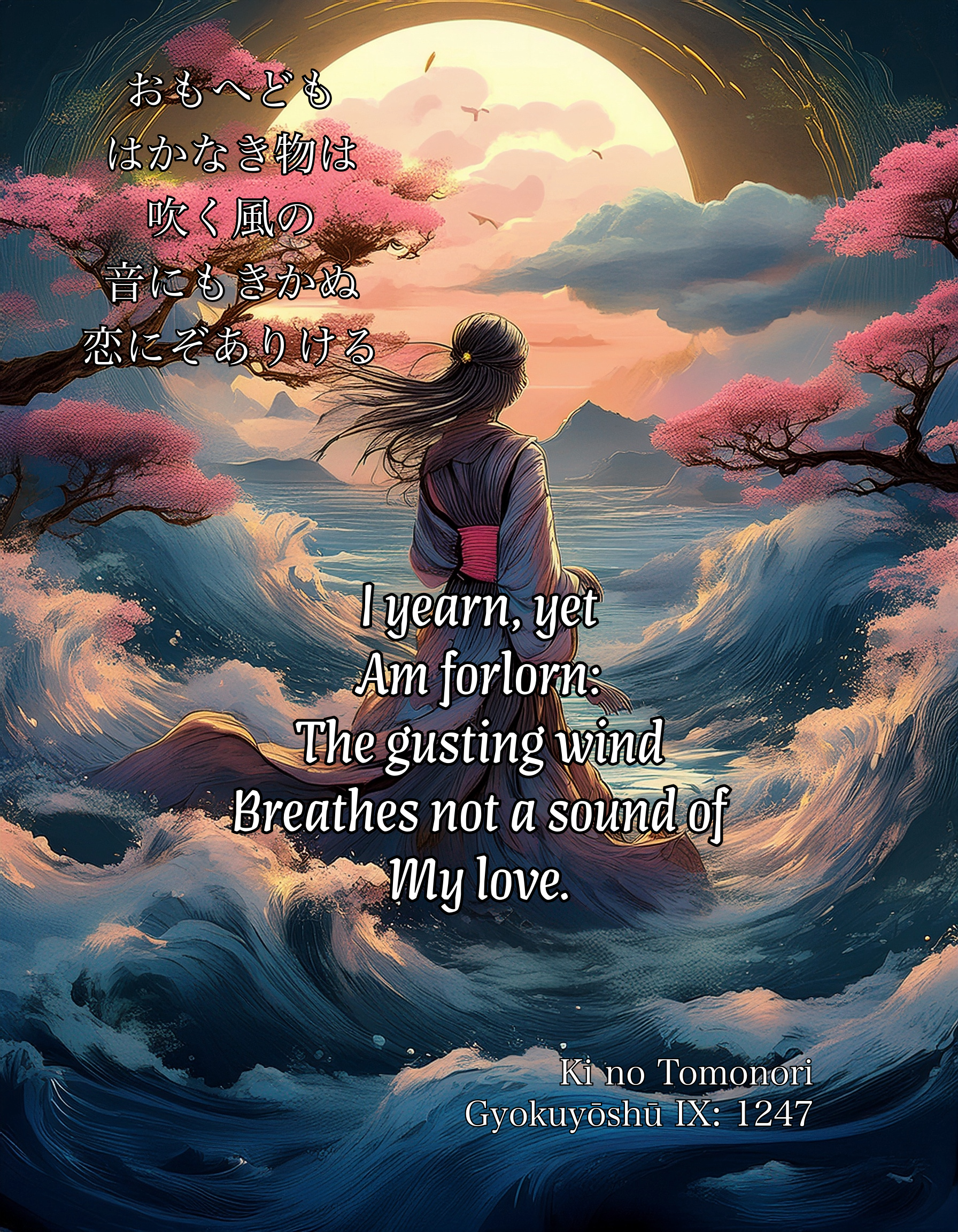
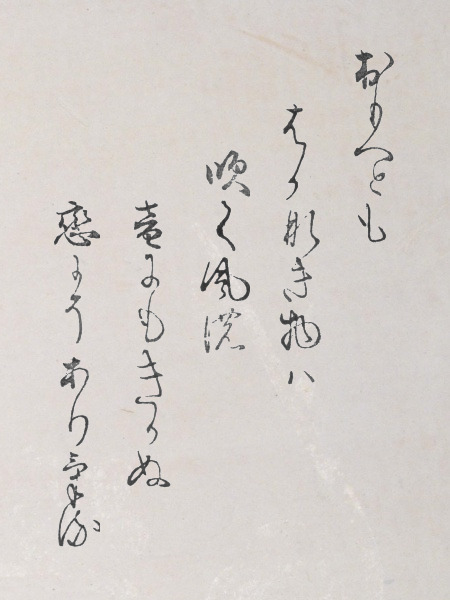
おもへどもはかなき物は吹く風の音にもきかぬ恋にぞありける
| omoedomo hakanaki mono wa fuku kaze no oto ni mo kikanu koi ni zo arikeru | I yearn, yet Am forlorn: The gusting wind Breathes not a sound of My love. |
Ki no Tomonori
Round Thirty-Nine
Left (Tie)
さをしかのふしどをあさみ吹く風に夜半に鳴く音ぞふかくなりゆく
| saoshika no fushido o asami fuku kaze ni yowa ni naku ne zo fukaku nariyuku | The stag’s Resting place disturbed by The gusting wind At midnight his belling cry Comes from deeper in the mountains. |
Chikanari
77
Right
さらでだにね覚かなしき秋風に夜しもなどか鹿の鳴くらん
| sarade dani nezame kanashiki akikaze ni yoru shimo nado ka shika no nakuran | Even were it not so, To waken is so sad With the cruel autumn wind; Why is it that above all at night The stag should cry so? |
Ie’kiyo
78
The Left poem’s ‘at midnight his belling cry comes from deeper’ does not sound especially elegant. The Right poem composes ‘why is it that above all at night the stag should cry so’, sounding like it is only at night that stags bell, but stags do this all the time in autumn. The Ancient and Modern also has the composition, ‘Mud-daubers buzzing / In the autumn bush clover; / Leaving with morning’.[1] The poems of Left and Right have no merits or faults between them—they should tie.


[1] This is a quotation from: Topic unknown. すがるなく秋のはぎはらあさたちて旅行く人をいつとかまたむ sugaru naku / aki no hagiwara / asa tachite / tabi yuku hito o / itsu to ka matan ‘Mud-daubers buzzing / In the autumn bush clover; / Leaving with morning, / Away on a journey: for him, / How long must I wait?’ Anonymous (KKS VIII: 366)
Round Five
Left (Win)
さくらやまはなのさかりに風ふけばこずゑをこして白波ぞたつ
| sakurayama hana no sakari ni kaze fukeba kozue o koshite shiranami zo tatsu | On the mount of Cherries So fine is the blossom that When the wind does blow, Passing o’er the treetops, Whitecaps arise! |
Controller’s Graduate
9
Right
この春ははなにこころのあくがれてこのもとにてもくらしつるかな
| kono haru wa hana ni kokoro no akugarete ko no moto nite mo kurashitsuru kana | This springtime By the blossoms my heart Is captivated, and Beneath the trees Does dwell! |
Kerin’in Graduate
10
Both Left and Right, in terms of diction, tone and style are superb with no faults at all. Thus, this is a tie.
The final section of the Left’s poem lacks fluency, yet it has conception. As for the Right’s poem, in order for one’s heart to be captivated by the blossom on every single treetop, one would need to be walking around. If one is resting peacefully beneath the trees, then one should say that one’s heart is captured. This section sounds erroneous, so the Left should win.


Round Twenty-Six
Left
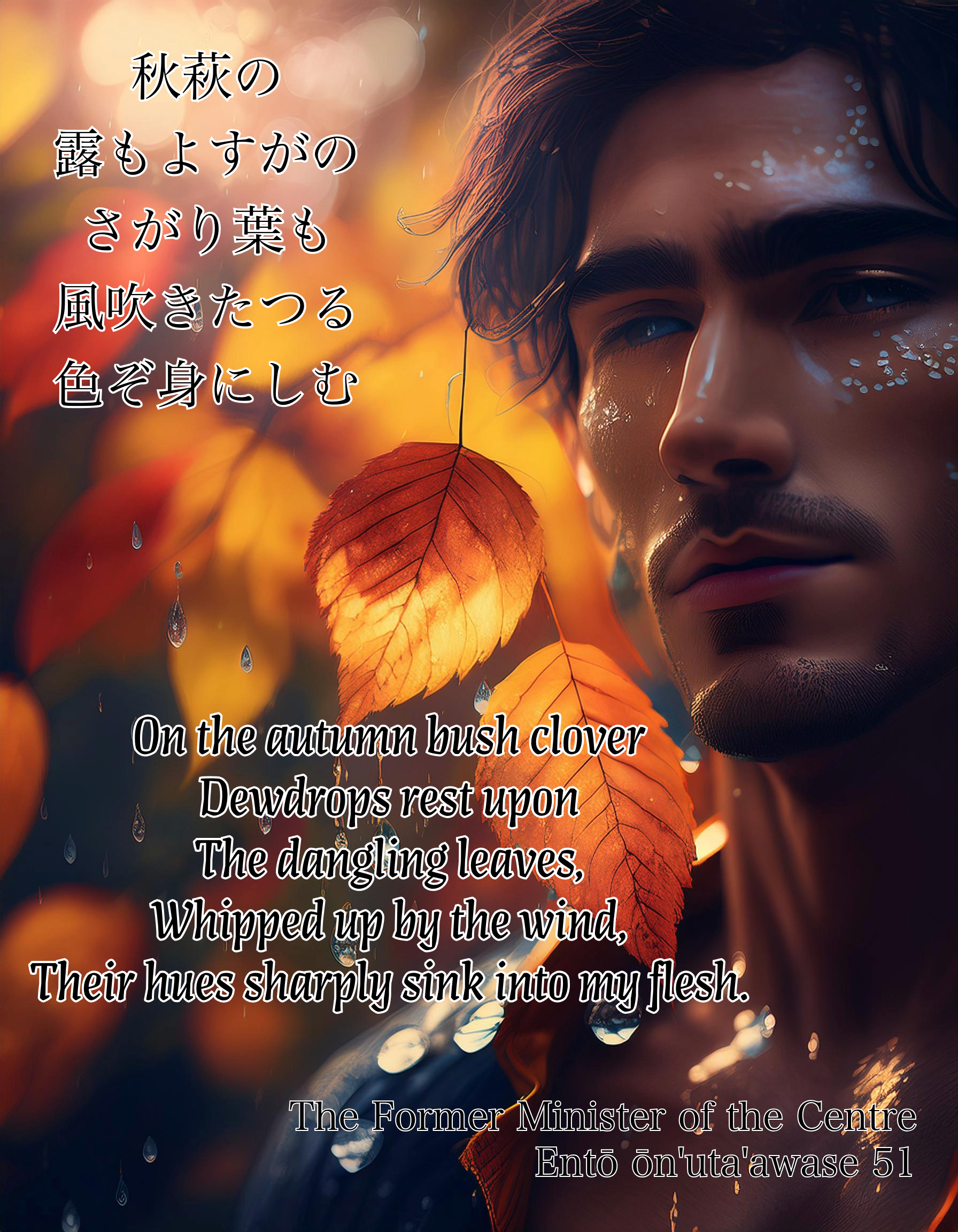
秋萩の露もよすがのさがり葉も風吹きたつる色ぞ身にしむ
| akihagi no tsuyu mo yosuga no sagariba mo kaze fukitatsuru iro zo mi ni shimu | On the autumn bush clover Dewdrops rest upon The dangling leaves, Whipped up by the wind, Their hues sharply sink into my flesh. |
The Former Minister of the Centre
51
Right (Win)
さだめなき風を待つ間もうつろひぬもとあらの萩にむすぶ白露
| sadamenaki kaze o matsu ma mo utsuroinu motoara no hagi ni musubu shiratsuyu | While the unsettled Breeze they do await, Faded from The sparse bush clover have The clinging dewdrops.[1] |
Kozaishō
52
The Left poem’s ‘rest upon the dangling leaves, whipped up by the wind’ seems a novel style, and yet, even though everything about dangling leaves is contained in the Ancient and Modern, it does not sound particularly evocative. The Right lacks even a small fault and appears gorgeous, so it should win.


[1] An allusive variation on: Topic unknown. 宮木野のもとあらの小萩つゆをおもみ風をまつごと君をこそまつ miyagino no / motoara no kohagi / tsuyu o omomi / kaze o matsu goto / kimi o koso matsu ‘On Miyagi Plain / The sparse bush clover / Weighed down with dewdrops / Awaits the wind, just as / I do wait for you…’ Anonymous (KKS XIV: 694)
Round Twenty-Five
Dew on Bush Clover
Left
下葉には色なる玉やくだくらむ風の吹きしく萩の上の露
| shitaba ni wa iro naru tama ya kudakuramu kaze no fukishiku hagi no ue no tsuyu | From the underleaves Hues have the gemlets taken In their shattering? Spread by the gusting wind Are the dewdrops on the bush clover… |
A Court Lady
49
Right (Win)
又やみむ又や見ざらん白露の玉おきしける秋萩の花
| mata ya mimu mata ya mizaran shiratsuyu no tama okishikeru akihagi no hana | Will I see again, or Will I not Silver dewdrop Pearls spread upon The autumn bush clover blooms? |
Ietaka
50
The Left’s poem does not seem to have a particularly superlative style. The Right’s poem, saying ‘will I see again, or will I not silver dewdrops’ is particularly charming and moving. Thus, it wins.


Composed when he was far from courtier’s hall.
あまつ風ふけひの浦にゐるたづのなどか雲井にかへらざるべき
| ama tsu kaze fukei no ura ni iru tazu no nado ka kumoi ni kaerazarubeki | Heaven’s breezes Blow upon the shore at Fukei, where Rests a crane: Why, beyond the clouds, May he not return? |
Fujiwara no Kiyotada
藤原清正[1]
[1] Fujiwara no Kiyotada 藤原清正 (?-953): one of the Thirty-Six Poetic Immortals and a minor courtier. As well as being included in Shinkokinshū, this poem is also listed in Wakan rōeishū (II: 453), Kiyotada’s personal collection, Kiyotada-shū (89) and also the personal collection of Fujiwara no Tadami 藤原忠見, Tadami-shū (143). While Wakan rōeishū simply gives the topic of the poem as ‘Cranes’, the personal collections provide more information. Tadami states that the poem was ‘Sent to the Shōni Palace Lady to present in his place when he was of about the age to be admitted to the Courtier’s Hall and had become Governor of Kii’ making the waka a plea for further advancement at court. Kiyotada himself simply says ‘When I had become Governor of Kii and had not yet been permitted to enter the Courtier’s Hall.’ Tanaka and Akase (1992, 502) note that Kiyotada was appointed Governor of Kii while still a Chamberlain at Sixth Rank, when this was usually a post held by someone of Junior Fifth Rank, Lower Grade, the lowest rank at which a man would be permitted to enter the Courtier’s Hall (tenjō no ma 殿上間) and have direct contact with the emperor. The poem is, thus, simultaneously, an expression of gratitude for imperial favour (the ‘heavenly wind’) to him (‘the crane’) which has made him Governor of Ki – the province where Fukei is located, and a plea that he be allowed above ‘the clouds’ (into the Courtier’s Hall), which is subtly laced with resentment (‘Why haven’t I had the promotion in rank which this post would normally bring?’)!


