降りつもる雪ふむいそのはま千どり浪にしをれてよはになくなり
| furitsumoru yuki fumu iso no hamachidori nami ni shiorete yowa ni nakunari | Fallen, piled high, The snows are trod upon the rocky shore By plovers on the beach, Weakened by the waves, Come their cries at midnight. |
352


Left – Bellflower
ゆめのみもかよへどあらぬありきぢかうつつにいかでみるよしもがな
| yume nomi mo kayoedo aranu arikiji ka utsutsu ni ikade miru yoshi mogana | Simply in my dreams Do I go back and forth, yet have no Lover’s path to walk, so In the waking world, somehow, I wish I had a way to see her! |
21
This poem is an acrostic with ‘bellflower’ (kichikau) contained in arikiji ka utsutsu. Old Japanese was written without indicating voicing, so chi and ji would have been identical at the time.
Right – Missing
Left – Bur Reed
あきのこむとしのををのみくりかへしかぞへてうゑん草のいろいろ
| aki no komu toshi no o o nomi kurikaeshi kazoete uemu kusa no iroiro | Autumn will come To the ending of the year, simply, Time and time again, Counting them will I plant A variety of grasses… |
20
This poem is an acrostic, with ‘bur reed’ (mikuri) contained in nomi kurikaeshi.
Right – Missing
Left – Gentian
かはのうへにけふよりうたむあじろにはまづもみぢばやよらんとすらむ
| kawa no ue ni kyō yori utamu ajiro ni wa mazu momijiba ya yoramu to suramu | Atop the river From today will they strike Upon the fish traps— Is it the scarlet leaves that first Will make to draw near? |
19a
かはのうへにいまよりうたむあじろにはまづもみぢばやよらんとすらむ
| kawa no ue ni ima yori utamu ajiro ni wa mazu momijiba ya yoramu to suramu | Atop the river From this moment will they strike Upon the fish traps— Is it the scarlet leaves that first Will make to draw near? |
19b
Right – Missing
This poem is an acrostic, with ‘gentian’ (riutamu) contained within yori utamu.
Round Three
Left
万代の秋のかたみになす物はきみがよはひをのぶるしらぎく
| yorozuyo no aki no katami ni nasu mono wa kimi ga yowai o noburu shiragiku | Of ten thousand ages’ Autumns a keepsake I will make: My Lord’s age Extended by a white chrysanthemum! |
Lord Akinaka
29
Right
今朝みればさながら霜をいただきて翁さびゆくしら菊の花
| kesa mireba sanagara shimo o itadakite okina sabiyuku shiragiku no hana | When this morn I look That’s how it is: with frost Bestowed A lonesome ancient seems This white chrysanthemum bloom! |
Lord Mototoshi
30
Toshiyori states: this first poem is strongly characterized by felicitation, and that’s about all the fault I can mention. As for the second poem, ‘a lonesome ancient seems’ is certainly an expression I don’t know. Still, if I think of examples from prior poems, ‘lone ancient’ could be interpreted as deriving from ‘dotaged ancient’, but then the conception seems different here, so this is most likely wrong. I can only give a decision once I am certain.
Mototoshi states: ‘Of ten thousand ages’ / Autumns a keepsake / Will make’ resembles Kanemori’s famous work,[1] which has often been alluded to in composition, I think. This poem is charming. ‘Will make’ is an extremely abbreviated expression, and so the final ‘age / Extended by a white chrysanthemum’ appears to have little connection to it. There is Tomonori’ s ‘Dew-dappled / Let us pluck and wear’[2], and also responses sent on the 9th day of the Ninth Month to the residences of Tadamine and Tsurayuki like ‘Bearing droplets / Age is extended by / Chrysanthemums’, aren’t there. Given that’s the case there would be many such keepsakes of extended age. As for the Right’s ‘That’s how it is: with frost / Bestowed / A lonesome ancient seems, well, it seems that just how I composed a poem about lingering chrysanthemums—have I done something wrong?


Round Two
Left
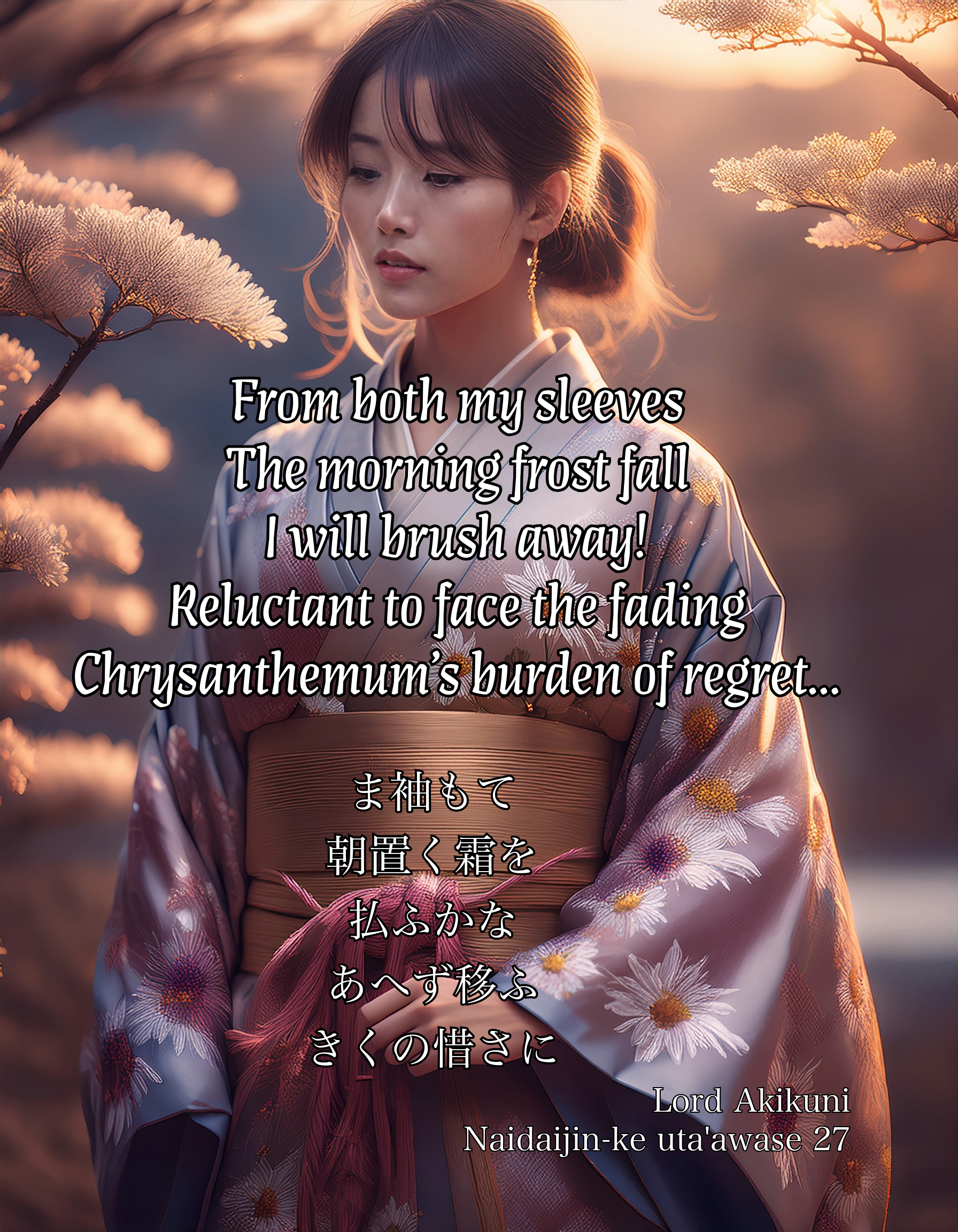
ま袖もて朝置く霜を払ふかなあへず移ふきくの惜さに
| masodemote asa oku shimo o harau kana aezu utsurou kiku no oshisa ni | From both my sleeves The morning frost fall I will brush away! Reluctant to face the fading Chrysanthemum’s burden of regret… |
Lord Akikuni
27
Right (Both Judges – Win)
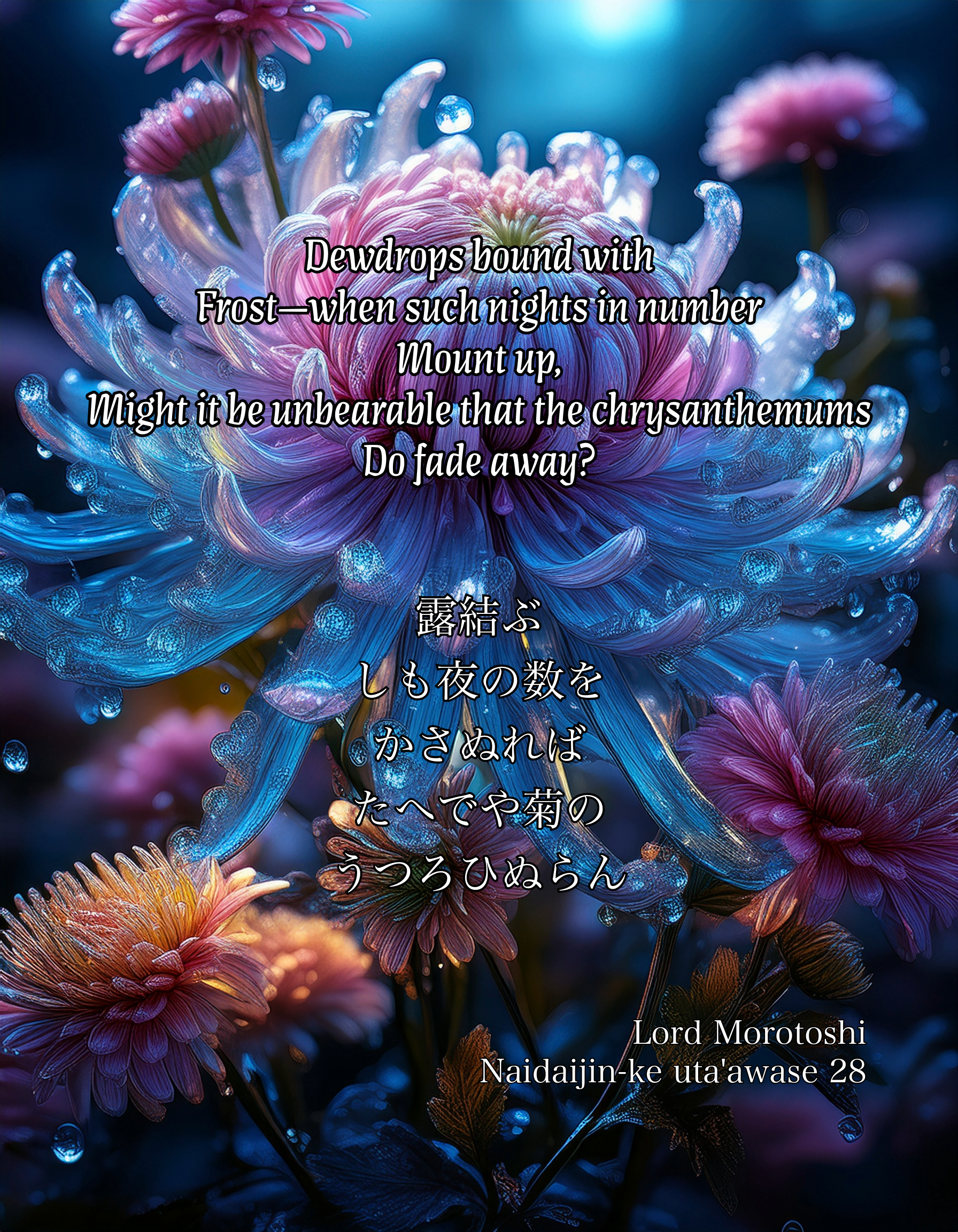
露結ぶしも夜の数をかさぬればたへでや菊のうつろひぬらん
| tsuyu musubu shimo yo no kazu o kasanureba taede ya kiku no utsuroinuran | Dewdrops bound with Frost—when such nights in number Mount up, Might it be unbearable that the chrysanthemums Do fade away? |
Lord Morotoshi
28
Toshiyori states: the first poem is extremely charming. Nevertheless, I must question the use of ‘reluctant to face the fading’ as I feel this is something I have not heard before. I can grasp the sense of diction such as ‘unable to do anything about’ or ‘without taking on autumn hues’, but did the poet mean to use the diction ‘unbearable’, perhaps? Even though this is somewhat archaic phrasing, it is used in composition. This poem’s expressions, though, I feel are somewhat unfamiliar. The conception and diction of the second poem are both extremely charming. However, this poem, too, is vague. What is going on with the initial ‘dewdrops bound’? Does it mean that the dewdrops get turned into frost? If so, then, from what is known of the calendar, this is something which only occurs on a single night, and from the following night there is only frost. It sounds as if the conception of this poem, though, is that night after night dew turns to frost, and this would be a fault. Despite this vagueness, however, its tone is elegant, so it seems superior.
Mototoshi states: the poem of the Left has a poetic configuration, but I strongly feel that it would have been preferable not to use the diction ‘both my sleeves’. It does seem as if this was used in the ancient Collection of a Myriad Leaves, but even given that was the case, in the preface to the Ancient and Modern, I recall it saying, ‘On examining the poems of ancient times, we find they use many archaic expressions. These were there not just to please the ear, but simply for moral instruction’. It appears that there are no instances of this piece of diction being used in poetry matches from the period of the Ancient and Modern, Later Selection and Gleanings, and these were all conducted for entertainment. Even in a poetry match conducted in Engi 12 [912], when the term ‘sleeve’ was used, I get the feeling that it was such a source of amusement that the poem was not recited. While the quality of the Right’s poem is not superb, the tone of ‘Dewdrops bound with / Frost—when such nights in number’ is not bad, so I feel the dew can still remain bound!
Lingering Chrysanthemums
Round One
Left (Both Judges – Win)
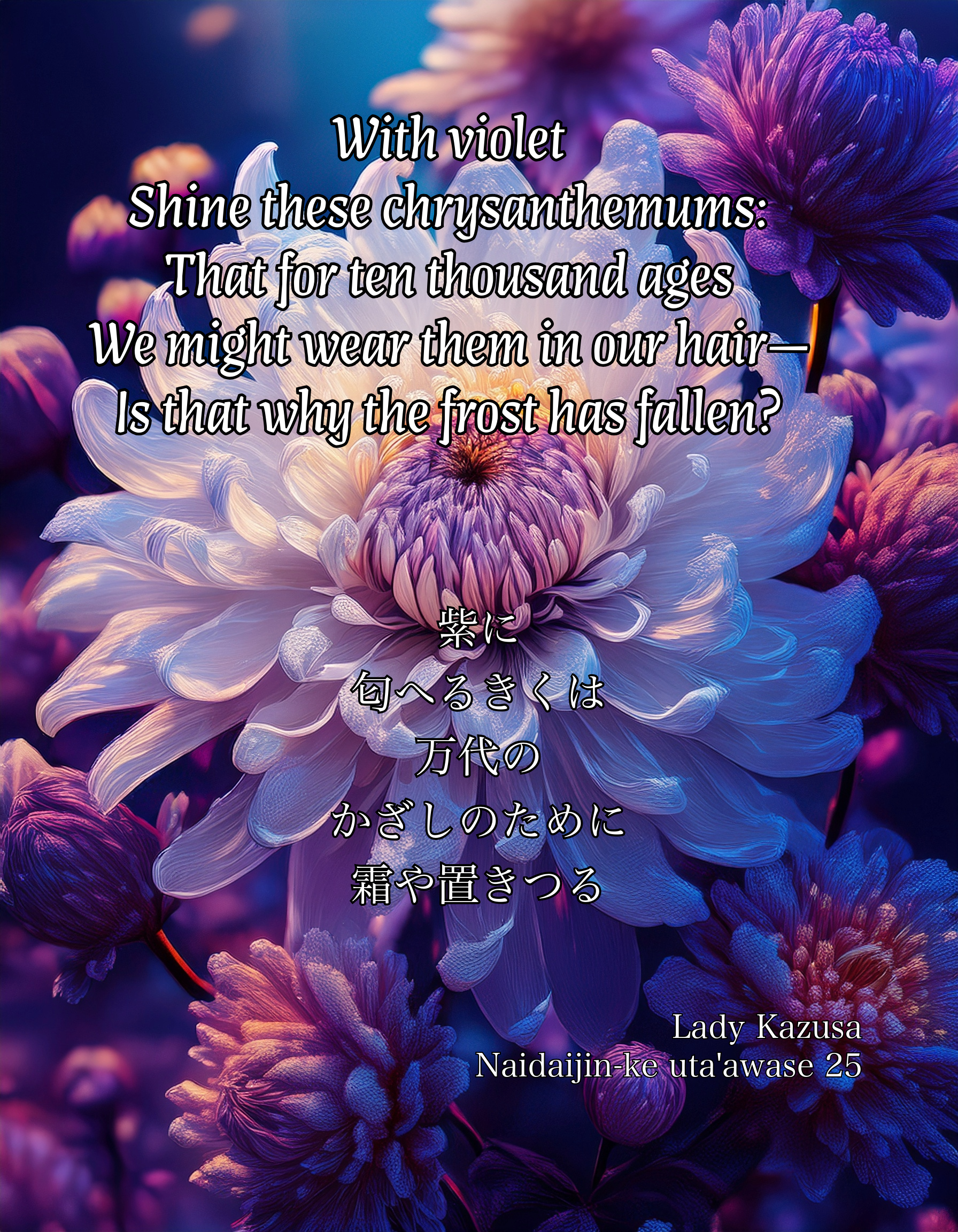
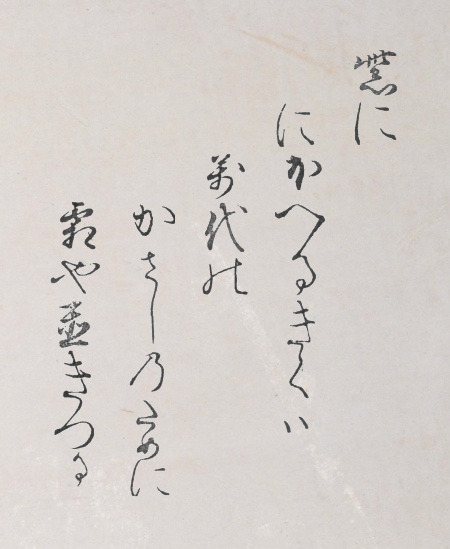
紫に匂へるきくは万代のかざしのために霜や置きつる
| murasaki ni nioeru kiku wa yorozuyo no kazashi no tame ni shimo ya okitsuru | With violet Shine these chrysanthemums: That for ten thousand ages We might wear them in our hair— Is that why the frost has fallen? |
Lady Kazusa
25
Right
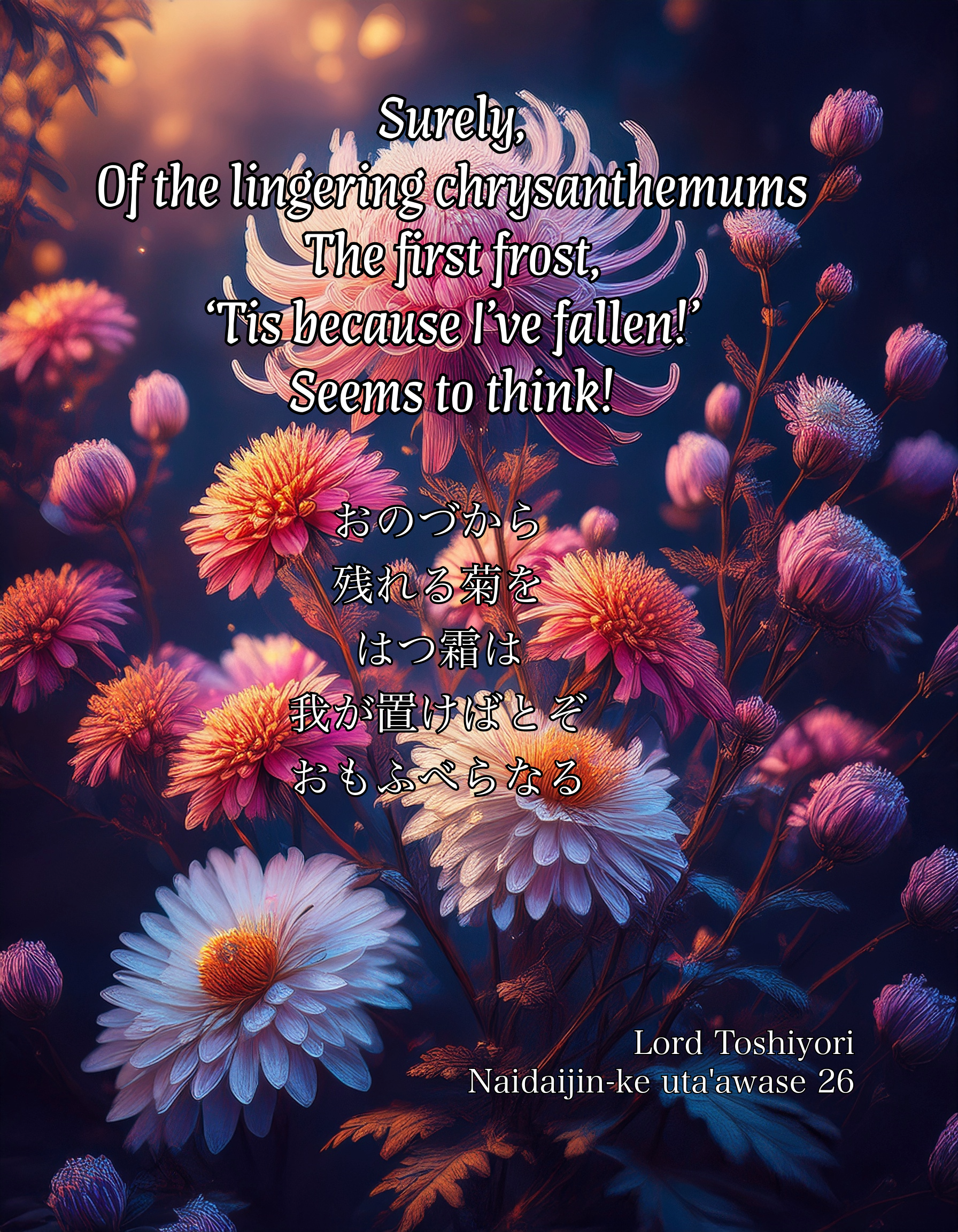
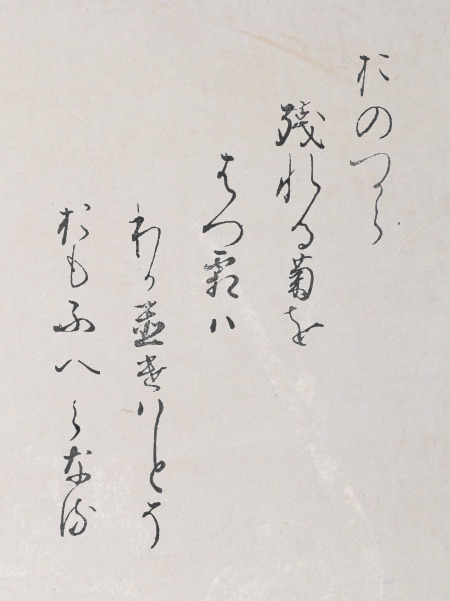
おのづから残れる菊をはつ霜は我が置けばとぞおもふべらなる
| onozukara nokoreru kiku o hatsushimo wa wa ga okeba to zo omouberanaru | Surely, Of the lingering chrysanthemums The first frost, ‘Tis because I’ve fallen!’ Seems to think! |
Lord Toshiyori
26
Toshiyori states: while the first poem is not remarkable, it does sound smooth. The concluding ‘has fallen’, though—would it be excessive to say that I feel it’s a bit grating? In the second poem, the assembled company have stated that ‘seems to’ is something that they have never heard before in their lives and given that they have said that this is what it sounds like, I make the Left the winner.
Mototoshi states: ‘With violet / Shine these chrysanthemums’ sounds appropriately poetic, but saying ‘that…we might wear them in our hair’ followed by the final ‘has fallen’ is a sequencing that is, in great part, inharmonious and lacking in gentle beauty. Nevertheless, I feel that the second poem’s ‘Surely, / Of the lingering chrysanthemums’ and the final ‘seems to’ is so unfamiliar that it makes me wonder what is going on with the sequencing there, so a single dipping in violet dye is superior and, I feel, all the sweeter!