Tag Archives: pines

Sumiyoshi-sha uta’awase kaō ni-nen 60

Round Ten

Left (Win)

かぞふればやとせへにけりあはれわがしづみしことはきのふとおもふに

kasoureba
yatose henikeri
aware wa ga
shizumishi koto wa
kinō to omou ni
When I count them up,
Many years have passed, but
Sadness
Overcomes me for the events
Of yesterday, I feel…

Lord Sanesada
119

Right

いたづらにふりぬるみをもすみよしのまつはさりともあはれしるらむ

itazura ni
furinuru mi o mo
sumiyoshi no
matsu wa sari tomo
aware shiruramu
How quickly
Age has come upon my flesh, too—
Sumiyoshi’s
Pines must that
Sadness know too well…

Lord Toshinari
120

The poem of the Left: these are not matters which could be understood by just anyone, yet even a superficial glance at it reveals that its conception and configuration display and exceptional sadness. How true it is that off all the myriad things in our lives it is the events of yesterday and today that we recall, and this is how we pass through the years and months, so how difficult, indeed, it is to supress the configuration of ‘When I count them up, / Many years have passed’! As for the Right’s poem, well, the conception of the initial section is pedestrian at best, although the latter section does seem to have some conception to it in places and shows some signs of thought. It is the poor composition of the judge, who is into his dotage. Once more, therefore, I have not rendered judgement, however, I feel that the deity would determine in favour of the Left.

Sumiyoshi-sha uta’awase kaō ni-nen 59

Round Nine

Left

いとふともなきものゆゑによのなかのあはれをさすがうちなげきつつ

itou tomo
naki mono yue ni
yo no naka no
aware o sasu ga
uchinagekitsutsu
With despite I regard it not, yet
This mundane world
Has such sadness, that
Ever am
I grief-stricken…

Lord Sanefusa
117

Right (Win)

いたづらにとしもつもりのうらにおふるまつぞわがみのたぐひなりける

itazura ni
toshi mo tsumori no
ura ni ouru
matsu zo wa ga mi no
tagui narikeru
How quickly
The years have piled up; on Tsumori
Shore grow
Pines – my sorry self, indeed,
Do they resemble!

Lord Yorimasa
118

The poem of the Left has a configuration which directly expresses a single emotion. Its conception sounds in keeping with this. The poem of the Right begins with ‘The years have piled up; on Tsumori / Shore grow’ and continues with ‘Pines – my sorry self, indeed’ which appears very pleasant. Thus, the Right wins.

Tōin senzai awase 01

The Garden Match held by the Chancellor at the Eastern Mansion

When His Lordship, the Chancellor, was having the Eastern Mansion refurbished, he divided his sons into teams and having a large number of charming plants grown in pots on the eastern and western sides of the main hall, he matched poems composed on the names of these plants. These poems are as follows.

Left – Pine

あだしきのちるにもさらににぬまつはちとせこえふるしるべなりけり

adashiki no
chiru ni mo sara ni
ninu matsu wa
chitose koefuru
shirube narikeri
The other trees’
Scattering is e’en more
Unlike the pines—
Passing through a thousand years
Is their singular sign.

1a

あたらしき春にもさらににぬまつはちとせこえこぬしるべなりけり

atarashiki
haru ni mo sara ni
ninu matsu wa
chitose koekonu
shirube narikeri
A new
Spring is e’en more
Unlike the pines—
That it last not a thousand years
Is a singular sign.

1b

Right

たれもみなちとせこえくるまつにのみひさしきことはならへとぞ思ふ

tare mo mina
chitose koekuru
matsu ni nomi
hisashiki koto wa
narae to zo omou
Every single one, without exception,
Passes through a thousand years—
That the pines, alone,
Are eternal:
Learn that! Or so I feel…

2

Sumiyoshi-sha uta’awase kaō ni-nen 49

Round Twenty-Four

Left (Win)

かぜのおとにわきぞかねましまつがねのまくらにもらぬしぐれなりせば

kaze no oto ni
waki zo kanemashi
matsu ga ne no
makura ni moranu
shigure nariseba
The gusts of wind
I cannot tell apart from
The rustle of the pines roots
For my pillow should no drips
From the shower fall…

Lord Sanefusa
97

Right

たびのいほはあらしにたぐふよこしぐれしばのかこひにとまらざりけり

tabi no io wa
arashi ni taguu
yoko shigure
shiba no kakoi ni
tomarazarikeri
My traveller’s hut
Is lashed by the storm wind’s
Sideways showers—
The brushwood walls
Halt it not at all.

Lord Yorimasa
98

The conception and configuration of the poem of the Left, starting ‘I cannot tell apart from / The rustle of the pines’ and continuing ‘For my pillow should no drips / From the shower fall’ is, once again, truly exceptional! As for the poem of the Right, while it appears to have a charming style and use of diction, even if it is the case that ‘sideways showers’ are a genuine phenomenon, it fails to sound particularly elegant, doesn’t it. In addition, the latter section of the poem, ‘the brushwood walls’, feels slightly lacking in conception. Thus, I make the Left the winner.

Sumiyoshi-sha uta’awase kaō ni-nen 47

Round Twenty-Two

Left

いなむしろしきつのうらのまつかぜはもりくるをりぞしぐれともしる

inamushiro
shikitsu no ura no
matsukaze wa
morikuru ori zo
shigure to mo shiru
A straw mat spread
At Shikitsu Bay, where when
On the wind through the pines
Come dripping droplets
I know a shower is falling!

Lord Kiyosuke
93

Right (Win)

おほぞらもみやこのかたをしのぶらしこよひはことにうちしぐれつつ

ōzora mo
miyako no kata o
shinoburashi
koyoi wa koto ni
uchishiguretsutsu
The heavens, too,
Of the capital
Think fondly, it seems,
For tonight is especially
Filled with constant showers…

Lord Sanetsuna
94

The poem of the Left appears to have a pleasant conception, blending showers with the wind through the pines and saying, ‘Come dripping droplets / I know a shower is falling!’, but it appears that the straw mat has only been spread because of the reference to Shikitsu [spreading] Bay. Considering the actual nature of a straw mat, however, I do not feel that the sense links with Shikitsu Bay, although it would be charming if sleeping on a journey in the shade of the willows beside a river, or even in a hut among the rice-fields. I do not feel it is appropriate to spread a straw mat beneath the pines at Sumiyoshi. In addition, it is only the straw mat here which has the conception of a journey—how should one feel about that? The configuration of the Right’s poem, beginning with ‘The heavens, too’ and following with ‘Of the capital / Think fondly, it seems’, I would say is a poem for a poetry match. While a counter-argument has been made about the Left’s poem, it’s really asking for the impossible, isn’t it. So, I impose victory for the Right.

Sumiyoshi-sha uta’awase kaō ni-nen 45

Round Twenty

Left

たびねするいそのとまやのむらしぐれあはれをなみのうちそへてける

tabinesuru
iso no tomaya no
murashigure
aware o nami no
utchisoetekeru
Dozing on my travels
In a sedge-thatched hut upon the rocky shore,
The cloudbursts’
Sadness with that of the waves
Is laced.

Lord Sane’ie
89

Right (Win)

もりもあへずまだきにぬるるたもとかなこずゑしぐるるまつのしたぶし

mori mo aezu
mada ki ni nururu
tamoto kana
kozue shigururu
matsu no shitabushi
No drips
Yet have come to my soaking
Sleeves—
The treetops showered, as
Beneath the pines I lay me down.

Atsuyori
90

The Left’s sound of the waves ‘In a sedge-thatched hut upon the rocky shore… Sadness with that of the waves / Is laced’ does, indeed, convey an inference of sadness, but the concluding ‘is laced’ sounds a bit inappropriate. The Right’s conception and configuration, too, are extremely charming. ‘Beneath the pines I lay me down’ is, I think, a novel construction—although I do get the impression that that it sounds like something which has prior precedent. Still, saying ‘No drips / Have yet come to my soaking’ and then ‘The treetops showered, as / Beneath the pines’ means that the sound conveys the loneliness as it truly is. Thus, again, the Right wins.

Sumiyoshi-sha uta’awase kaō ni-nen 39

Round Fourteen

Left

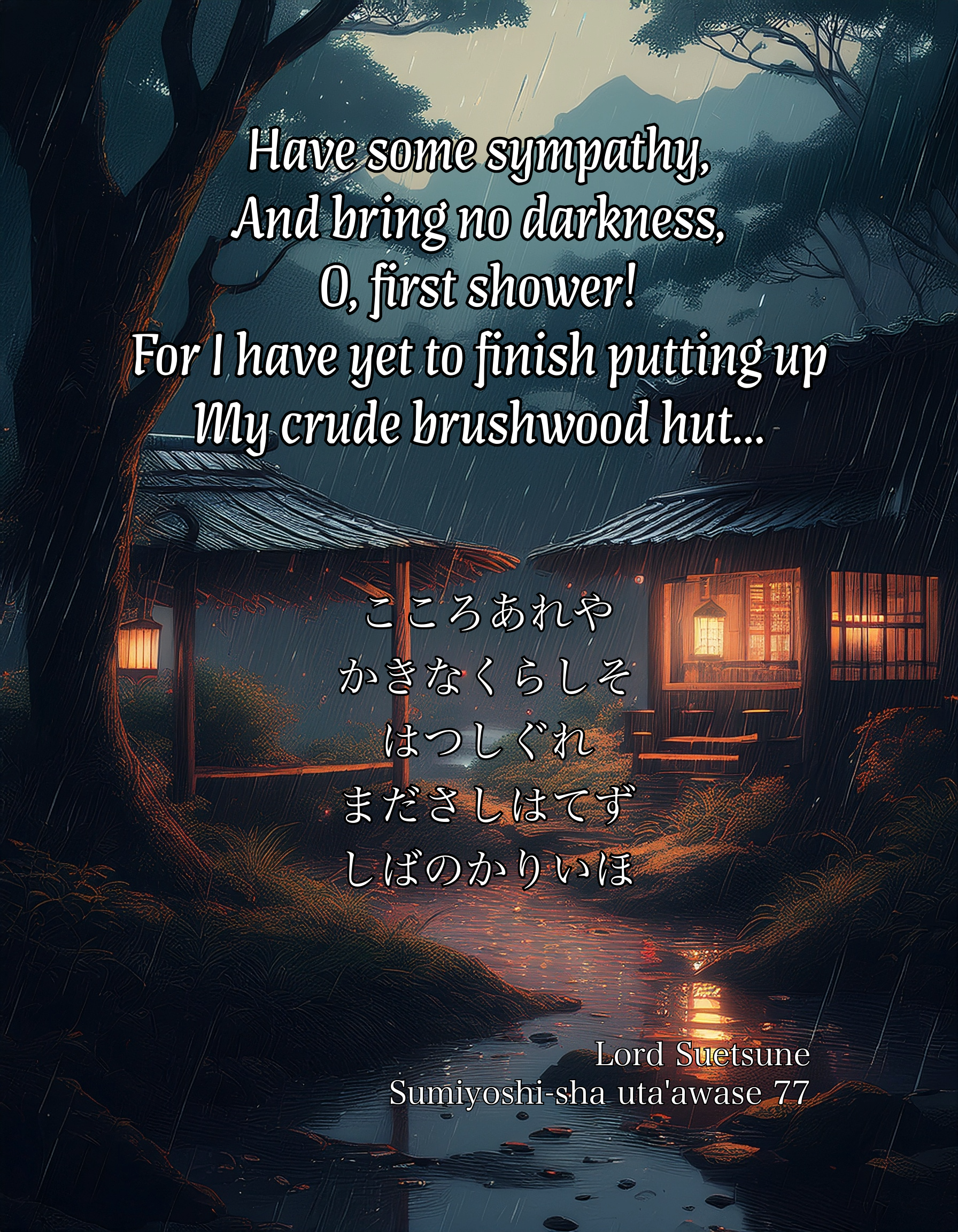
こころあれやかきなくらしそはつしぐれまださしはてずしばのかりいほ

kokoro are ya
kaki na kurashi so
hatsushigure
mada sashihatezu
shiba no kari’io
Have some sympathy,
And bring no darkness,
O, first shower!
For I have yet to finish putting up
My crude brushwood hut…

Lord Suetsune
77

Right (Win)

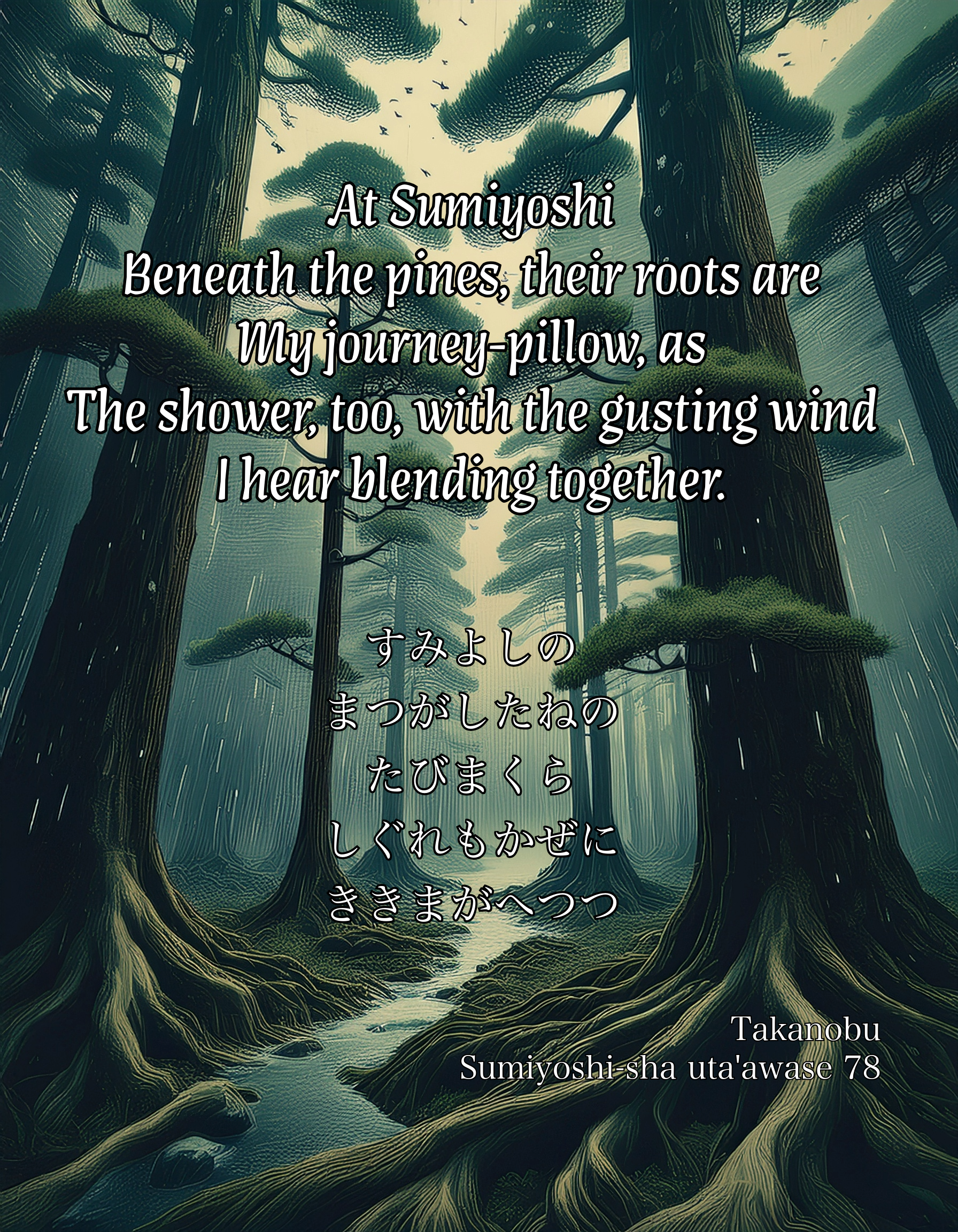
すみよしのまつがしたねのたびまくらしぐれもかぜにききまがへつつ

sumiyoshi no
matsu ga shita ne no
tabimakura
shigure mo kaze ni
kikimagaetsutsu
At Sumiyoshi
Beneath the pines, their roots are
My journey-pillow, as
The shower, too, with the gusting wind
I hear blending together.

Takanobu
78

The Left’s latter section, which states that the poet has ‘yet to finish putting up’ his hut, has a truly charming configuration as a poem on the conception of travel, but the phrase ‘have some sympathy’ does not appear to be a conception which has prior precedent. It could be a way of expressing the emotion through the shower. As for the Right, while I do question the sound of ‘journey-pillow’, it is the case that in Cathay-style poems this appears, but what are we do to about the fact that this is not ‘pillow on my journey’, I wonder? The sequencing of ‘the shower, too, with the wind’ is pleasant, isn’t it. Thus, I make the Right the winner.

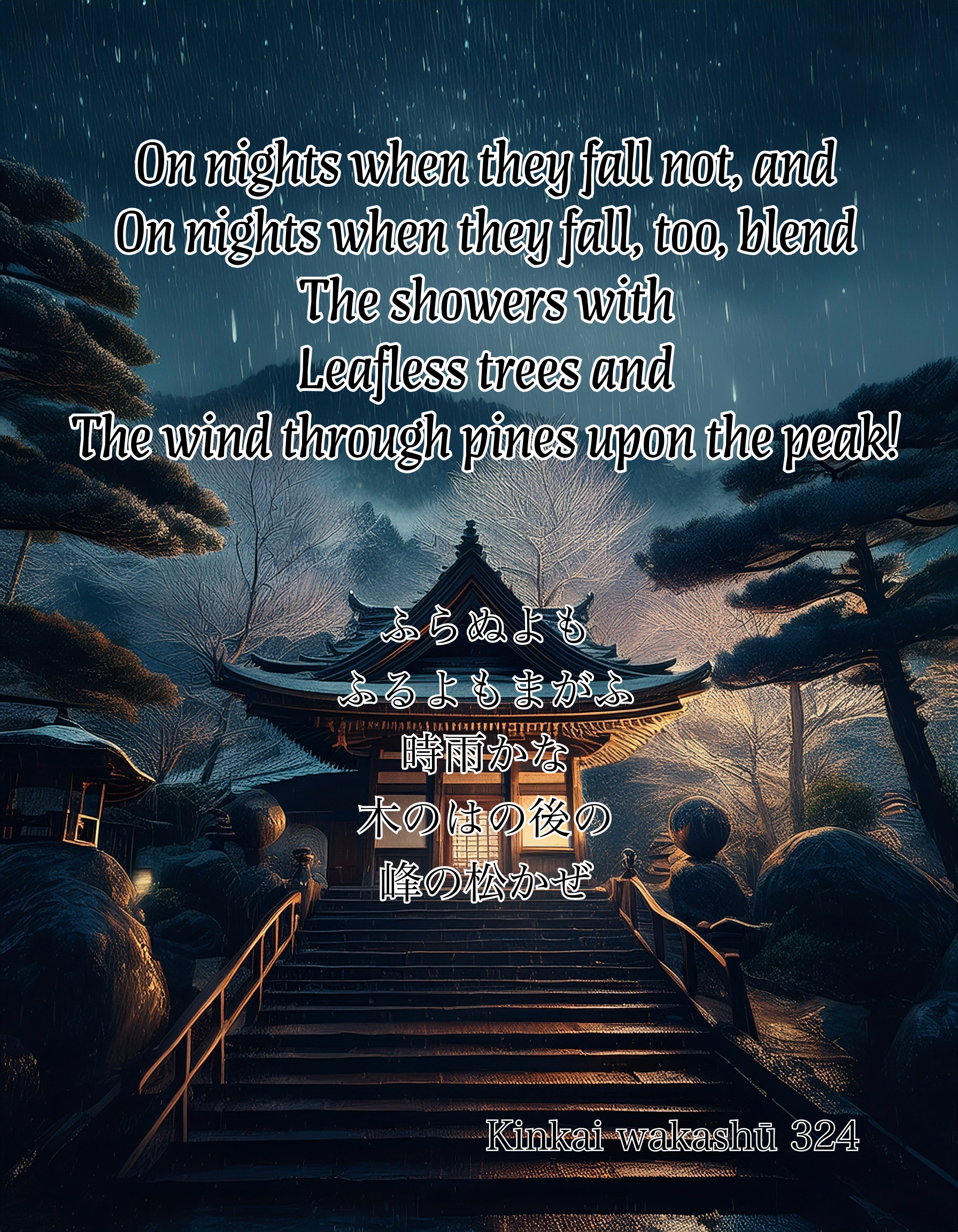
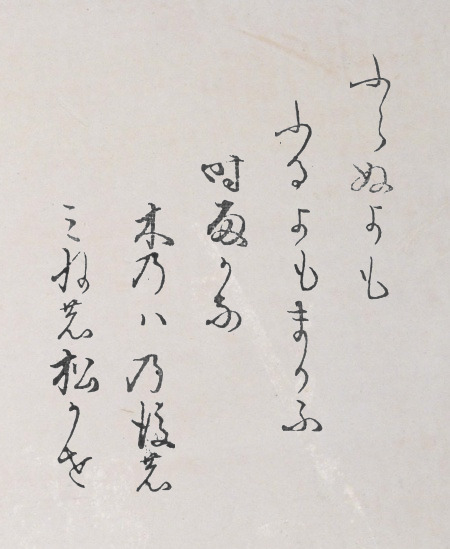
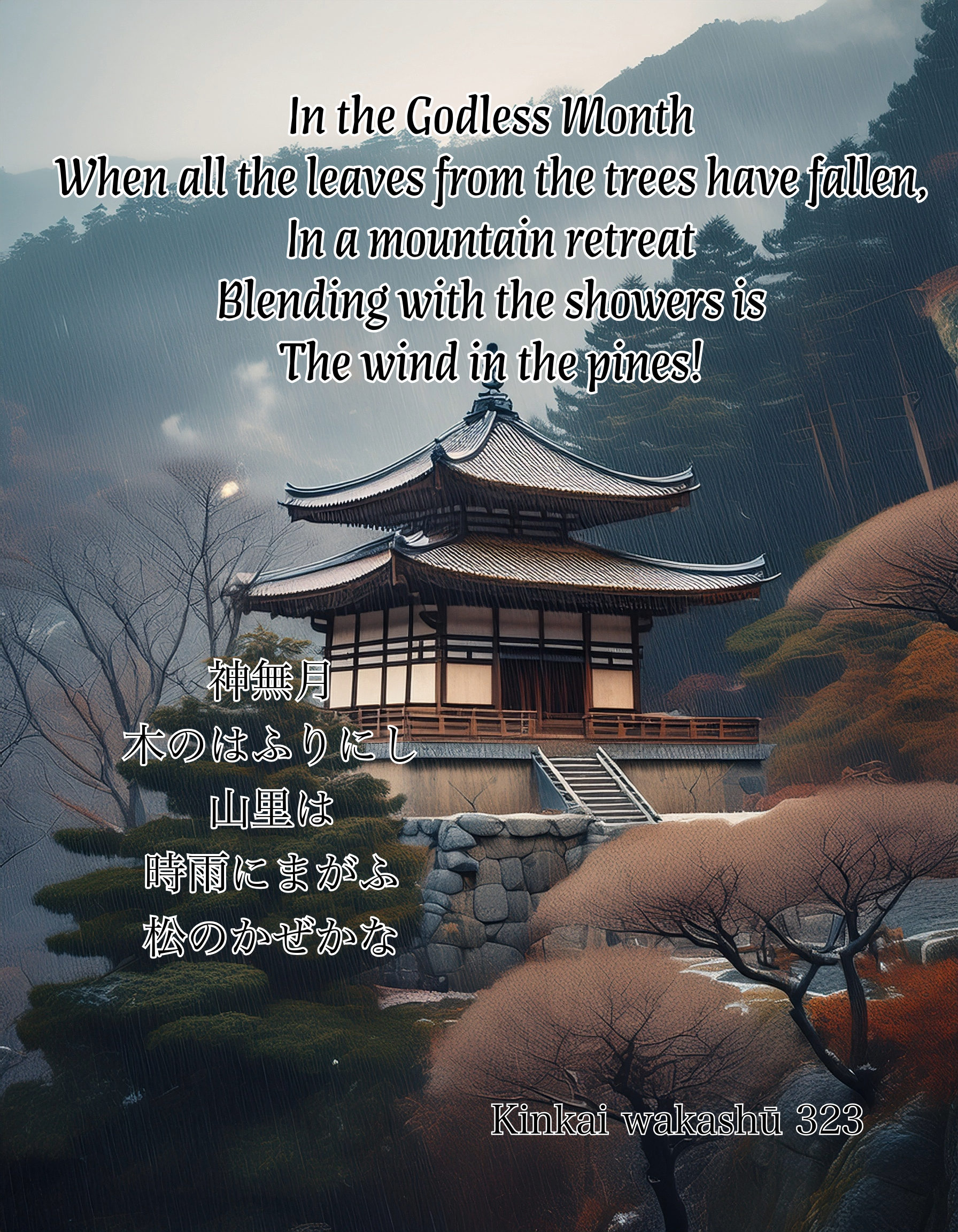
Kinkai wakashū 323

The wind through the pines sounding like a shower

神無月木のはふりにし山里は時雨にまがふ松のかぜかな

kamidazuki
ko no ha furinishi
yamazato wa
shigure ni magau
matsu no kaze kana
In the Godless Month
When all the leaves from the trees have fallen,
In a mountain retreat
Blending with the showers is
The wind in the pines!

Sumiyoshi-sha uta’awase kaō ni-nen 25

Left (Tie)

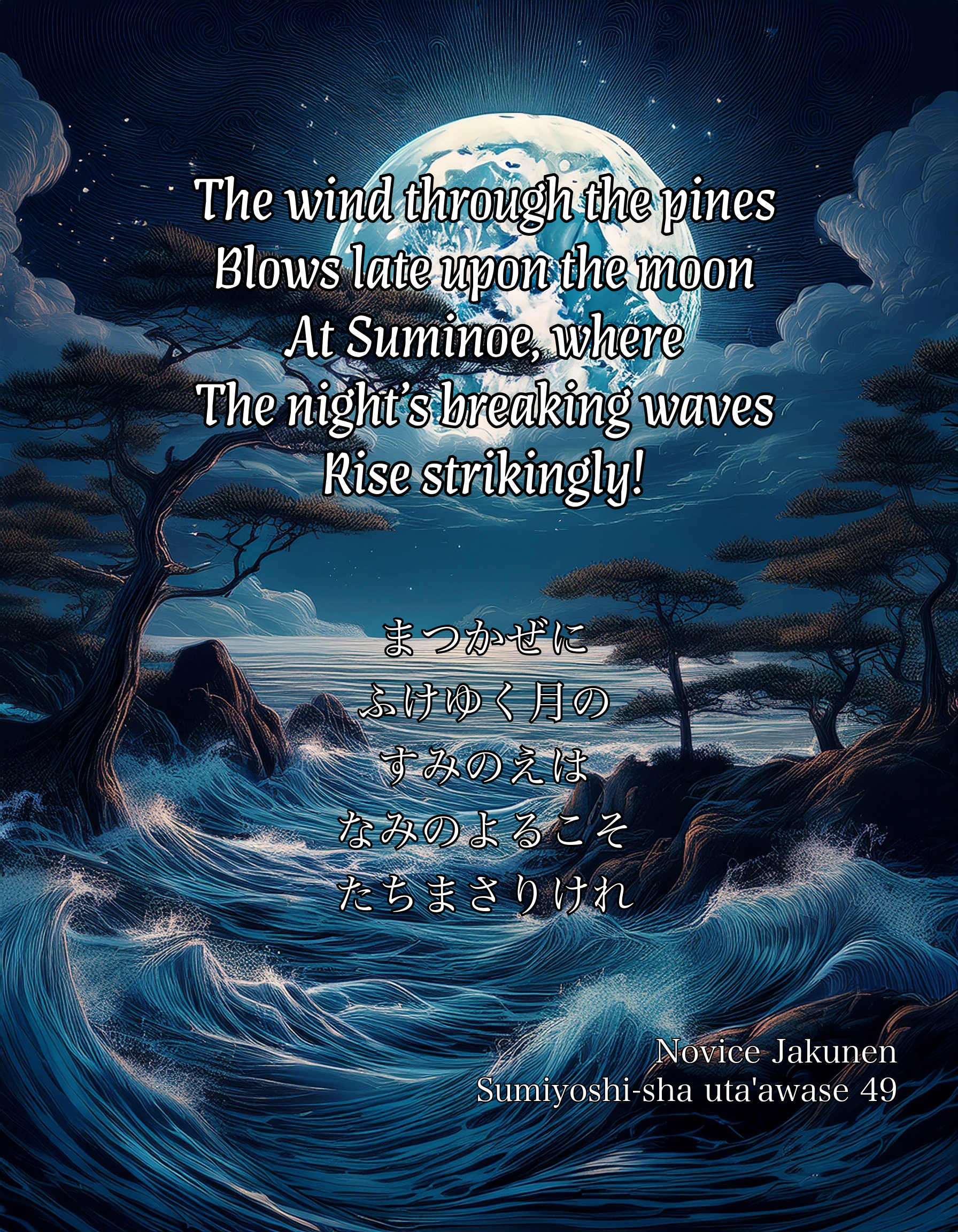
まつかぜにふけゆく月のすみのえはなみのよるこそたちまさりけれ

matsukaze ni
fukeyuku tsuki no
suminoe wa
nami o yoru koso
tachimasarikere
The wind through the pines
Blows late upon the moon
At Suminoe, where
The night’s breaking waves
Rise strikingly!

Novice Jakunen[1]
49

Right

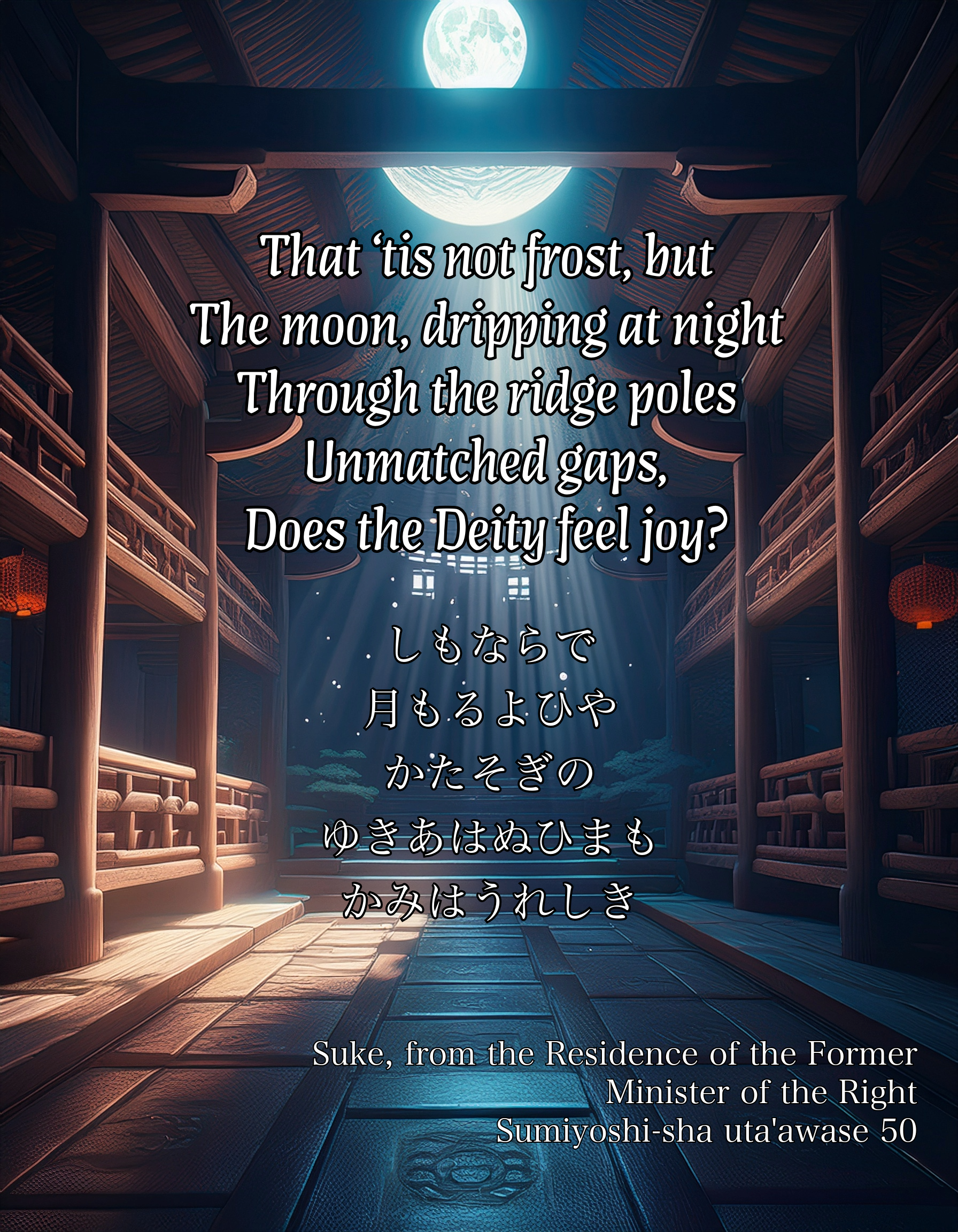
しもならで月もるよひやかたそぎのゆきあはぬひまもかみはうれしき

shimo narade
tsuki moru yoi ya
katasogi no
yukiawanu hima mo
kami wa ureshiki
That ‘tis not frost, but
The moon, dripping at night
Through the ridge poles
Unmatched gaps,
Does the Deity feel joy?

Suke, from the Residence of the Former Minister of the Right[2]
50

The Left poem’s ‘Blows late upon the moon / At Suminoe’ sounds pleasant, but there have been recent poems, such as ‘Brings waves–that / I would tell you!’[3] and ‘Simply with the waves / Did seem to draw near with the night’[4] and while the initial section of the poem here differs, basing a poem on this is not that unusual, I think. The tone of the Right’s poem is charming, but it does not seem likely that the Deity would feel joy simply at the moon coming through the gaps in His ridgepoles. The Deity’s power is limitless and wards eighty isles beyond Sumiyoshi—indeed, there is nowhere in Tsumori’s shore or Sumiyoshi beach, above the waves or in the shad of the pines that it does not reach. I have discussed ridgepoles earlier. Nevertheless, the configuration of the poem isn’t bad, so these should tie, I think.


[1] Shami Jakunen 沙弥寂念

[2] Zen-udaijin no ie no Suke前右大臣家佐

[3] 人しれぬ思ひありそのはま風に浪のよるこそいはまほしけれ hito shirenu omoi ariso no hamakaze ni nami no yoru koso iwamahoshikere ‘Unknown to all / My passion burns—toward a rocky / Beach the breeze / Brings waves–that / I would tell you!’ Middle Captain Toshitada (Horikawa-in enjo awase 17/KYS (2) 468/500)

[4] Composed when he was asked by people in the capital what the moon had been like, when he had returned there, after going to Akashi to gaze upon it, at a time when it was particularly bright. 有明の月もあかしの浦風に波ばかりこそよるとみえしか ariake no tsuki mo akashi no urakaze ni nami bakari koso yoru to mieshika ‘The dawntime Moon’s brightness, with Akashi’s / Beach breezes / Simply with the waves / Did seem to draw near with the night…’ Taira no Tadamori (KYS (2) III: 216/KYS (3) III: 212)