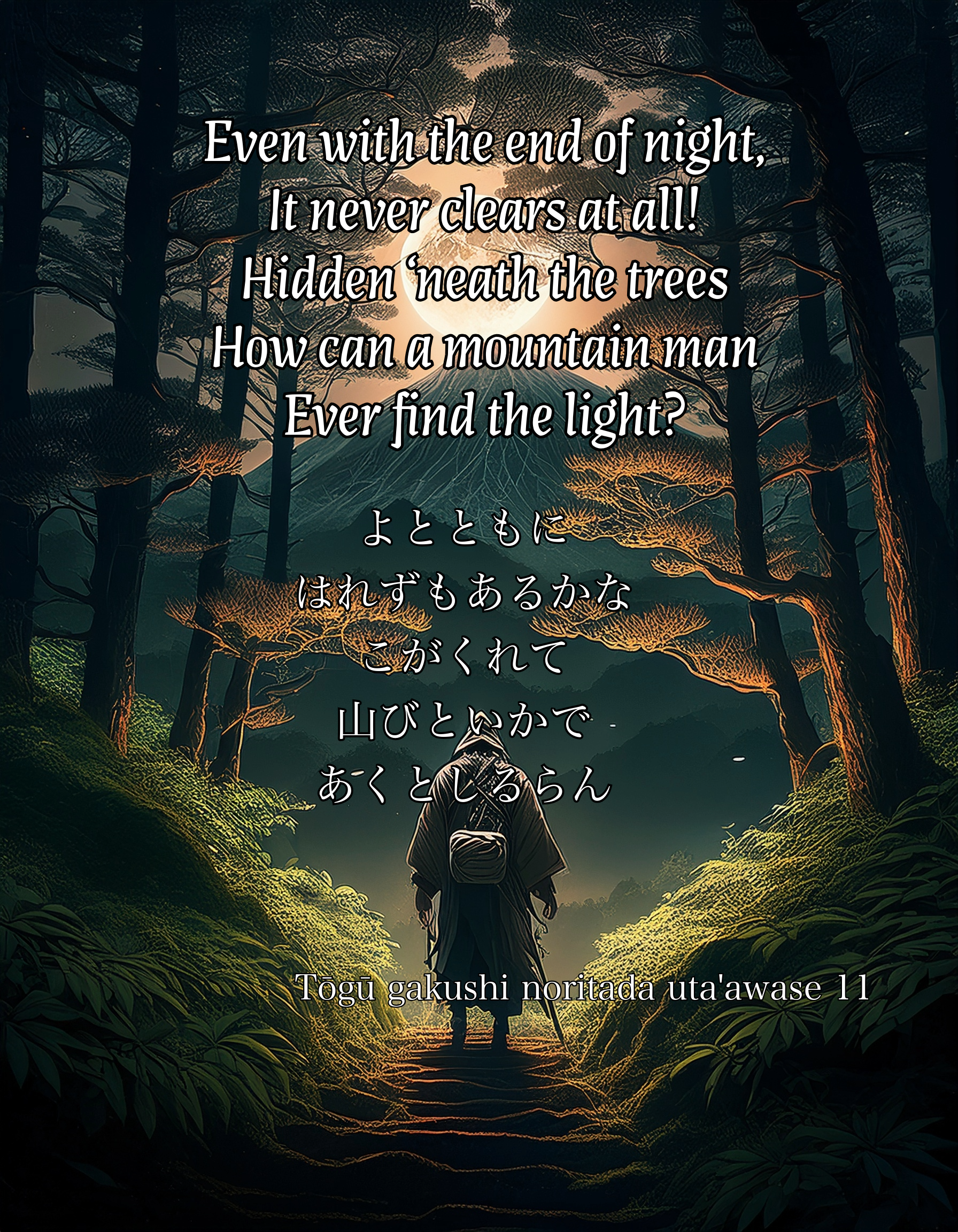
yo to tomo ni harezu mo aru kana kogakurete yamabito ikade aku to shiruran
Even with the end of night, It never clears at all! Hidden ‘neath the trees How can a mountain man Ever find the light?
11
Right
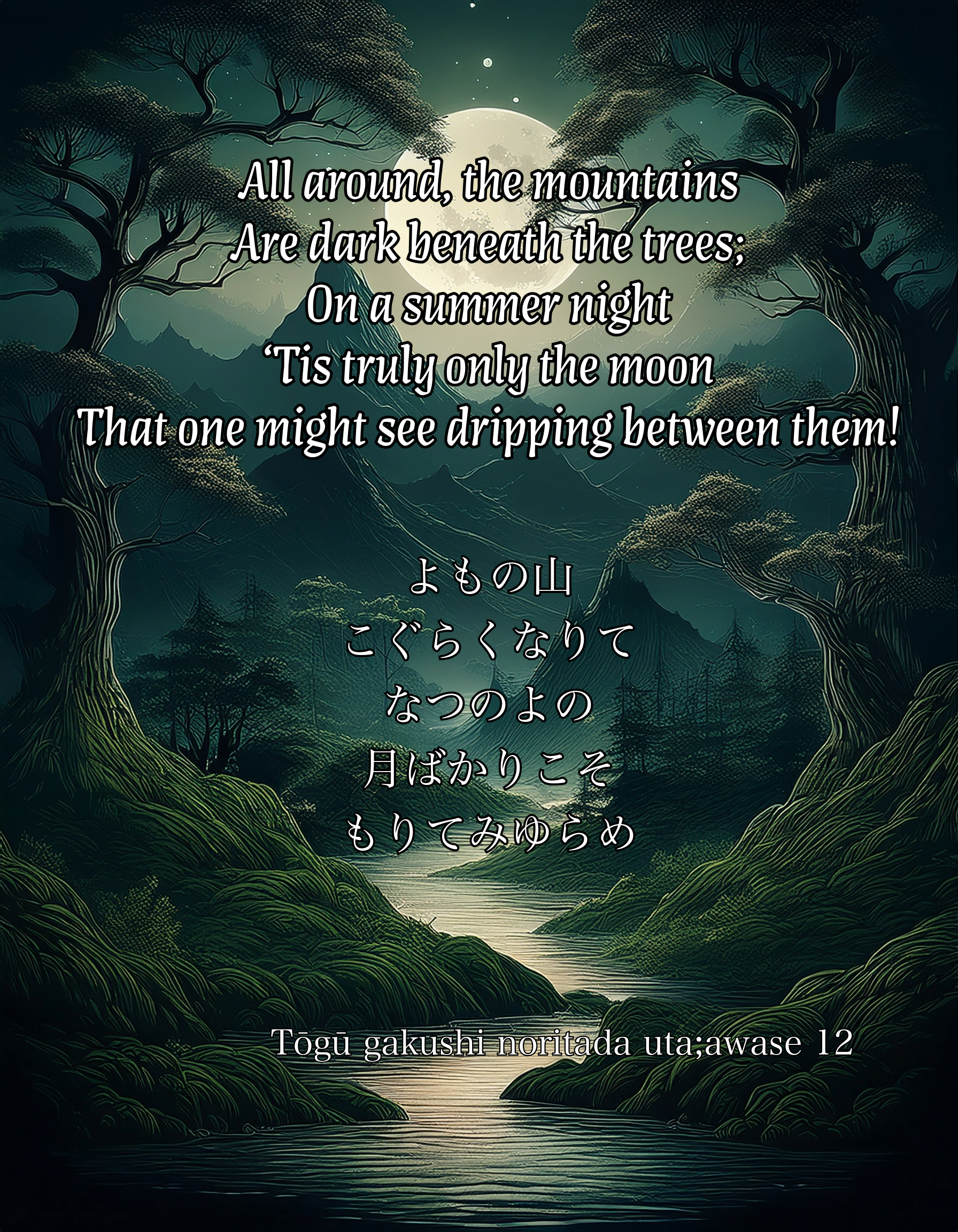
よもの山こぐらくなりてなつのよの月ばかりこそもりてみゆらめ
yomo no yama koguraku narite natsu no yo no tsuki bakari koso morite miyurame
All around, the mountains Are dark beneath the trees; On a summer night ‘Tis truly only the moon That one might see dripping between them!
12
This topic refers to a hunted stag concealed among the trees in the summer mountains. There is not a particular strong feeling of either evergreen or other types of mountain forests,[ii] but the Left’s poem has ‘Even with the end of night’, forgetting that this implies a season of biting wind and showers striking the leaves on the trees—thus the darkness here is excessively conceived. While the Right takes ‘dark shade’ as an opportunity to compose with the elevated conception of the moon dripping between the trees—and surpasses the peaks in doing this—I wonder if the conceptions of both poems don’t contain brightness? Thus, both Left and Right are examples of the ‘Reizei Palace’,[iii] so I would decide on a tie for these.
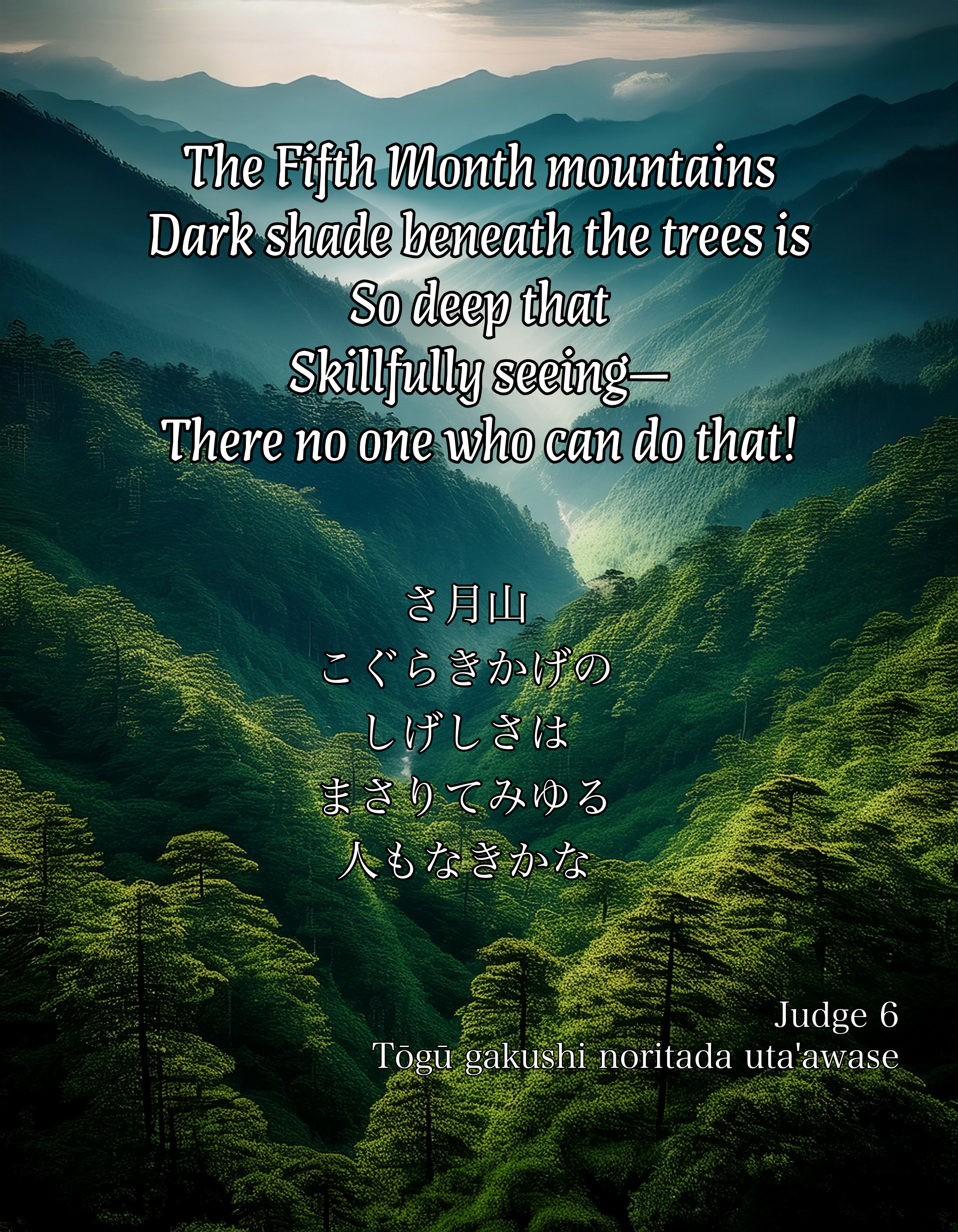
さ月山こぐらきかげのしげしさはまさりてみゆる人もなきかな
satsuki yama koguraki kage no shigeshisa wa masarite miyuru hito mo naki kana
The Fifth Month mountains Dark shade beneath the trees is So deep that Skillfully seeing— There no one who can do that!
kumo kakaru takashi no yama no akegure ni tsuma madowaseru oshika naku nari
All hung about with cloud On Takashi Mountain In the gloaming Having lost his mate A stag bells out.
Nakamasa 11
Right
山がつの先あかつきをしりがほに裾野に出でて鹿ぞ鳴くなる
yamagatsu no mazu akatsuki o shirigao ni susono ni idete shika zo naku naru
A mountain man First of all, that ‘tis dawn Knows plain upon his face, As he sets out upon the slopes As a stag bells out!
Head 12
The Left poem’s conclusion, ‘Having lost his mate / A stag bells out’ seems no different from that of a poem by Gō no Jijū in poetry match held by the First Princess.[1] As for the poem of the Right’s ‘A mountain man / Awaits the dawn / Knowing plain upon his face’—what on earth might a mountain man look like while waiting for dawn? There is the tale of Hangu Pass in Cathay, where the barrier guard was waiting for dawn and opened the gate after hearing a cock’s crow, but the expression ‘a mountain man awaits the dawn’ has never appeared before in a poem—either one of Cathay or in the words of Yamato, so I feel that both Left and Right lack any superlative qualities.
[1] Stags. をぐら山たちどもみえぬゆふぎりにつままどはせるしかぞなくなる ogurayama / tachidomo mienu / yūgiri ni / tsuma madowaseru / shika zo nakunaru ‘On gloomy Ogura Mountain / Stands unseen / Among the evening mists / Having lost his mate / A belling stag.’ (Yūshi naishinnō-ke uta’awase eishō go-nen 27). This event was held at the residence of Imperial Princess Sukeko (Yūshi) on the 5th day of the Sixth Month, Eishō 5 [26.10.1050]. The poem won its round, and was later included in Goshūishū (IV: 292).
hito shirezu harenu nageki no aru mono o amaneku terase aki no yo no tsuki
Unknown to all A grief which never clears I have, so Shine without restraint, O, moon this autumn night!
His Excellency, Nagazane, Former Assistant Governor General of Dazai 3
Right
山の端のうき雲晴れてすみのぼる月と共にもゆくこころかな
yama no ha no ukigumo harete suminoboru tsuki to tomo ni yuku kokoro kana
At the mountains’ edge The drifting clouds unfurl, and Clearly climbing With the moon Goes my spirit!
Lady Hyōenokami 4
In the poem of the Left, the expression following ‘A grief which never clears / I have, so’ is both forceful and lacking in gentility; in addition, the poem of the Right’s ‘drifting clouds clear away’ and what follows seems stagnant, so the light of the moon these nights seems to be of the same standard.
kimi ga yo wa nagai no ura no hamakaze ni tatsu shiranami no kazu mo shirarezu
My Lord’s reign: At Nagai Bay The beach breezes Rouse the whitecaps In number entirely unknown.
Controller’s Graduate 65
Right
きみがよをまつちのやまのこまつばらちよのけしきを見るぞうれしき
kimi ga yo o matsuchi no yama no komatsubara chiyo no keshiki o miru zo ureshiki
My Lord’s reign Awaiting upon Matsuchi Mountain The pine seedling groves The sight for a thousand ages Joyfully will see!
Kerin’in Graduate 66
It’s impossible to decide on a winner or loser between the Left and the Right here in terms of conception, diction and overall style. To put it in general terms, I must make this round a further tie.
Neither Left nor Right is remarkable, but nor do they have any faults to mention. I’d make this round a tie.
kimi ga yo wa kami ni zo inoru suminoe no matsu no chitose o yuzure to omoeba
My Lord’s reign: To the gods I pray, that Suminoe’s Pines their thousand years Pass on—that is my hope…
Retired from the World 61a
きみがへむやちよのかずはあめにますとよをかひめの神やしるらん
kimi ga hemu yachiyo no kazu wa ame ni masu toyo’okahime no kami ya shiruran
That my Lord will endure The number of eight thousand ages— Residing in the heavens, The Goddess of the Eternal Hills, The deity, knows well, no doubt!
Retired from the World 61b
Right (Win)
君がよはつきじとぞおもふ春の日の御笠の山にささむかぎりは
kimi ga yo wa tsukiji to zo omou haru no hi no mikasa no yama ni sasamu kagiri wa
My Lord’s reign Will never fade, I feel! While in spring the sun Upon Mikasa Mountain Shines down…
Senior Assistant Minister Past Lecturer 62
Both Left and Right have neither strengths nor weakness in their diction and sense, but I feel that ‘While in spring the sun / Upon Mikasa Mountain / Shines down’ is a bit more dependable at present than ‘Suminoe’s / Pines their thousand years’.
It is certainly not the case that there are no dubious elements about the Left’s poem. As ‘eight thousand ages’ is a definite number, what is it that the Goddess of the Eternal Hills is expected to know? If this is something in the deity’s hands, then it should be, ‘does not even know the number’. I’m sure the Goddess herself would ask what she’s expected to know. The Right seems stronger.
[i] There are different poems by Eien this round in different versions of the text of the contest. As can be inferred from the judgements, Mototoshi saw the first poem and Toshiyori the second. This strongly suggests that Mototoshi’s judgements were circulated before the text of the contest was submitted to Toshiyori, and Eien revised his poem this round as a result (Kubota et al. 2018, 308).
furu yuki ni yama no hosomichi uzumorete mare ni toikoshi hito mo kayowazu
With the falling snow The mountain’s narrow pathways Are buried; But rarely did he visit and now Cannot make his way at all.
Cell of Fragrant Cloud 53
Right
あしたつるみわのひばらにゆきふかみみやぎひくをのかよひぢもなし
ashi tatsuru miwa no hibara ni yuki fukami miyagi hiku o no kayoiji mo nashi
Reeds stand tall in Miwa, where the cypress groves Are deep with snow; To cut sacred timber, the woodsman Has no path to tread at all.
Cell of Compassionate Light 54
The Left’s poem, in terms of style and diction, entirely grasps the way someone might feel. What a sense of grief! The Right’s poem is composition that fairly drips and delves into playfulness, but in so doing lacks feeling. Truly, the former poem has superlative qualities, resembling a black dragon’s pearl![i] Thus, the Left must win.
The Left does seem to have been composed but simply stated. It possesses a calm elegance. The Right seems to have been created after a great deal of thought. This poem shows effort and the former such calm that I wish to declare them a tie. This may enrage the poets, but the ignorant may give the appearance of being knowledgeable, as they say. I wonder who composed these…
[i]Riju 驪珠 as an abbreviation of riryū no tama 驪龍の珠 (‘black dragon’s pearl’). Mototoshi uses this analogy deliberately as black dragons were associated with winter. The pearl, which they were often depicted as holding or being located in their throat, was a symbol of the dragon’s spiritual development and a marker of its immortality. This is thus an effusive statement of praise for Shōchō’s poem.
uchikirashi amagiru sora to mishi hodo ni yagate tsumoreru yuki no shirayama
Suddenly concealed By mist, the skies I glimpsed and In a moment drifted Snow covered Shira Mountain with white.
Controller’s Graduate 51
Right
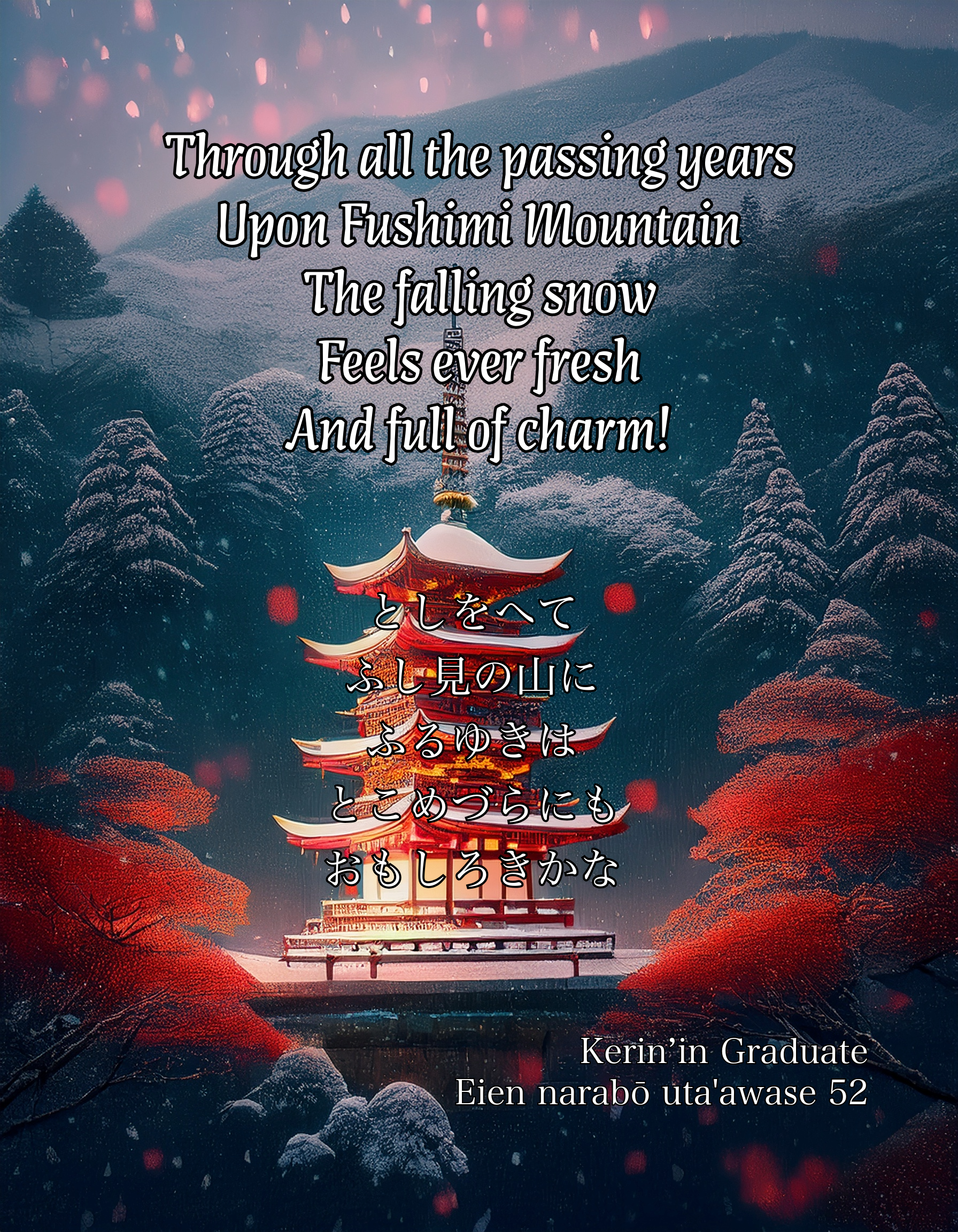
としをへてふし見の山にふるゆきはとこめづらにもおもしろきかな
toshi o hete fushimi no yama ni furu yuki wa tokomezura ni mo omoshiroki kana
Through all the passing years Upon Fushimi Mountain The falling snow Feels ever fresh And full of charm!
Kerin’in Graduate
52
The poem of the Left’s ‘Suddenly concealed / By mist, the skies’ is a clear case of repeating the same meaning. In addition, ‘snow covered Shira Mountain’ is one which is snow-capped regardless of whether it’s summer or winter. It’s not a mountain where one would be startled at seeing it ‘suddenly concealed’. The poem of the Right says that ‘through all the passing years the estate at Fushimi…feels ever fresh’, which seems as if this poem is specifying a period when this applies. It’s certainly a bit of a reach to say that this would be charming, but it’s not incongruous. Thus, I make this a tie.
I am unable to grasp the sense of the Left poem’s ‘suddenly concealed’. If it had been ‘concealed with falling’ then that would be better. In addition, I don’t understand the final ‘snow covered Shira Mountain’ either. I would have preferred it if the order had been ‘Shira Mountain’s snow’, but putting the ‘snow’ first seems to lack fluency and so, regretfully I would change this.
The Right’s ‘Fushimi Mountain’ is difficult to understand. It seems that ‘estate’ is a more standard composition, and ‘mountain’ is a novel usage. Having ‘Fushimi’ ‘feel fresh’ is evidence of thought, but even so, ‘mountain’ is vague.