Category Archives: Poetry Competitions

Eien narabō uta’awase 31

Round Three

Left[i]

君が代は神にぞいのる住之江の松の千年をゆづれとおもへば

kimi ga yo wa
kami ni zo inoru
suminoe no
matsu no chitose o
yuzure to omoeba
My Lord’s reign:
To the gods I pray, that
Suminoe’s
Pines their thousand years
Pass on—that is my hope…

Retired from the World
61a

きみがへむやちよのかずはあめにますとよをかひめの神やしるらん

kimi ga hemu
yachiyo no kazu wa
ame ni masu
toyo’okahime no
kami ya shiruran
That my Lord will endure
The number of eight thousand ages—
Residing in the heavens,
The Goddess of the Eternal Hills,
The deity, knows well, no doubt!

Retired from the World
61b

Right (Win)

君がよはつきじとぞおもふ春の日の御笠の山にささむかぎりは

kimi ga yo wa
tsukiji to zo omou
haru no hi no
mikasa no yama ni
sasamu kagiri wa
My Lord’s reign
Will never fade, I feel!
While in spring the sun
Upon Mikasa Mountain
Shines down…

Senior Assistant Minister Past Lecturer
62

Both Left and Right have neither strengths nor weakness in their diction and sense, but I feel that ‘While in spring the sun / Upon Mikasa Mountain / Shines down’ is a bit more dependable at present than ‘Suminoe’s / Pines their thousand years’.

It is certainly not the case that there are no dubious elements about the Left’s poem. As ‘eight thousand ages’ is a definite number, what is it that the Goddess of the Eternal Hills is expected to know? If this is something in the deity’s hands, then it should be, ‘does not even know the number’. I’m sure the Goddess herself would ask what she’s expected to know. The Right seems stronger.


[i] There are different poems by Eien this round in different versions of the text of the contest. As can be inferred from the judgements, Mototoshi saw the first poem and Toshiyori the second. This strongly suggests that Mototoshi’s judgements were circulated before the text of the contest was submitted to Toshiyori, and Eien revised his poem this round as a result (Kubota et al. 2018, 308).

Eien narabō uta’awase 30

Round Two

Left (Win)

君がよはあまのいはとをいづるひのいくめぐりてふかずもしられず

kimi ga yo wa
ama no iwato o
izuru hi no
iku meguri chō
kazu mo shirarezu
My Lord’s reign:
Since from the stone door in the heavens
Emerged the sun,
‘How many circuits has she made?’, they ask—
A number quite unknown.

Lord Saburō
59

Right

みかさやまふもとのさとはあめのしたふるにおもひもあらじとぞ思ふ

mikasayama
fumoto no sato wa
ame no shita
furu ni omoi mo
araji to zo omou
At Mikasa Moutain’s
Foot, in a hamlet
‘neath the heavens
Passing time—painful thoughts
There I’d have not a one, I feel!

Ushigimi
60

The Left’s poem goes beyond the general flow of diction, containing mystery and depth. I have to say it is truly superior. While the Right’s poem has no faults to mention, it has yet to emerge from prosaic expression. Thus, the Left wins.

The ‘stone door in the heavens’ is that which the supreme sun-deity Amaterasu stood before and then entered. But when we’re talking about dawn breaking at the end of night, we say ‘gates of heaven’. Which of these two was did the poet have in mind, I wonder? If he was thinking of dawn breaking, then the usage is erroneous, but even if he did mean ‘stone door of the heavens’, then do we use this about the circuits of the sun? This is vague. In addition, the final ‘they ask’ is difficult to pronounce. As for the Right’s poem, ‘‘neath the heavens’ lacks emotion. The dual use of ‘thoughts’ and ‘feels’, as I have already remarked, is not an error, but does grate on the ears a bit.

Eien narabō uta’awase 29

Felicitations

Round One

Left

みどりなるまつかげひたすいけ水にちよのすみかとみゆるやどかな

midori naru
matsukage hitasu
ikemizu ni
chiyo no sumika to
miyuru yado kana
Evergreen
The pine tree’s shapes sink
Into the pond waters—
A residence for a thousand ages
Does that dwelling seem!

Lord Dainagon
57

Right (Win)

ちとせともいろにはいでていはし水ながれむほどは君がよなれば

chitose to mo
iro ni wa idete
iwashimizu
nagaremu hodo wa
kimi ga yo nareba
For a thousand years or more
Does its hue emerge—
Spring waters from the rocks
Might flow as long as
My Lord’s reign will be, so…

Lord Chūnagon
58

What on earth might be the colour of the Left poem’s ‘pine tree’s shapes sink’ and the Right poem’s ‘thousand years’ hue’? When one talks about ‘hue’ that means ‘scarlet’ and, in addition, it’s used of blossoms or autumn leaves. I have yet to see wisteria colouring the water in numerous private collections. The two poems are about the same, but the Right is marred by a series of faults.

The Left’s ‘shapes sink’ is extremely vague. ‘Sink’ means to submerge an object in water. One could certainly compose about a pine tree’s branches sinking, but how can we accept ‘shapes sink’ to mean an object’s reflection from beneath the water in the absence of a poem as precedent? The end is extremely, charming, though.

The poem of the Right doesn’t have anything special about it. It’s a pedestrian affair which doesn’t seem to show much evidence of thought. How are we to distinguish between a poem which is hackneyed but lacking any faults and one which is vague?

Eien narabō uta’awase 28

Round Seven

Left (Win)

しらゆきのふりしきぬればかづらきやくめのいはばしそことしられず

shirayuki no
furishikinureba
kazuraki ya
kume no iwabashi
soko to shirarezu
Snow, so white
Has fallen, scattering
Upon Kazuraki, that
The broken stone bridge of Kume
Is there no one knows at all.

Lady Kazusa
55

Right

まきもくのあなしひばらもうづもれてかかるみゆきもふればふりけり

makimoku no
anashi hibara no
uzumorete
kakaru miyuki mo
fureba furikeri
In Makimoku
Anashi’s cypress groves
Are buried,
Such a fair fall of snow
Has there been.

Lady Shikibu
56

The Left has neither positives nor negatives. Up to ‘the broken stone bridge of Kume’ shows some imagination. It feels overly remote. The Right’s ‘Anshi’s cypress groves’ is something I’ve not encountered in a poem before. The standard usage is ‘cypress groves of Anashi’. Compared to this, I feel the expression is more unsatisfactory. ‘Such a fair fall of snow / Has there been’ is surprising, too, and not something I’m accustomed to seeing, so the Left seems a bit better at present.

The Left does not appear to have any significant faults. ‘That’ in ‘upon Kazuraki, that’ sounds a bit distant. If you’re talking about a bridge, you should say that you can see across it, shouldn’t you. It is a bridge which it’s impossible to cross, so that’s difficult to say. The Right’s expression ‘Anashi’s cypress groves’ is pedestrian so I would have preferred it omitted. In addition, the final ‘has there been’ feels commonplace. A win for the Left, perhaps.

Eien narabō uta’awase 27

Round Six

Left

ふるゆきに山のほそみちうづもれてまれにとひこし人もかよはず

furu yuki ni
yama no hosomichi
uzumorete
mare ni toikoshi
hito mo kayowazu
With the falling snow
The mountain’s narrow pathways
Are buried;
But rarely did he visit and now
Cannot make his way at all.

Cell of Fragrant Cloud
53

Right

あしたつるみわのひばらにゆきふかみみやぎひくをのかよひぢもなし

ashi tatsuru
miwa no hibara ni
yuki fukami
miyagi hiku o no
kayoiji mo nashi
Reeds stand tall in
Miwa, where the cypress groves
Are deep with snow;
To cut sacred timber, the woodsman
Has no path to tread at all.

Cell of Compassionate Light
54

The Left’s poem, in terms of style and diction, entirely grasps the way someone might feel. What a sense of grief! The Right’s poem is composition that fairly drips and delves into playfulness, but in so doing lacks feeling. Truly, the former poem has superlative qualities, resembling a black dragon’s pearl![i] Thus, the Left must win.

The Left does seem to have been composed but simply stated. It possesses a calm elegance. The Right seems to have been created after a great deal of thought. This poem shows effort and the former such calm that I wish to declare them a tie. This may enrage the poets, but the ignorant may give the appearance of being knowledgeable, as they say. I wonder who composed these…


[i] Riju 驪珠 as an abbreviation of riryū no tama 驪龍の珠 (‘black dragon’s pearl’). Mototoshi uses this analogy deliberately as black dragons were associated with winter. The pearl, which they were often depicted as holding or being located in their throat, was a symbol of the dragon’s spiritual development and a marker of its immortality. This is thus an effusive statement of praise for Shōchō’s poem.

Eien narabō uta’awase 26

Round Five

Left (Tie)

うちきらしあまぎるそらと見しほどにやがてつもれる雪の白山

uchikirashi
amagiru sora to
mishi hodo ni
yagate tsumoreru
yuki no shirayama
Suddenly concealed
By mist, the skies
I glimpsed and
In a moment drifted
Snow covered Shira Mountain with white.

Controller’s Graduate
51

Right

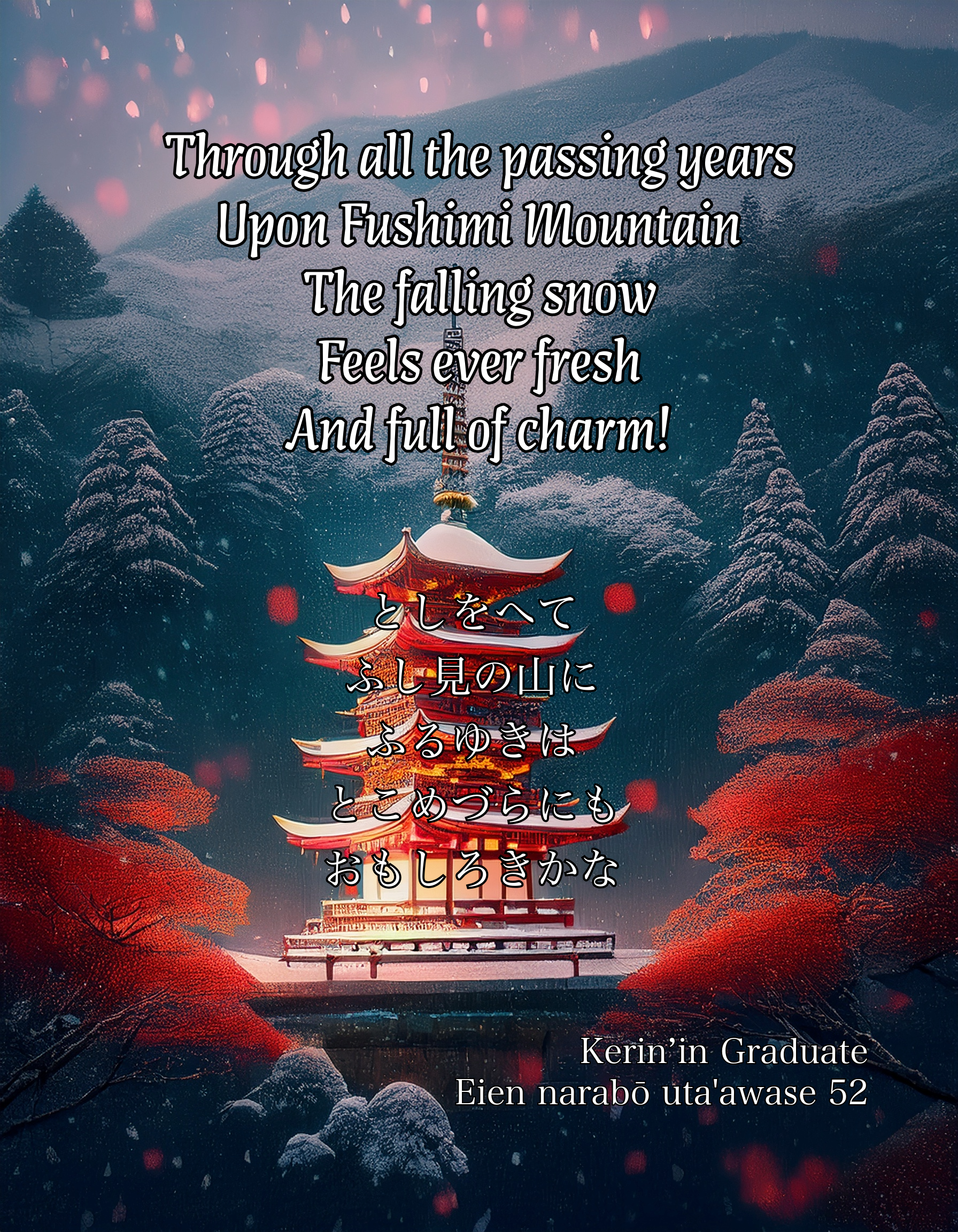
としをへてふし見の山にふるゆきはとこめづらにもおもしろきかな

toshi o hete
fushimi no yama ni
furu yuki wa
tokomezura ni mo
omoshiroki kana
Through all the passing years
Upon Fushimi Mountain
The falling snow
Feels ever fresh
And full of charm!

Kerin’in Graduate

52

The poem of the Left’s ‘Suddenly concealed / By mist, the skies’ is a clear case of repeating the same meaning. In addition, ‘snow covered Shira Mountain’ is one which is snow-capped regardless of whether it’s summer or winter. It’s not a mountain where one would be startled at seeing it ‘suddenly concealed’. The poem of the Right says that ‘through all the passing years the estate at Fushimi…feels ever fresh’, which seems as if this poem is specifying a period when this applies. It’s certainly a bit of a reach to say that this would be charming, but it’s not incongruous. Thus, I make this a tie.

I am unable to grasp the sense of the Left poem’s ‘suddenly concealed’. If it had been ‘concealed with falling’ then that would be better. In addition, I don’t understand the final ‘snow covered Shira Mountain’ either. I would have preferred it if the order had been ‘Shira Mountain’s snow’, but putting the ‘snow’ first seems to lack fluency and so, regretfully I would change this.

The Right’s ‘Fushimi Mountain’ is difficult to understand. It seems that ‘estate’ is a more standard composition, and ‘mountain’ is a novel usage. Having ‘Fushimi’ ‘feel fresh’ is evidence of thought, but even so, ‘mountain’ is vague.

Eien narabō uta’awase 25

Round Four

Left

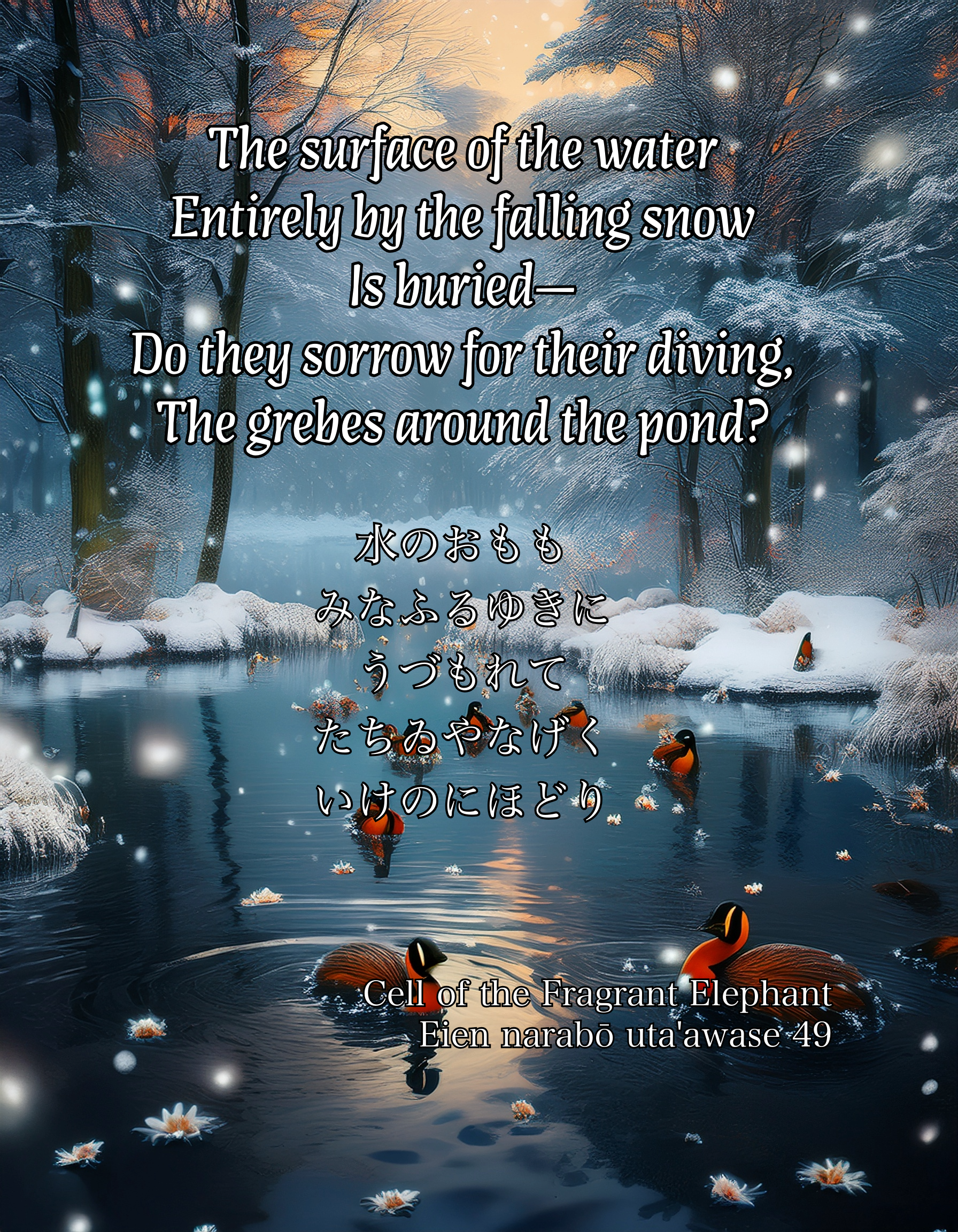
水のおももみなふるゆきにうづもれてたちゐやなげくいけのにほどり

mizu no omo mo
mina furu yuki ni
uzumorete
tachi’i ya nageku
ike no niodori
The surface of the water
Entirely by the falling snow
Is buried—
Do they sorrow for their diving,
The grebes around the pond?

Cell of the Fragrant Elephant
49

Right (Win)

みよしのに雪ふりぬれば我がやどのならのかれ葉はいとどさびしも

miyoshino ni
yuki furinureba
wa ga yado no
nara no kareba wa
itodo sabishi mo
In fair Yoshino
Snow has fallen, so
At my house
The withered oak leaves are
All the more alone…

Cell of the Everlasting Truth
50

The poem of the Left’s ‘surface of the water entirely buried by snow’ is something that I have never heard before. ‘Grieving grebes’, too, are something I have yet to encounter. Really, what sort of poem is this? As for the poem of the Right, while ‘all the more alone’ and what precedes it fails to sound elegant, at the current time I feel it’s a little bit superior.

It’s extremely difficult to conceive of the surface of a body of what which hasn’t yet frozen being buried in snow. If snow fell extremely heavily, then, surely, the water would overflow, then freeze, and then get buried, wouldn’t it? I might be going a little too far here, though. As for the Right’s poem, is ‘my house’ in Yoshino? Or is it on an estate elsewhere? If it’s on an estate, is the poet looking at the falling snow and imagining Yoshino? It’s vague. Then again, as the poem doesn’t say explicitly that the oaks are buried by the snow, is it only imagining this? How might something be which has not been seen for sure? The oaks here, too, would be like that, as snow is something which doesn’t distinguish where it falls…

Eien narabō uta’awase 24

Round Three

Left

おぼつかないづれいづちのみちならむしをりも見えずふれるしらゆき

obotsukana
izure izuchi no
michi naramu
shiori mo miezu
fureru shirayuki
How strange!
Which is which
Path, I wonder?
Even the laden branches go unseen
In the falling snow, so white.

Retired from the World
47

Right

雪ふかみとなりのさともうづもれてけぶりのみこそしるしなりけれ

yuki fukami
tonari no sato mo
uzumorete
keburi nomi koso
shirushi narikere
So deep the snow, that
The estate next door
Is buried;
Trails of smoke are the only
Sign it’s there!

Senior Assistant Minister Past Lecturer

48

The poem of the Left’s ‘even the laden branches go unseen’ and what follows is both poetic and a familiar usage. As for the Right’s poem, how can ‘the estate next door be buried’ unless it’s the only place that snow is falling and nowhere else? Thus, I feel that the snow falling to conceal the broken branches has more feeling to it.

The Left’s ‘which path’ gives me the impression that there are many of them. This sense of multiplicity is something I can imagine—which is a good thing—and, I think, see me using myself. ‘Laden branches’ are something which occur on peaks deep in the mountains. It might be a bit remiss of me, but I wonder whether I can imagine snow drifting so high on a mountain peak?

As for the Right’s poem, we use ‘next door’ when there’s a fence of some sort between one estate and another, don’t we? As such, saying that the smoke is the sign is rather vague. Even if there’s been a quite extraordinary snowfall, there would be something other to notice as well as the smoke, so this is an error, isn’t it. It would be acceptable to refer to smoke if the estate were further away.

Eien narabō uta’awase 23

Round Two

Left

ゆきふればしるしのすぎもはなさきてみわの山べもいかがたづねむ

yuki fureba
shirushi no sugi mo
hana sakite
miwa no yamabe mo
ikaga tazunemu
When the snow has fallen,
The symbolic cedars, too,
Bloom with blossom—
To Miwa’s mountainside
How might I make my way?

Lord Saburō
45

Right (Win)

しらゆきにふるの山みちうづもれてたどるばかりになりもゆくかな

shirayuki ni
furu no yamamichi
uzumorete
tadoru bakari ni
nari mo yuku kana
In snow, so white,
Furu’s ancient mountain paths
Are buried, so
Simply I must feel my way
As I go along!

Ushigimi
46

The Left’s poem is an entirely transparent adaptation of an earlier work. This poem is:

ふる雪に印の杉もうづもれていづこなるらむ三輪の山本

furu yuki ni
shirushi no sugi mo
uzumorete
izuko naruruamu
miwa no yamamoto
In the falling snow,
Even the symbolic cedars
Are buried
Where might be
Miwa mountain’s foot?[i]

The Right’s poem has nothing of interest about it, nor does it have any faults to indicate. Thus, there are insufficient grounds for judgement.

The Left’s poem follows the conception of a poem which appeared in the Kaya Palace Poetry Match.[ii] Although this is an earlier work, truly, it’s not that good, and so this poem doesn’t seem that superlative. Why couldn’t one visit if blossom has simply bloomed? The former poem says it would be difficult to get there because it’s buried in snow. The Right’s poem isn’t that good, but it seems better than the Left, so it should win.


[i] The source of this poem is unclear, however,

[ii] Snow. ふるゆきにすぎのあをばもうづもれてしるしも見えずみわのやまもと furu yuki ni / sugi no aoba mo / uzumorete / shirushi mo miezu / miwa no yamamoto ‘In the falling snow / The green cedar needles / Are buried, so / The symbol goes unseen, / Of Miwa mountain’s foot.’ Lady Settsu (Kaya no in shichiban uta’awase 55). This poetry match, Kaya no in shichiban uta’awase 高陽院七番歌合 (‘Seven Round Poetry Match held at the Kaya Palace’), was sponsored by Fujiwara no Morozane 藤原師実 (1042-1101) and held on the 19th day of the Eighth Month, Kahō 1 [1.10.1094]. The judge, Minamoto no Tsunenobu 源経信 (1016-1097), approved of this poem, saying it was ‘extremely charming’. It was later included in Kin’yōshū (IV: 285), with the headnote, ‘Composed on the conception of snow at the Poetry Match held at the Residence of the Former Uji Chancellor’.

Eien narabō uta’awase 22

Snow

Round One

Left (Win)

たまのきにははそのもりもなりにけりふるしらゆきのきえぬかぎりは

tama no ki ni
hahaso no mori mo
narinikeri
furu shirayuki no
kienu kagiri wa
Into trees of gems has
The oak forest
Turned
While the falling snow
Does not fade away…

Lord Dainagon
43[i]

Right

ゆきふればあをばの山も見がくれてときはのきをやけさはをるらむ

yuki fureba
aoba no yama mo
migakurete
tokiwa no ki o ya
kesa wa oruramu
Snow has fallen, so
The verdant mountain
Vanishes from sight—
Might the evergreens
Be broken the morning?

Lord Chūnagon
44[ii]

The poem of the Left is entirely lacking in any interest. Isn’t this a sage’s jewelled tree? It really leaves me grief-stricken. The poem of the Right contains two faults in a single work. First, this is not the right time of year to be referring to a ‘verdant mountain’. Second, ‘vanishes from sight’ refers to disappearing in water. In the Collection of a Myriad Leaves ‘vanishing from sight’ is written as ‘hidden in the water’. Thus we have lines such as, ‘swarming frogs hiding in the weeds beneath the waves’. There are no prior poems mentioning ‘mountains vanishing from sight’ in either ancient or modern times.

On the matter of the ‘tree of gems’, I heard a long time ago that this might have appeared in an important source, but as this is something I know little about, even if this is a fault, it’s difficult for me to say anything about it. Well, in any case, it doesn’t sound bad. Would someone who knows all about this compose poorly? The Right’s poem lacks elegance, but it doesn’t sound like it has any other faults. It’s inferior to the Left only in ornamentation.


[i] Some sources identify Mototoshi as the composer of this poem.

[ii] This poem is included in Toshiyori’s personal collection, Sanboku kikashū (670), with the headnote, ‘Composed in place of someone for a poetry match in Nara’,