Tag Archives: kazu

Naidaijin-ke uta’awase 14

Round Two

Left

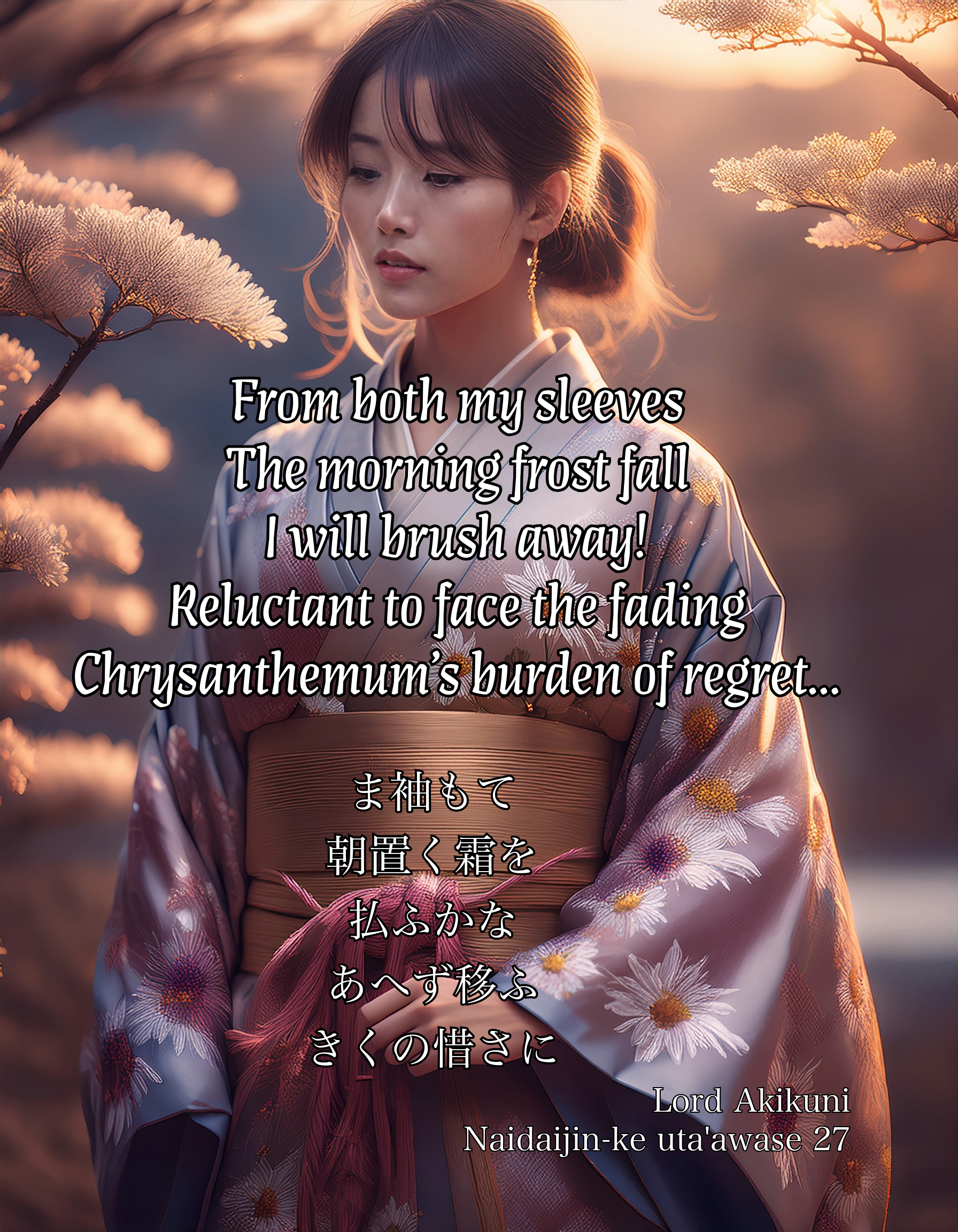
ま袖もて朝置く霜を払ふかなあへず移ふきくの惜さに

masodemote
asa oku shimo o
harau kana
aezu utsurou
kiku no oshisa ni
From both my sleeves
The morning frost fall
I will brush away!
Reluctant to face the fading
Chrysanthemum’s burden of regret…

Lord Akikuni
27

Right (Both Judges – Win)

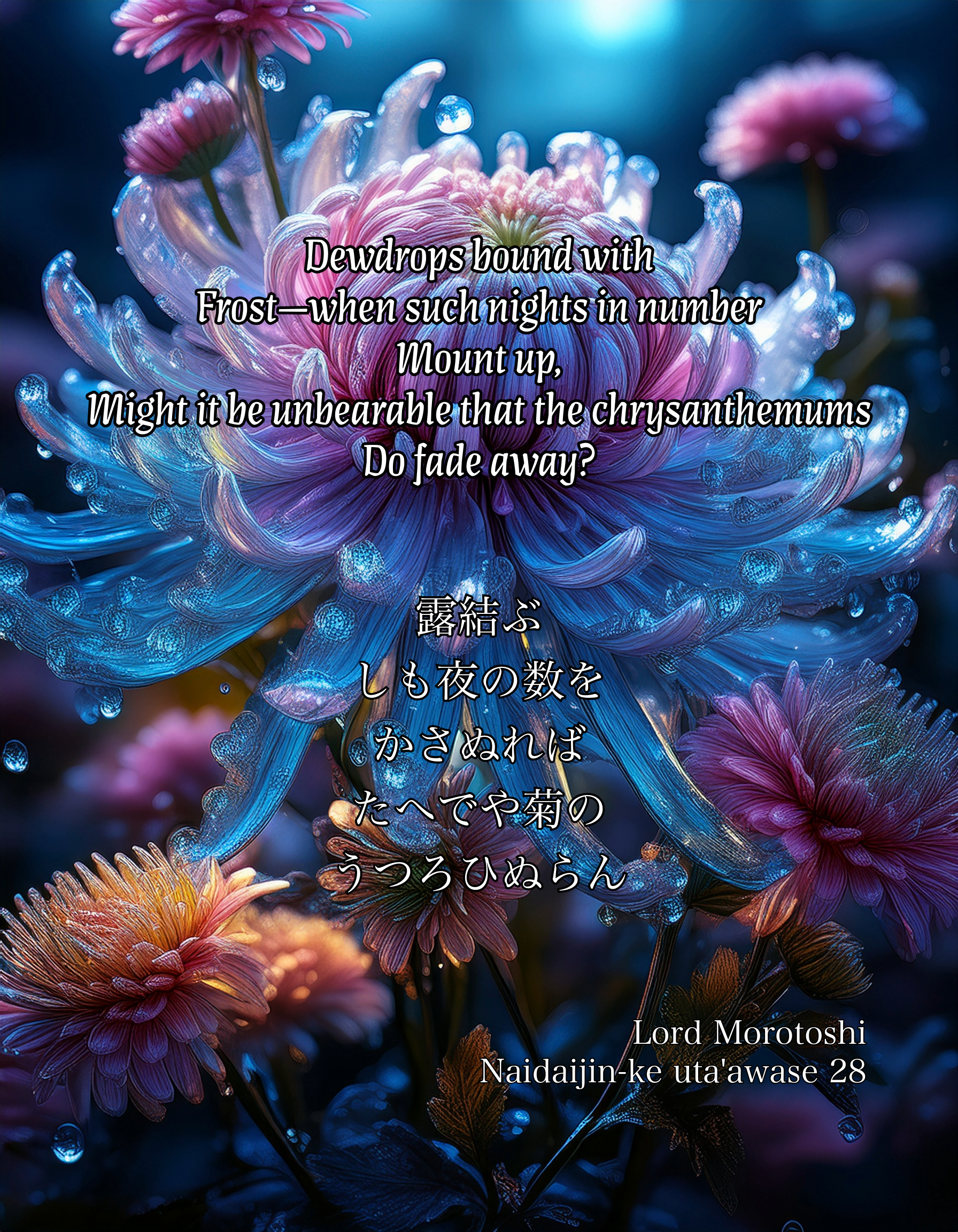
露結ぶしも夜の数をかさぬればたへでや菊のうつろひぬらん

tsuyu musubu
shimo yo no kazu o
kasanureba
taede ya kiku no
utsuroinuran
Dewdrops bound with
Frost—when such nights in number
Mount up,
Might it be unbearable that the chrysanthemums
Do fade away?

Lord Morotoshi
28

Toshiyori states: the first poem is extremely charming. Nevertheless, I must question the use of ‘reluctant to face the fading’ as I feel this is something I have not heard before. I can grasp the sense of diction such as ‘unable to do anything about’ or ‘without taking on autumn hues’, but did the poet mean to use the diction ‘unbearable’, perhaps? Even though this is somewhat archaic phrasing, it is used in composition. This poem’s expressions, though, I feel are somewhat unfamiliar. The conception and diction of the second poem are both extremely charming. However, this poem, too, is vague. What is going on with the initial ‘dewdrops bound’? Does it mean that the dewdrops get turned into frost? If so, then, from what is known of the calendar, this is something which only occurs on a single night, and from the following night there is only frost. It sounds as if the conception of this poem, though, is that night after night dew turns to frost, and this would be a fault. Despite this vagueness, however, its tone is elegant, so it seems superior.

Mototoshi states: the poem of the Left has a poetic configuration, but I strongly feel that it would have been preferable not to use the diction ‘both my sleeves’. It does seem as if this was used in the ancient Collection of a Myriad Leaves, but even given that was the case, in the preface to the Ancient and Modern, I recall it saying, ‘On examining the poems of ancient times, we find they use many archaic expressions. These were there not just to please the ear, but simply for moral instruction’. It appears that there are no instances of this piece of diction being used in poetry matches from the period of the Ancient and Modern, Later Selection and Gleanings, and these were all conducted for entertainment. Even in a poetry match conducted in Engi 12 [912], when the term ‘sleeve’ was used, I get the feeling that it was such a source of amusement that the poem was not recited. While the quality of the Right’s poem is not superb, the tone of ‘Dewdrops bound with  / Frost—when such nights in number’ is not bad, so I feel the dew can still remain bound!
Sumiyoshi-sha uta’awase kaō ni-nen 71

Round Twenty-One

Left (Tie)

かずならぬみこそおもへばうれしけれうきにつけてぞよをもいとはむ

kazu naranu
mi koso omoeba
ureshikere
uki ni tsukete zo
yo o mo itowamu
Not even numbered among folk
Am I, thinking that
Fills me with joy, but
All the cruelties of this world
Make me wish to leave it.

Asamune
141

Right

ながらへばかくてのみやははてむとてすぎにしかたはなぐさみもしき

nagaraeba
kakute nomi ya wa
hatemu tote
suginishi kata wa
nagusami mo shiki
Should I live on, then
Being simply as I am
Would I reach my end, I wonder?
In days gone by
I had some hope of consolation…

Kanetsuna
142

The sequencing of the Left’s ‘Am I, thinking that’ appears elegant. The Right, starting with ‘Would I reach my end, I wonder?’ sounds overly forceful, yet the conception of saying ‘in days gone by’ is still pleasant. Thus, once again, I make this a tie.

Sumiyoshi-sha uta’awase kaō ni-nen 09

Round Nine

Left

すみのえのこほりとみゆる月かげにとけやしぬらむかみのこころも

suminoe no
kōri to miyuru
tsukikage ni
toke ya shinuramu
kami no kokoro mo
At Suminoe
As ice appears
The moonlight, but
Is not, perhaps, melted
Even the deity’s heart?

Lord Fujiwara no Kinshige
Senior Fourth Rank, Lower Grade
Without Office[1]
17

Right (Win)

すみよしのおまへのきしのまつのはもかずかくれなくみゆる月かげ

sumiyoshi no
omae no kishi no
matsu no ha mo
kazu kakurenaku
miyuru tsukikage
At Sumiyoshi
On the coast before the shrine
Even the pine needles
Cannot hide their numbers,
Appearing in the moonlight.

Venerable Dharma Eye Enjitsu[2]
18

While in the Left ‘ice appears’ and ‘is not, perhaps, melted’ seem to have some kind of linkage, if we consider this as a Cathay-style poem saying ‘A chill night’s moon / Ice atop the swell’, then I would have preferred it to say ‘is, perhaps, bound’. An alternative version of this would, of course, be ‘A spring morn’s breeze / Ice on the eastern shore’ which could lead to ‘is not, perhaps, melted’, I think. The Right has ‘On the coast before the shrine / Even the pine needles’ and through this type of linkage expresses the brightness of the moon. While this type of smug-sounding expression also appeared in the round before last, the moon here does seem bright and so I can say that the Right wins.


[1] San’i shōyon’ige Fujiwara ason Kinshige 散位正四位下藤原朝臣公重

[2] Hōgen kashōi Enjitsu 法眼和尚位円実

Daikōtaigōgū no suke taira no tsunemori-ason ke uta’awase 34

Round Ten

Left

をぐらやま下ゆく水のさざれ石も数かくれなくてらす月かげ

ogurayama
shita yuku mizu no
sazare’ishi mo
kazu kakurenaku
terasu tsukikage
Beneath gloomy Mount Ogura
Flow waters full
Of pebbles,
Unable to conceal their numbers
In the shining moonlight.

Lord Kiyosuke
67

Right (Win)

あまの川とわたる月の影すみてにごれるよともみえぬ空かな

ama no kawa
towataru tsuki no
kage sumite
nigoreru yo tomo
mienu sora kana
Across the River of Heaven’s
Mouth passes the moon’s
Clear light—
Even this cloudy world
Does not appear so beneath this sky!

Shinkaku
68

There’s nothing to mention about the Left, and the same is the case for the Right, but for some reason should it win?

Daikōtaigōgū daijin kiyosuke-ason ke uta’awase 33

Round Thirty-Three

Left (Tie)

人数にあらずなるみのうらに又老の浪さへよるぞかなしき

hito kazu ni
arazu narumi no
ura ni mata
oi no nami sae
yoru zo kanashiki
Numbered among proper folk
I am not, as at Narumi
Bay, yet again do cruel
Waves of age
Break—so sad!

Lord Kinshige
65

Right

うきながらなほをしまるる命かな後の世とてもたのみなければ

ukinagara
nao oshimaruru
inochi kana
nochi no yo tote mo
tanominakereba
In constant suffering
Still do I regret
This life!
For even in the world to come
Can I place no trust…

Moromitsu
66

Neither has any parts I can’t understand.

Daikōtaigōgū daijin kiyosuke-ason ke uta’awase 30

Round Thirty

Personal Grievances

Left (Tie)

としをへて梅も桜もさくものを我が身のはるにまちぞかねぬる

toshi o hete
ume mo sakura mo
saku mono o
wa ga mi no haru ni
machi zo kanenuru
The years go by and
The plum and cherry, too,
Burst into bloom, yet
For the springtime of my sorry self
It is so hard to have waited!

Kiyosuke
59

Right

数ならで年へぬる身は今さらに世をうしとだにおもはざりけり

kazu narade
toshi henuru mi wa
ima sara ni
yo o ushi to dani
omowazarikeri
Innumerable are
The years I’ve passed, but
Right now, that
The world is a cruel place, even
I do not think.

Shun’e
60

Both of these have no faults to point out, but also no superlative parts either.